The 'Culture Shock' Trap: How to Navigate Unseen Social Rules
Golden Hook & Introduction
SECTION
Nova: You know, we often hear "just be yourself" in new situations. It’s the go-to advice, right? But what if "yourself" is precisely the problem, in a way you can’t even see?
Atlas: Oh man, that’s going to sting for a lot of people, myself included! We all think we’re being universally understood, but you’re suggesting our default setting might actually be a communication barrier? That’s a fascinating, and slightly terrifying, thought.
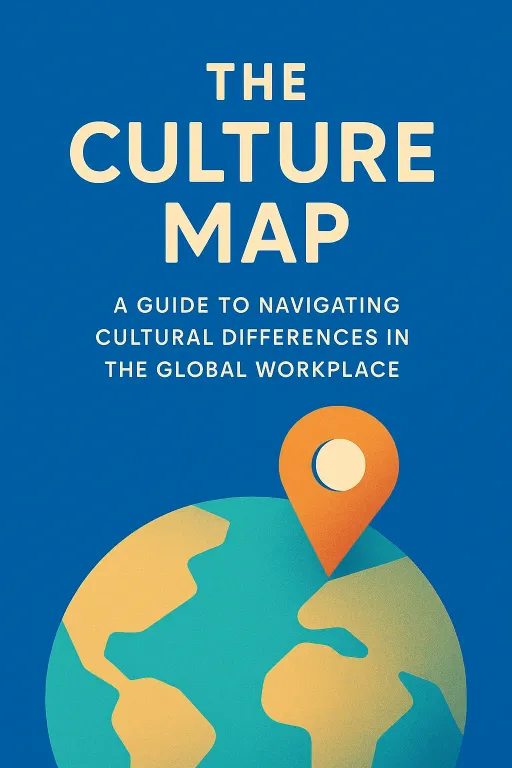
Nova: Absolutely. And today, we’re dissecting this fascinating concept, drawing heavily from the brilliant insights of "The Culture Map" by Erin Meyer and "Thinking, Fast and Slow" by Daniel Kahneman. What's truly remarkable about Erin Meyer is her background: she's a professor at INSEAD, one of the world's leading business schools, and she spent years advising global executives. She literally observed firsthand how cultural differences either make or break international teams, helping countless leaders bridge these unseen divides. Her work is a direct result of turning potential friction into profound collaboration.
Atlas: Wow, so she’s been in the trenches, not just theorizing from an ivory tower. That immediately gives her work so much more weight. So, what exactly are these "unseen divides" you’re talking about? How do we even begin to spot something we’re supposedly blind to?
Nova: That’s the million-dollar question, Atlas. It leads us straight into our first core idea: the invisible playbook.
The Invisible Playbook: Unveiling Cultural Blind Spots
SECTION
Nova: We all carry around an "invisible playbook" of social rules, a kind of internal operating manual for how the world works and how people should interact. These are the unspoken norms that guide everything from how we communicate, to how we build trust, to how we give feedback. And when we step into a new cultural space—be it a different country, a new company, or even just a different department—our playbook often doesn't match the local one.
Atlas: I can definitely relate to that. I’ve been in situations where I felt like I was speaking a different language, even though we were all speaking English. It’s like everyone else got a memo I didn’t.
Nova: Exactly! And it’s not because of ill intent. It’s because of differing frameworks for interaction. For example, Meyer tells a story about an American manager, an engineer named John, working with his German team. John believed in being direct, clear, and getting straight to the point. He’d give feedback like, "This report needs a complete overhaul; it’s too disorganized." He thought he was being efficient.
Atlas: Sounds pretty normal to me. Get to the point, fix the problem.
Nova: Right? But to his German team, who valued thoroughness and a more structured, hierarchical approach to feedback, John’s directness felt incredibly rude, dismissive, and even unprofessional. They interpreted his bluntness as a lack of respect for their effort, rather than constructive criticism. They started to disengage, their motivation plummeted, and productivity suffered. John was baffled, thinking, "Why are they so sensitive? I'm just telling them the truth!"
Atlas: So basically, his "truth" was their "insult." That sounds rough, but how is that a "blind spot" if he was just being himself? He probably wasn't even aware his directness was culturally specific.
Nova: Precisely. His cultural lens, his 'System 1' thinking as Daniel Kahneman would call it, made him automatically assume his way was the universal, logical way. Kahneman's work on cognitive biases shows us that our automatic, fast thinking often relies on familiar patterns. John’s brain was using its familiar cultural script without even realizing there were other scripts available, let alone preferred ones. He was blind to the fact that his direct feedback, while normal in his home culture, was perceived as harsh and demoralizing in the German context.
Atlas: I see. So it’s not that he was wrong, but that his was incongruent with the unwritten rules of that specific environment. It makes me wonder how many times I’ve inadvertently stepped on cultural landmines without even knowing it!
Nova: It happens to all of us, Atlas. The key is recognizing these innate cultural lenses. It allows us to move beyond surface-level interactions and foster deeper, more effective connections, which brings us to our second big idea.
Decoding the Unspoken: Tools for Navigating Cultural Complexity
SECTION
Nova: So, how do we move from simply recognizing this problem to actually solving it? How do we decode the unspoken? This is where Meyer’s "Culture Map" becomes an absolute superpower. She distills cultural differences into eight dimensions, offering practical frameworks to understand and navigate them.
Atlas: Okay, so she gives us a map, literally. That’s a relief! What’s the first dimension we should be looking at? Because if I’m honest, it still feels a bit like trying to read minds.
Nova: Let's take 'communicating' – specifically, how direct or indirect a culture is. Think about the difference between, say, a low-context culture like the United States, where messages are explicit and precise, versus a high-context culture like Japan, where much of the meaning is embedded in the context, non-verbal cues, and shared understanding.
Atlas: So you’re saying in Japan, what's said can be just as important as what said? That’s a huge shift from how most of us operate day-to-day. Can you give an example?
Nova: Absolutely. Meyer recounts a meeting between an American tech firm and a Japanese partner. The American team presented a new feature, and the Japanese team listened intently, nodded, and said, "This will be very difficult." The Americans, being from a low-context culture, heard "difficult, but doable, let’s find a way." They pushed forward, assuming it was a challenge to overcome.
Atlas: And it wasn't, was it?
Nova: Not at all. In the high-context Japanese culture, "This will be very difficult" was a polite, indirect way of saying, "No, this is impossible, we cannot do this." The Japanese team was trying to save face and maintain harmony, but the American team completely missed the subtle but crucial message. This led to wasted time, frustration, and ultimately, a breakdown in trust.
Atlas: Wow. That’s a perfect example of two well-intentioned groups completely missing each other because of an unseen rule. So, how can our listeners actually this? What's the first step to 'mapping' a new culture without constantly making these kinds of mistakes?
Nova: The first step is conscious observation, using Kahneman’s 'System 2' thinking. Instead of automatically reacting, pause. Ask yourself: "How do people here communicate feedback? How do they build trust? Is it through task-based achievements or through personal relationships?" If you're in a new team, don't just assume your way is the only way. Observe how others operate. Look for patterns in their interactions.
Atlas: So, it’s about actively engaging your analytical brain to override those automatic cultural assumptions. Like being a detective in a new land. But what if you get it wrong? Isn’t there a risk of overthinking and coming across as inauthentic?
Nova: That’s a valid concern, and it’s why Meyer emphasizes adaptation, not assimilation. It’s not about losing who you are, but expanding your repertoire. Start small: mirror the speed of communication, adjust your level of directness slightly. The goal is to build bridges, not to become someone you're not. Recognizing these dimensions allows for empathy and flexibility, transforming potential friction points into moments of deeper understanding.
Synthesis & Takeaways
SECTION
Nova: Ultimately, what we’re talking about here is more than just cultural etiquette. It’s about recognizing the profound impact of our invisible playbooks on every interaction. Whether you’re dealing with an international client, a new colleague, or even just navigating family dynamics, these unseen rules are always at play.
Atlas: It really makes you reflect on that deep question you brought up at the beginning: "What unexamined cultural assumptions do you bring to your most challenging interactions, and how might they be re-framed?" Because it’s not just about other cultures; it’s about understanding our own ingrained biases.
Nova: Exactly. Understanding these invisible rules is a genuine superpower for connection and effectiveness. It doesn't just make you a better global citizen; it makes you a more insightful, adaptable, and ultimately, more successful individual in any context. It makes the world feel less chaotic and more navigable.
Atlas: That’s actually really inspiring. It’s about adding tools to our mental toolkit, not just pointing out our flaws. For all our listeners out there, we encourage you to reflect on a recent interaction where things felt a bit "off." Could an unseen cultural rule have been at play? And how might you approach it differently next time with this new lens?
Nova: It's a journey, not a destination, but a journey well worth taking.
Atlas: This is Aibrary. Congratulations on your growth!