Stop Believing in a Single Story, Start Embracing Complexity: The Guide to Cultural Fluency.
Golden Hook & Introduction
SECTION
Nova: Atlas, five words. Describe the essence of today's books.
Atlas: Oh, that's a good challenge! Mind-bending, perspective-shifting, utterly essential.
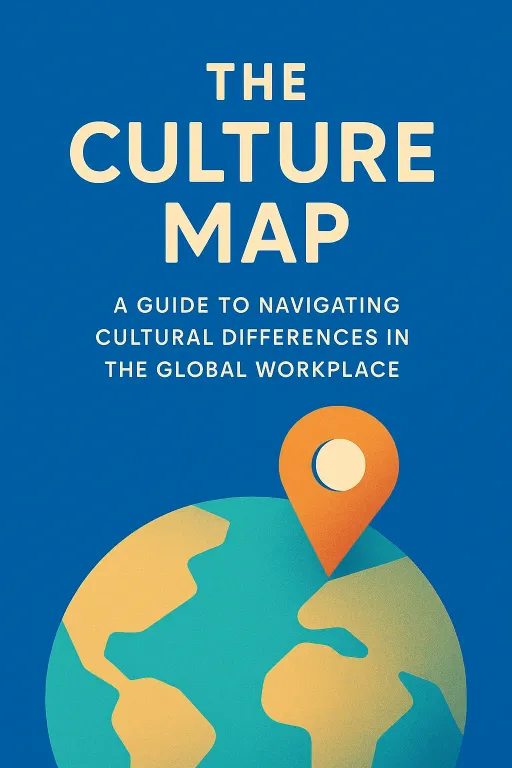
Nova: You nailed it! "Mind-bending" because they really twist your brain in the best way possible. Today, we're diving into two incredible works that, when put together, form a masterclass in cultural fluency: "The Culture Map" by Erin Meyer and "Sapiens: A Brief History of Humankind" by Yuval Noah Harari.
Atlas: Oh, I like that pairing! They sound like they tackle similar themes from very different angles.
Nova: Absolutely. Erin Meyer is a professor at INSEAD, and she's spent her career advising global executives. Her book is this incredibly practical, data-driven guide to navigating cultural differences in the business world, almost like a GPS for international teams. She really breaks down communication and leadership styles across cultures.
Atlas: Right, so very much about practical application.
Nova: Exactly. Then you have Yuval Noah Harari, a historian from the Hebrew University of Jerusalem, whose work is just epic in scope. "Sapiens" is this sweeping, interdisciplinary look at human history, challenging our deepest assumptions about society, power, and even what it means to be human. He’s known for his rigorous academic approach, but he makes these vast, complex ideas incredibly accessible.
Atlas: So, one is a tactical playbook, the other is a grand philosophical narrative. What brings them together for us today?
Nova: Well, despite their different approaches, both authors fundamentally expose our cultural blind spots. They force us to question the idea that there's a single, universal way of seeing the world. They show us how deeply ingrained our own cultural lenses are, and then they give us tools to either understand those lenses or to peek through others.
The Blind Spot: Unmasking Cultural Constructs
SECTION
Atlas: That's a fascinating starting point, this "blind spot." I mean, I try to be open-minded, but I'm sure I have a ton of assumptions I don't even realize are assumptions. How does Harari specifically make us aware of these hidden constructs?
Nova: He does it by introducing this brilliant concept he calls "shared fictions" or "inter-subjective realities." Harari argues that much of what we take for granted as objective truth—things like nations, money, human rights, corporations—are actually powerful stories we've collectively agreed to believe. They don't exist in nature; they exist solely in our shared imagination.
Atlas: Wait, so even something as fundamental as "money" isn't a universal natural law? It's just a story we all buy into?
Nova: Exactly! Think about it: a dollar bill has no inherent value. It's just a piece of paper. Its value comes entirely from our collective belief that it represents something. The same goes for a country. What is France, really? It's a landmass, sure, but "France" as a nation-state with laws and a shared identity is a story, a construct that billions of people believe in.
Atlas: Wow. That's kind of unsettling, but also incredibly powerful. It means we've built entire civilizations on these shared narratives.
Nova: Absolutely. And here's where it gets really interesting for our discussion today. Harari shows how these collective beliefs shape everything, even our deepest assumptions about human nature. For example, the concept of "individual liberty" or "freedom" is something many of us in Western societies hold as a universal, self-evident truth, right?
Atlas: Yeah, absolutely. It's a cornerstone.
Nova: But if you look at many East Asian cultures, for instance, the concept of collective harmony and familial duty might take precedence. The "self" is often seen as deeply intertwined with the group, and "freedom" might be perceived more as freedom disruption, or freedom contribute to the collective good, rather than purely individual autonomy.
Atlas: That makes me wonder, does that mean my idea of "fairness" is also just a story? Because I feel like fairness is just… fair.
Nova: That's a perfect example, Atlas! What's "fair" is often deeply colored by cultural narratives. In some cultures, fairness might be about equal outcome for everyone, while in others, it might be about equal opportunity, or even about respecting hierarchy. It's not about one being universally "right" or "wrong," but about understanding that these are different cultural operating systems at play.
Atlas: So, the cause of our differing views is these ingrained cultural narratives, the process is how we internalize them without questioning, and the outcome is that we often clash without understanding. I can definitely recall a time I assumed everyone would react to a situation with the same sense of "justice" I had, only to be completely baffled by their response.
Nova: And that's the "blind spot" Harari illuminates. He helps us see that even our most cherished, seemingly universal beliefs about human nature are often constructs. Once you realize that, it's like a veil lifts, and you start to see the incredible diversity in how humans organize their lives and make sense of the world. It shifts you from frustration to a profound sense of understanding.
Decoding the Culture Map: Navigating Differences
SECTION
Atlas: That's a huge shift. So once we accept that our own lens is just one of many, the next step is learning how to read lenses. That's where Erin Meyer's "Culture Map" becomes our indispensable guide, right?
Nova: Precisely. Meyer takes that high-level understanding from Harari and gives us practical, actionable frameworks. She identifies eight scales that map how cultures vary, and understanding these scales can literally save business deals, prevent diplomatic blunders, and foster genuine connection.
Atlas: Okay, so give me an example. What's one of these scales that really throws people off?
Nova: A classic one is "Direct vs. Indirect Communication." Think about a scenario: an American manager, let's call her Sarah, is working with a Japanese employee, Kenji. Sarah believes in being very direct with feedback – "Be honest, get straight to the point, no sugar-coating." She tells Kenji, "Your presentation was a bit disorganized, and your data was weak." She thinks she's being helpful.
Atlas: And Kenji's reaction is...?
Nova: Kenji is devastated. He feels publicly shamed, loses face, and becomes deeply demotivated. From his cultural perspective, direct criticism, especially in front of others, is incredibly disrespectful. Feedback in Japan is often given very indirectly, sometimes through a third party, or with a lot of positive framing before hinting at areas for improvement.
Atlas: Wow. So, Sarah thought she was being clear and efficient, but she actually created a huge problem. That's a perfect illustration of how our "deeply held belief" about how to give feedback is a cultural construct.
Nova: Exactly. Meyer's framework illuminates this. American culture tends to be "low-context" and "direct negative feedback." Japanese culture is "high-context" and "indirect negative feedback." Neither is inherently better; they're just different. Sarah wasn't trying to be rude; Kenji wasn't being overly sensitive. They were simply operating on different cultural maps.
Atlas: So, are we just supposed to become chameleons then? Change our entire communication style depending on who we're talking to? Because that sounds exhausting and a bit inauthentic.
Nova: That's a great question, and it's a common misconception. Meyer clarifies that it's not about becoming someone you're not. It's about understanding the. It's about recognizing when you need to adjust your – not your personality – and developing strategies. For Sarah, it might mean delivering feedback privately, starting with positives, and using more softening language. It's about building bridges, not abandoning your identity.
Atlas: So, it's about adding tools to your toolkit, not throwing out your existing ones. Like, you wouldn't use a hammer to drive a screw, even if you love hammers. You'd pick up a screwdriver.
Nova: That's a perfect analogy! It’s about recognizing which tool is appropriate for the cultural context. Another example: "Egalitarian vs. Hierarchical Leadership." In an egalitarian culture, the boss might sit with their team, encourage debate, and even be called by their first name. In a hierarchical culture, the boss is the authority figure, decisions flow top-down, and challenging them directly is unthinkable.
Atlas: That sounds like a recipe for disaster if you mix those two up. Imagine an intern from an egalitarian culture trying to "challenge" a CEO from a highly hierarchical one.
Nova: Precisely. The intern might think they're showing initiative and critical thinking, while the CEO might see them as insubordinate or disrespectful. Understanding these dimensions helps you navigate meetings, negotiations, and team dynamics, turning potential friction into productive collaboration. It’s about moving from frustration to understanding, and ultimately, to connection.
Synthesis & Takeaways
SECTION
Atlas: It feels like both Harari and Meyer are telling us that the world is far more complex and fascinating than our individual experiences often allow us to see.
Nova: Absolutely. They both underscore that cultural fluency isn't about memorizing a checklist of dos and don'ts for every country. It's about cultivating a deep sense of curiosity, humility, and the willingness to question your own default settings.
Atlas: And what's the big payoff? Why bother with all this complexity?
Nova: The payoff is profound, Atlas. When you understand Harari's "shared fictions," you realize that so much of what divides us are just different stories. When you apply Meyer's "Culture Map," you gain the ability to actually decode those stories and communicate across them effectively. It empowers us to build bridges instead of walls, turning potential frustration into genuine connection, both personally and professionally. It's about moving from a world of "us vs. them" to a world of "how can we understand each other better?"
Atlas: So, it's ultimately about richer understanding and more effective interaction. It’s about expanding our own mental maps to include the incredible diversity of human experience.
Nova: Exactly. It makes you ask: What deeply held belief or assumption about human nature might actually be a cultural construct you've never questioned? Think about it. When you encounter someone who thinks or acts differently, instead of labeling it as "weird" or "wrong," the question shifts: What cultural narrative might be shaping their perspective? What part of their "culture map" am I not seeing?
Atlas: That’s such a powerful reframe. It transforms difference from a barrier into an invitation for discovery.
Nova: It truly does. And that, my friends, is the journey these books invite us on.
Nova: This is Aibrary. Congratulations on your growth!