Beyond the Battlefield: Culture as Your Hidden Lever for Influence
Golden Hook & Introduction
SECTION
Nova: You might be the sharpest mind in the room, with a strategy that's bulletproof on paper. But what if I told you that your biggest blind spot isn't a lack of data, but something far more invisible, yet utterly capable of derailing everything you've built?
Atlas: Whoa, invisible blind spots? For analytical people like us, that sounds... almost offensive! We pride ourselves on seeing everything, on having the facts. Are you saying our logic isn't enough?
Nova: Exactly, Atlas. We're diving into a fascinating concept today, one that challenges the very foundation of purely rational decision-making. We're talking about culture, not as a 'soft skill,' but as your hidden lever for influence, a concept brilliantly explored in "Beyond the Battlefield: Culture as Your Hidden Lever for Influence."
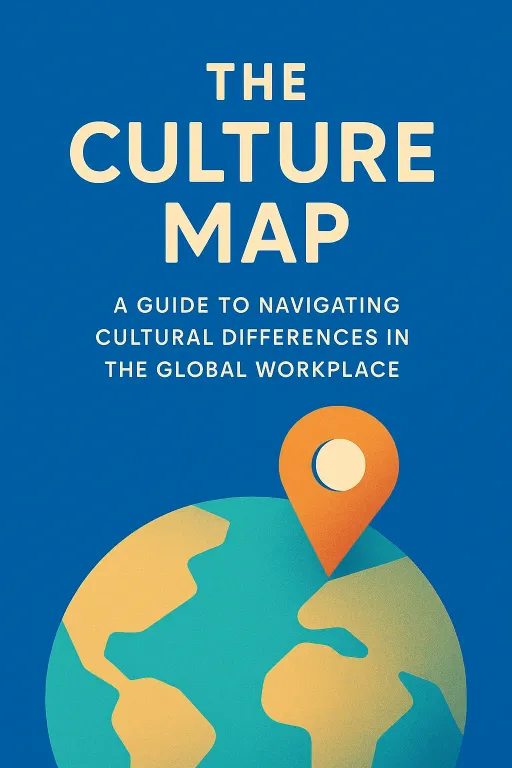
Atlas: And to really unpack this, we're looking at two absolute titans whose work underpins this idea. First, we've got "The Culture Map" by Erin Meyer, a true pioneer in decoding global business cultures. Her work as a professor at INSEAD has literally shaped how international teams communicate and lead.
Nova: Absolutely. And then, the legendary "Thinking, Fast and Slow" by Daniel Kahneman, who literally won a Nobel Prize for showing us how our brains actually work, not just how we they work. His insights into System 1 and System 2 thinking are foundational to understanding implicit cultural influence.
Atlas: Right. So, two powerhouses, showing us that even the most logical minds often miss how unspoken cultural norms are reshaping their interactions, their strategies, their entire playing field. I'm intrigued, but also a little skeptical about how 'invisible' something can be for a confident builder.
Decoding Explicit Cultural Norms for Strategic Advantage
SECTION
Nova: Well, let's start with the more 'visible' aspects of the invisible, if you will. Erin Meyer's "Culture Map" provides this incredible framework for decoding explicit cultural norms. Think of it as a GPS for navigating global business. She identifies dimensions like direct versus indirect communication, or consensual versus top-down decision-making. These are the rules of the game that you can actually learn and map out.
Atlas: Okay, so this isn't just about being 'polite' or 'culturally sensitive' in a vague way. It's about strategic effectiveness. For someone trying to build a global team, how do you even begin to map these differences without accidentally offending everyone along the way?
Nova: That's where the framework becomes so powerful. Take a classic example: a Western manager, let's call him Mark, needs to give critical feedback to his team member, Kenji, who is Japanese. Mark, coming from a direct communication culture, pulls Kenji aside and says, "Kenji, your presentation was weak, you need to improve X, Y, and Z." He thinks he's being clear and helpful.
Atlas: Sounds like standard operating procedure in many places. Clear, concise, no beating around the bush.
Nova: Exactly. But Kenji, from a high-context, indirect culture where public feedback, even private but direct, can cause immense loss of face, is devastated. He doesn't just hear "improve"; he hears "I've failed, I've shamed my team." His motivation plummets, he withdraws, and his performance actually gets worse. Mark, the analytical strategist, sees the data—performance decline—but misses the.
Atlas: Wow. So the intent was positive, the execution was logical from one perspective, but the cultural mismatch led to the complete opposite of the desired outcome. It's not just a miscommunication; it's a strategic failure that impacts tangible growth.
Nova: Precisely. Meyer's framework would immediately flag this. It would advise Mark to use indirect feedback, perhaps through a third party, or by framing it as a team challenge rather than individual criticism. It's about adapting your approach, not just your words, to the cultural context.
Atlas: I imagine a lot of our listeners, who are used to clear-cut metrics and direct action, might find this 'soft skill' aspect a bit squishy. Can you give us another example where ignoring these explicit maps had a really tangible, painful consequence? Something that hits the bottom line?
Nova: Oh, absolutely. Imagine a high-stakes merger between a German engineering firm and an American tech company. The Germans prioritize consensus, detailed planning, and hierarchy for decision-making. The Americans value speed, agile iteration, and empowering individual leaders to make quick calls.
Atlas: Right, sounds like a recipe for friction already.
Nova: It was. Decisions that would take the American team a week to make were stuck in German committee meetings for months, awaiting full consensus and multiple layers of approval. Conversely, when the American CEO made a swift, unilateral decision, the German team felt disrespected, their expertise ignored, leading to passive resistance and a breakdown in trust. The merger, despite its logical synergies, failed to realize its potential because of a fundamental clash in explicit decision-making cultures, costing millions in lost opportunities and integration challenges. These aren't minor hiccups; they're strategic icebergs.
Unveiling Implicit Cultural Biases and System 1 Thinking
SECTION
Nova: And that brings us to an even deeper layer, Atlas, one that often operates entirely beneath our conscious radar. We're talking about the invisible hand of culture shaping our itself, particularly our fast, intuitive System 1, as Daniel Kahneman so brilliantly laid out in "Thinking, Fast and Slow."
Atlas: System 1, the gut reaction system. So you're saying culture isn't just about we interact, but before we even realize we're thinking? That's a bit unsettling for an analytical strategist who prides themselves on rational, deliberate thought.
Nova: It is, and that's why Kahneman's work is so crucial. System 1 is our automatic, intuitive, emotional brain. It's incredibly efficient, but it's also prone to biases and shortcuts. And here's the kicker: cultural context heavily influences that System 1. It shapes what feels 'normal,' what triggers a quick judgment, what we implicitly trust or distrust. It's like a cultural operating system running on our cognitive hardware.
Atlas: A cultural operating system. That's a powerful analogy. So, even if I consciously try to be objective, my System 1 is still making snap judgments based on ingrained cultural patterns I might not even be aware of? That's a true hidden lever.
Nova: Exactly. Let's take a recruitment scenario. A tech company is interviewing candidates for a leadership role. The interview panel, largely from a culture that values overt assertiveness and self-promotion as signs of leadership, unconsciously favors candidates who exhibit those traits.
Atlas: That sounds like a common scenario. We look for 'executive presence.'
Nova: Right. But what if a highly competent candidate from a culture that values humility, collective achievement, and deference to authority comes across as less assertive, less self-promoting? Their answers might be brilliant, their experience profound, but their culturally-shaped System 1 presentation doesn't align with the panel's culturally-shaped System 1 'leader' archetype.
Atlas: Wow, that's not just a miscommunication; that's a systemic failure built into the very fabric of judgment. For builders focused on growth, these hidden biases could be costing them top talent or critical market insights, simply because someone didn't like a leader, even if they were. How do we even begin to detect something that's 'invisible' and happening at a subconscious level?
Nova: That's the challenge, and Kahneman's answer lies in understanding and deliberately engaging System 2 – our slow, deliberate, rational thinking. It means building processes that force us to slow down, to question our gut reactions, to look for specific, objective criteria rather than relying on an 'overall impression.' It means actively seeking diverse perspectives on the hiring panel, or structuring interviews to minimize the influence of presentation style.
Atlas: So it's about building a 'cultural intelligence' muscle that can override our default settings. It's about understanding that our 'instincts' are often culturally programmed, and sometimes those programs are leading us astray, not towards optimal decisions.
Nova: Precisely. It's about recognizing that ignoring these implicit psychological undercurrents is like trying to build a skyscraper without understanding the soil composition. It might look good on paper, but it's fundamentally unstable. Mastering cultural intelligence means acknowledging both the explicit maps and the invisible psychological forces at play.
Synthesis & Takeaways
SECTION
Nova: So, Atlas, what we've really been talking about today is that cultural intelligence isn't just about avoiding faux pas. It's about understanding the dual nature of culture: the explicit rules you can learn and map out with tools like Meyer's Culture Map, and the implicit biases that subtly shape our most fundamental thoughts and decisions, as Kahneman so brilliantly revealed.
Atlas: And for the confident builder, the analytical strategist, or the practical achiever, it sounds like ignoring either of these is like trying to navigate a minefield blindfolded. It's not just about being 'nice' or 'aware'; it's about competitive advantage, preventing strategic disasters, and unlocking new levels of influence and tangible growth. So, what's a 'tiny step' our listeners can take right now to start engaging with this hidden lever?
Nova: The book offers a fantastic tiny step: Identify a recent miscommunication or a strategic challenge you faced. Then, simply ask yourself: could a cultural difference, explicit or implicit, have played a hidden role in it? Just that act of reflection opens the door to seeing the invisible lever.
Atlas: That's a powerful challenge. Because once you see it, you can't unsee it, and then you can start to actually it. It's about transforming those frustrating, inexplicable moments into opportunities for deeper understanding and more effective action.
Nova: Absolutely. It's about turning those hidden levers into powerful tools for building, influencing, and achieving.
Atlas: A fantastic journey into the unseen forces that shape our world. Thank you, Nova.
Nova: My pleasure, Atlas.
Nova: This is Aibrary. Congratulations on your growth!