Architecting the Responsive Organization
Golden Hook & Introduction
SECTION
Nova: Atlas, if I asked you to describe the traditional corporate hierarchy in five words, what would they be? Go!
Atlas: Oh man, that's easy. "Slow, stifling, siloed, static, soul-crushing." Did I get a bonus word in there? Because it feels like soul-crushing needs two.
Nova: You definitely captured the essence! And I think a lot of our listeners, especially those building ambitious, scalable businesses, probably feel that frustration. That very sentiment is what today's insights are all about: escaping that soul-crushing stasis to build truly responsive organizations.
Atlas: Right? We're constantly trying to optimize operations, build efficient systems, and innovate business models, but it often feels like we're fighting the very structure we've created. So, what's the antidote to the corporate slow-mo?
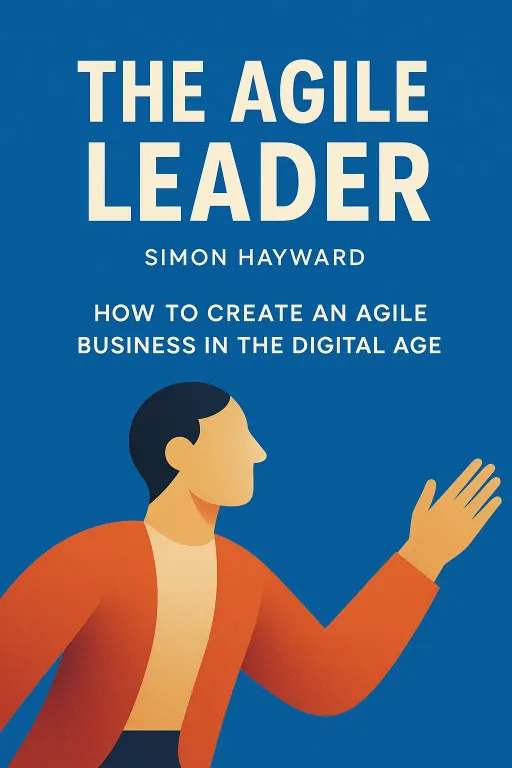
Nova: Well, today we're diving into a powerful combined perspective, drawing from two insightful books: "The Agile Leader" by Simon Hayward, and "The Loop Approach" by Sebastian Klein and Ben Hughes. What’s fascinating about these authors is that they aren't just theorists; they've spent years embedded in organizations, helping them navigate complex transformations. Hayward, with his deep leadership development background, understands the human psychology at play, while Klein and Hughes, from their consultancy experience, offer a hands-on, modular framework.
Atlas: That's exactly what I want to hear. Practical application. Because for many strategists and builders, "agility" can sound like a buzzword. We need to know how to actually something that grows sustainably.
Nova: Absolutely. And that’s our journey today. We'll start by exploring the critical human foundation of agility – psychological safety and shared purpose, as laid out by Hayward. Then, we'll discuss how to design the structural 'loops' that allow teams to truly govern themselves, using the framework from Klein and Hughes. It’s about building organizations that are not just fast and flexible, but deeply human and inherently self-governing.
The Human Element of Agility – Psychological Safety & Shared Purpose
SECTION
Nova: So, let's kick off with Simon Hayward's core insight from "The Agile Leader." He argues that true agility isn't just about speed or adopting a new process. It's fundamentally about creating an environment where teams feel a profound sense of psychological safety and are bound by a shared purpose. That's what allows them to pivot without friction.
Atlas: Okay, but for our listeners focused on market entry, scaling, and hitting aggressive growth targets, psychological safety can sometimes sound like a "nice-to-have," a softer HR buzzword. Isn't the real driver speed and efficiency?
Nova: That’s a common misconception, Atlas, and it's precisely what Hayward challenges. He illustrates how a of psychological safety is actually a massive drag on speed and efficiency. Imagine a high-stakes product development team. They're under immense pressure to launch. If team members are afraid to admit mistakes, to flag potential issues early, or to challenge a flawed assumption from a senior leader, what happens?
Atlas: They plow ahead, right? They might bury problems, hoping they'll fix themselves, or worse, they might not even the problems because everyone's just nodding along to the loudest voice in the room.
Nova: Exactly! Hayward recounts a situation where a software team was developing a critical update. A junior engineer spotted a potential bug that could lead to significant data loss. But the team lead was known for being highly critical, and the project was already behind. The engineer hesitated, worried about being blamed for further delays. The bug wasn't reported until much later, after the update had already gone live, causing a major outage and a public relations nightmare.
Atlas: Wow. That's not just a "soft skill" issue; that's a direct hit to the bottom line, to reputation, and to the very speed they were trying to achieve. The fear of failure the failure.
Nova: Precisely. Hayward emphasizes that psychological safety is the bedrock where learning, innovation, and genuine agility can flourish. It's the freedom to speak up, to experiment, to fail fast and learn, without fear of punitive consequences. And hand-in-hand with that is shared purpose. When everyone understands they're doing what they're doing, and believes in that collective mission, decisions become faster, more aligned, and friction disappears. It’s the invisible glue.
Atlas: So, how does a leader, especially one building resilient organizations in a high-stakes environment, actively this psychological safety? It can feel like a nebulous concept.
Nova: Hayward offers concrete insights. It starts with leadership vulnerability. When leaders admit their own mistakes or uncertainties, it signals that it's okay for others to do the same. Then, it's about actively soliciting input, especially dissenting views, and truly listening. Creating forums for blameless post-mortems—where the focus is on went wrong, not —is also crucial. And finally, constantly reinforcing the shared purpose, making sure everyone understands their contribution to the larger mission. This translates directly into more robust team dynamics, reducing churn and increasing engagement.
Atlas: I can definitely relate to that. When you're driven by growth, you want your teams to be self-starters, to take initiative. But they won't if they're constantly looking over their shoulder. It really is about engineering trust and empowerment.
Designing Responsive Organizational Loops for Autonomy
SECTION
Nova: So, once you have that human foundation of psychological safety and shared purpose, how do you actually an organization to leverage it? This is where Sebastian Klein and Ben Hughes' "Loop Approach" comes in. They provide a modular system for self-organization, moving away from rigid hierarchies to responsive feedback loops.
Atlas: Okay, "loops" sounds a bit abstract. For someone trying to optimize operations and build efficient systems, how is this different from just good project management? How does it truly enable and scalable success?
Nova: That’s a great question, and it gets to the heart of their argument. Klein and Hughes are essentially saying: stop trying to control every output, and instead, design the —the 'loops'—that empower teams to govern themselves. Think of it less like a traditional hierarchy with a single command center, and more like a complex, adaptive organism. Each 'loop' is a self-contained unit with clear responsibilities, decision-making authority, and built-in feedback mechanisms.
Atlas: In other words, you’re not just managing tasks; you’re designing the operating system for how decisions are made, how information flows, and how teams adapt. Like, instead of a top-down order to "launch X product by Y date," a loop would define the customer problem, the team’s resources, and a clear feedback mechanism?
Nova: Exactly! Let’s take a classic example. In a traditional company, launching a new feature might involve multiple hand-offs: product team defines, engineering builds, marketing launches. Each hand-off is a potential bottleneck, a point where information gets lost, or priorities shift. Klein and Hughes would advocate for a cross-functional 'feature loop.' This loop would own the entire process from customer insight to launch and iteration. They have the autonomy to make decisions within their defined scope, and critically, they have embedded feedback mechanisms – like direct customer interaction or immediate performance metrics – that inform their next steps.
Atlas: So, it’s not just a team, but a team that's with built-in self-correction and continuous learning. That makes sense for business model innovation, because the feedback is so direct. But how does that prevent chaos? If everyone's governing themselves, who's steering the ship?
Nova: That’s the brilliance of the 'modularity' aspect. Each loop has a clear mandate and boundaries. The leadership's role shifts dramatically from telling people to do, to designing and nurturing these loops. They become the "architects of the system," ensuring the loops are well-defined, resourced, and aligned with the overall organizational vision. It’s about distributed leadership, where accountability is built into the design of the loop itself, rather than being imposed from above.
Atlas: That makes me wonder about scalability. If you have dozens, maybe hundreds of these loops, how do you keep them all synchronized? For someone focused on scalable success, this could either be incredibly powerful or incredibly unwieldy.
Nova: Klein and Hughes address this by emphasizing the 'modularity.' Loops can be nested, connected, and dissolved as needed. The key is that the connections between loops are also designed as clear interfaces, not vague reporting lines. It's about designing the communication and decision-making pathways, ensuring that information flows efficiently and that interdependencies are managed proactively. It fuels sustainable growth because it allows the organization to adapt at the edge, where the work is actually being done, rather than waiting for top-down directives.
Atlas: Okay, so it's about building a highly adaptable, self-correcting organism rather than a rigid machine. It's a fundamental shift from controlling outputs to designing an environment where autonomy thrives within a clear, systemic framework. That's a huge mindset shift for leaders, moving from "command and control" to "architect and enable."
Synthesis & Takeaways
SECTION
Nova: Exactly, Atlas. What both Simon Hayward and Sebastian Klein and Ben Hughes are really driving home is that building a truly responsive organization isn't just about adopting an agile methodology. It's about a fundamental re-architecture, both of the human element and the operational structure.
Atlas: So, it's not enough to tell people to be agile; you have to create an environment of psychological safety where they be agile, and then you have to design the systems—the "loops"—that empower them to actually autonomously. It's about engineering trust and empowerment into the very DNA of the organization.
Nova: Precisely. Hayward gives us the "why" – the human imperative for trust and shared purpose. Klein and Hughes then give us the "how" – the practical framework to design self-governing systems. Together, they offer a powerful blueprint for leaders who want to move beyond simply optimizing existing operations to truly building resilient, innovative, and scalable organizations.
Atlas: For our listeners who are analyzing business models and striving for scalable success, this isn't just theory; it's a blueprint for the future of work. It challenges us to look beyond the surface and ask: are we controlling outputs, or are we designing the conditions for organic growth and innovation? It's about embracing iterative learning at every level.
Nova: And that shift in perspective, from trying to control every outcome to architecting the environment for self-organization, is where true, lasting competitive advantage lies. It's how organizations can truly thrive in an ever-changing world.
Atlas: Absolutely. So, we encourage you to reflect on the 'loops' within your own organization. Are they empowering or inhibiting? And perhaps, schedule 30 minutes this week for deep work on a strategic challenge, keeping these principles in mind.
Nova: This is Aibrary. Congratulations on your growth!