Mastering the Art of Influence: Rhetoric for the Modern Analyst.
Golden Hook & Introduction
SECTION
Nova: Communication isn't about you say. It's about you say it.
Atlas: Wait, are you telling me all my meticulously researched data is pointless if I don't wrap it in a pretty bow? That sounds rough.
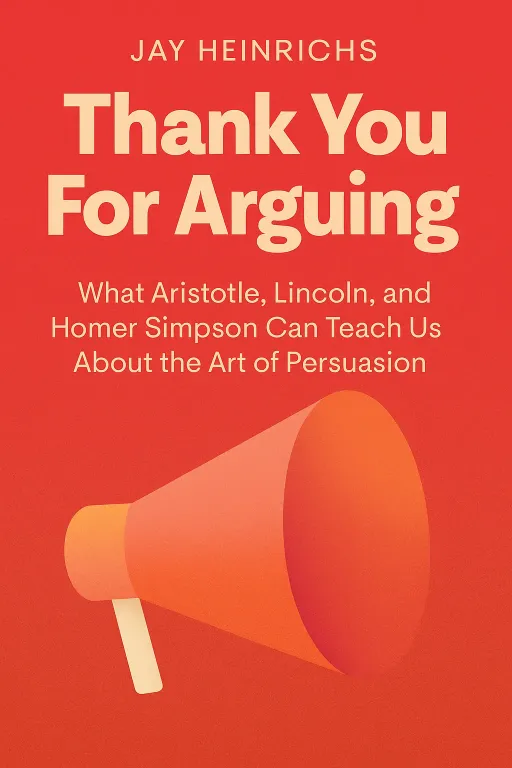
Nova: Not pointless, Atlas, but perhaps underutilized. We're talking about the art of influence, specifically through the lens of Jay Heinrichs' brilliant book, "Thank You for Arguing: What Aristotle, Lincoln, and Homer Simpson Can Teach Us About the Art of Persuasion."
Atlas: Oh, I like that title. It sounds like it’s going to be both insightful and a little bit irreverent.
Nova: Absolutely. Heinrichs, for those who don't know, is a former journalist and a congressional speechwriter. He brings this incredibly refreshing, often humorous, and deeply practical approach to classical rhetoric, making it digestible for anyone who's ever felt their arguments weren't quite landing. He basically says, if your arguments aren't getting through, it might be less about the content and more about how you're presenting it.
Atlas: That makes me wonder – as someone who values context and informed discourse, I often focus on the purity of the facts. But you're suggesting the frame is just as vital?
Nova: Even more so. Think of it like this: you can have the most perfectly engineered engine, but if it’s sitting on cinder blocks in the garage, it’s not going anywhere. The frame gives it direction, purpose, and the ability to move. And the ancient Greeks, with their mastery of rhetoric, gave us the blueprint for that frame.
Deep Dive into Logos - The Logic Architect
SECTION
Nova: So, let's start with the foundation, the engine itself: Logos. This is the appeal to logic. It's about using facts, figures, and rational arguments to persuade. It’s what most analysts inherently gravitate towards.
Atlas: Right. The numbers, the data, the irrefutable evidence. That’s my comfort zone.
Nova: Exactly. And it’s crucial. For example, consider Abraham Lincoln in his debates against Stephen Douglas. Lincoln wasn't just throwing out opinions. He meticulously built his arguments using logical deductions. In his Cooper Union speech, for instance, he didn’t just the Founding Fathers opposed the spread of slavery; he went through the historical records, state by state, vote by vote, showing how the majority of the signers of the Constitution had voted to restrict slavery in new territories.
Atlas: So he wasn't just making a claim; he was presenting a detailed, verifiable chain of reasoning. That’s good.
Nova: Precisely. His argument was a logical edifice, brick by brick, proving his point through historical precedent and the Founders' intentions. The cause-and-effect chain was crystal clear: if the Founders acted this way, then their intent was X, and therefore our current policy should align with X. It’s incredibly compelling because it feels undeniable.
Atlas: But wait, I’ve seen plenty of arguments that logical but are actually full of holes, full of logical fallacies. How do you distinguish between sound Logos and something that just logic?
Nova: That’s a brilliant question, and it's where Heinrichs really shines. He teaches you not just to deploy these tools, but to them. Sound Logos relies on valid premises and accurate inferences. A fallacy, on the other hand, might use an irrelevant conclusion, generalize from too few examples, or attack the person rather than the argument. It's like a finely crafted watch versus a cheap knock-off; they both tell time, but one has genuine internal integrity.
Atlas: I guess that makes sense. So, pure logic is foundational, but it's not the whole story. I mean, we’ve all seen situations where the most logical argument in the room still doesn’t win the day.
Deep Dive into Pathos - The Emotional Resonator & Ethos - The Character Catalyst
SECTION
Nova: And that naturally leads us to the other crucial appeals, because you're absolutely right, logic alone is often not enough. If Logos is the engine, Pathos is the fuel, and Ethos is the driver. Let’s talk about Pathos: the appeal to emotion. This is about stirring feelings in your audience to make them more receptive to your message.
Atlas: That sounds a bit manipulative. As an analyst, my instinct is to avoid emotion in favor of objectivity.
Nova: That’s a common misconception, Atlas. Pathos isn't about manipulation; it's about connection. Think of Martin Luther King Jr.'s "I Have a Dream" speech. He didn't just present logical arguments for civil rights; he painted a vivid, sensory picture of a future where children of former slaves and slave owners could sit together at the table of brotherhood. He invoked hope, injustice, shared values, and the profound yearning for freedom and equality.
Atlas: Wow. That gives me chills just thinking about it. He wasn't just stating facts; he was making people the possibility, the injustice.
Nova: Exactly. He made the abstract concepts of freedom and equality tangible and emotionally resonant. He leveraged shared values and aspirations, ensuring his audience didn't just understand his message intellectually, but also felt it deeply in their hearts. The emotional impact was immense, fostering a sense of shared purpose and urgency.
Atlas: Okay, I see. So it’s about evoking appropriate emotions to connect, not to trick. But how do you, as a communicator, do that ethically? How do you build that emotional bridge without just playing on people’s fears or prejudices?
Nova: The ethical use of Pathos comes from aligning the emotion with the truth of your argument and the values of your audience. It's about empathy, about understanding what truly moves people, and then connecting your message to those authentic sentiments. It’s not about fabricating emotion, but amplifying existing ones that are relevant to your cause.
Nova: And then we have Ethos. This is the appeal to character or credibility. It's about convincing your audience that you are a trustworthy, knowledgeable, and well-intentioned source.
Atlas: Is that just about having fancy credentials? Because I’ve seen plenty of people with impressive titles who I wouldn’t trust as far as I could throw them.
Nova: That’s a great push, Atlas. It's not credentials, though those certainly help. Ethos is built on three pillars: virtue, practical wisdom, and goodwill. Virtue means your audience perceives you as sharing their values. Practical wisdom means you seem experienced and sensible. And goodwill means they believe you have their best interests at heart.
Atlas: So, it’s about perceived authenticity, then? Like, if a scientist is presenting climate data, their Ethos isn't just their PhD, but also their perceived objectivity, their passion for truth, and their dedication to the planet.
Nova: Absolutely. It's how they present themselves, their tone, their willingness to engage with counter-arguments, their perceived integrity. The analyst who can build Ethos in a skeptical world isn't just the one with the best data, but the one who can demonstrate they are reliable, fair-minded, and genuinely invested in finding the best solution, not just winning an argument. It’s about projecting that sense of shared purpose and trustworthiness.
Synthesis & Takeaways
SECTION
Nova: So, what we've discovered is that Logos, Pathos, and Ethos aren't isolated tools; they're a dynamic, interconnected system. True influence, the kind that moves people and shapes discourse, is a synergistic dance between appealing to the head, the heart, and establishing your own credibility.
Atlas: That’s actually really inspiring. It means that even with the most complex data, there's an art to making it land, to making it resonate. It’s not just about being right; it’s about being understood and trusted.
Nova: Exactly. And understanding this architecture of persuasion empowers you not just to construct more compelling arguments, but also to dissect those of others. It sharpens your analytical skills, allowing you to see beyond the surface, connecting the dots between is said and it works – or doesn't.
Atlas: That gives me chills. So, for our listeners who are constantly analyzing information, trying to make their case, or simply navigate the endless stream of arguments out there, what’s a tiny step they can take?
Nova: Heinrichs recommends a powerful tiny step: choose a recent political speech you've encountered – maybe from a debate, a news conference, or even a social media post – and try to identify at least one clear example of Logos, one of Pathos, and one of Ethos within it. Just being able to consciously label them changes how you perceive communication.
Atlas: That's a fantastic exercise. It makes you an active participant, not just a passive receiver. It's about taking that intellectual curiosity, that desire for clarity, and applying it to the real world.
Nova: Indeed. Because in a world saturated with information and competing narratives, the ability to understand and wield rhetoric isn't just a skill for debaters or politicians. It's a fundamental tool for anyone seeking to engage meaningfully, understand global power dynamics, and contribute to informed discourse. It allows you to trust your inherent ability to connect the dots and realize just how valuable your insights can be.
Atlas: That’s a really powerful thought. How much more effectively could we engage with the world if we all understood these dynamics? It's a profound shift in perspective.
Nova: It truly is. So, we invite all our listeners to take that tiny step this week. Observe the rhetoric around you. See how these ancient appeals continue to shape our modern conversations. How might understanding these tools change the way you approach your next important conversation or presentation?
Atlas: And how might it change the way you interpret the news, or even the ads you see? It’s everywhere once you know what to look for.
Nova: This is Aibrary. Congratulations on your growth!