The Invisible Threads: How Organizational Culture Drives Product Success
Golden Hook & Introduction
SECTION
Nova: Atlas, quick question for you. If you had to pick one thing, the absolute secret sauce for a product to hit it big, to truly resonate and succeed, what would it be?
Atlas: Oh, that's easy, Nova. Unflappable leadership, a killer marketing budget, and probably a dash of pure, unadulterated luck. Or maybe just a genius idea that no one else has thought of. What do you think?
Nova: See, that’s where most people look. We focus on the tangible, the visible metrics, the strategies we can write down. But what if I told you the real 'secret sauce' isn't something you can see on a spreadsheet or a Gantt chart? What if it's something invisible, yet incredibly powerful?
Atlas: Invisible? Now you've got my attention. For someone who thrives on data and clear processes, that sounds a bit… ethereal. Are we talking about team vibes? Good energy?
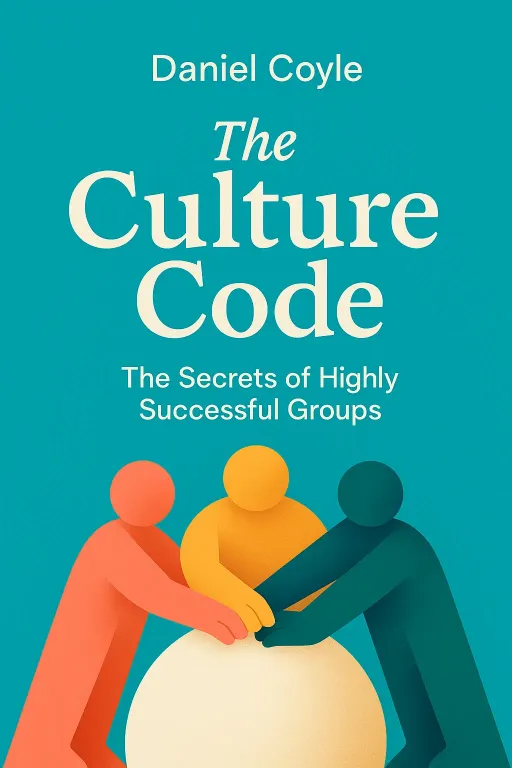
Nova: In a way, yes, but far more profound and measurable than just 'vibes.' Today, we’re pulling back the curtain on what we call 'The Invisible Threads: How Organizational Culture Drives Product Success.' We're drawing profound insights from two truly groundbreaking books: Daniel Coyle's 'The Culture Code' and General Stanley McChrystal's 'Team of Teams.'
Atlas: Oh, interesting pairing. Coyle, I know, is celebrated for demystifying how groups work. But McChrystal, a general? What does military strategy have to do with product success?
Nova: That's the beauty of it. Coyle, a master storyteller and journalist, didn't just theorize about culture; he embedded himself in diverse, high-performing groups – from Pixar animation studios to Navy SEAL teams – to reverse-engineer what made them tick. He found surprisingly simple, yet profound, patterns. And McChrystal, well, he famously transformed elite military units, not with more firepower, but by fundamentally changing how they connected and operated in the face of a rapidly evolving enemy. These aren't just business books; they're blueprints for human connection and adaptability in high-stakes environments. We're going to explore how the unseen forces of psychological safety and shared purpose are the true architects of enduring success, and how to build agile, resilient 'teams of teams' that can thrive in any environment.
Unmasking the Invisible Threads: Psychological Safety & Shared Purpose
SECTION
Atlas: So, these 'invisible threads' you mentioned, Nova. For a strategic builder, someone focused on tangible outcomes and clear processes, how does something like 'psychological safety' actually translate into a better product? Is it just about being 'nice' to each other at work?
Nova: That's a great question, and it’s a common misconception. Psychological safety isn't about being nice or avoiding conflict. It's about creating an environment where team members feel safe enough to take risks, to speak up with ideas, to admit mistakes, and to challenge the status quo without fear of punishment or humiliation. Daniel Coyle, in "The Culture Code," breaks it down into three core skills: building safety, sharing vulnerability, and establishing purpose.
Atlas: Okay, 'building safety' makes sense on paper, but I’m still picturing a lot of hand-holding. What does that look like in a high-pressure product development sprint? Give me an example where this wasn't just 'nice,' but truly made a difference in the final product.
Nova: Absolutely. Think about a product team facing a really complex technical challenge, maybe a bug that’s causing major delays. In a low-safety environment, individuals might hide their struggles, fearing they'll look incompetent. They might try to fix it alone, or worse, pass the buck. But Coyle recounts stories from places like Google's Project Aristotle, where they found that the highest-performing teams weren't necessarily the smartest or most experienced. They were the ones with the highest psychological safety.
Atlas: So, Google, the data giants, actually found that 'feelings' were more important than pure intellect? That’s counterintuitive.
Nova: Exactly. In one instance Coyle highlights, a team struggled with a critical software feature. They were behind schedule, and tensions were high. The breakthrough came not from a brilliant individual coder, but when a junior engineer, after a particularly frustrating meeting, hesitantly admitted they had been struggling with a specific piece of code for weeks and had been too afraid to ask for help, fearing they'd be seen as not capable.
Atlas: Whoa. That’s a huge admission. Most people would just keep quiet and hope it went away.
Nova: Right? But the team leader, instead of chastising them, immediately thanked them for their honesty, framed it as a shared problem, and explicitly stated that everyone makes mistakes and asking for help is a sign of strength, not weakness. From that moment, the entire dynamic shifted. Other team members started sharing their own roadblocks, and within hours, they collaboratively identified the root cause of the bug, which was far more complex than any single person could have solved.
Atlas: So, that single act of vulnerability, met with acceptance rather than blame, suddenly unlocked collective intelligence? That’s powerful. It’s like the team's brain got bigger because everyone felt safe to contribute their piece, even the messy parts.
Nova: Precisely. The outcome wasn't just a fixed bug; it was a more robust product because they had truly identified the deep-seated issue, and a much stronger, more cohesive team. That’s psychological safety in action: it allows for open communication, innovative problem-solving, and ultimately, a more resilient and higher-quality product. It’s about creating an environment where mistakes are learning opportunities, not career-enders.
Atlas: I can see how that would foster innovation. If you're constantly worried about looking foolish, you're not going to suggest that wild, out-of-the-box idea that might just be the next big thing.
Nova: And that connects directly to the third skill: establishing purpose. When everyone understands the 'why' behind their work – not just 'build this feature,' but 'this feature will help our users achieve X, which aligns with our company's mission to Y' – it transforms tasks into meaningful contributions. It gives people a reason to be vulnerable, to push through challenges, and to trust one another, because they're all rowing in the same direction towards a shared, inspiring goal.
From Command-and-Control to Collaborative Agility: Building Teams of Teams
SECTION
Atlas: Okay, so building safety and purpose is foundational. But how do you scale that safety and purpose across a large, complex organization? I can see it working for a small, tight-knit product team. But what about a company with hundreds or thousands of people, multiple product lines, and global operations? That sounds like a different beast entirely.
Nova: And that naturally leads us to the second key idea we need to talk about, which often acts as a critical enabler for the very culture we just discussed: how do you scale that safety and purpose across a large, complex organization? This is where General Stanley McChrystal's 'Team of Teams' becomes incredibly relevant. McChrystal observed that traditional command-and-control structures, which worked for industrial-era problems, were far too slow and rigid for modern, complex threats.
Atlas: He was literally fighting an enemy that was agile and networked, while his own forces were structured like a pyramid.
Nova: Exactly. He realized that even with the best individual teams, if they operated in silos – if the intelligence team didn't fully understand the operational team's needs, or the tech team wasn't aligned with the ground forces – they would fail. So, he built a network of interconnected teams, each empowered with broad awareness, what he called "shared consciousness," and strong relational ties, or "trust across boundaries."
Atlas: What do you mean by "shared consciousness"? Isn't that just... sharing information? We have meetings for that.
Nova: It’s far more than just meetings, Atlas. Shared consciousness is about everyone having a real-time, holistic understanding of the entire operational landscape, not just their small piece of it. It’s about deeply understanding the 'why' and 'how' of every other team's actions. McChrystal achieved this through radical transparency and constant, cross-functional communication – daily "operational tempo" meetings where representatives from relevant group, from intelligence to logistics, shared updates, challenges, and insights, not just upwards to a commander, but sideways to each other.
Atlas: So, instead of just reporting to their boss, they were all reporting to each other, in a sense? That sounds incredibly time-consuming. How do you get anything done if everyone is constantly in meetings?
Nova: It was a huge shift, but the alternative was failure. The key was that this shared consciousness wasn't about micromanagement; it was about empowering distributed decision-making. If a small product team, for example, deeply understands the customer insights from the marketing team, the technical constraints from the engineering team, and the sales pipeline from the business development team, they can make faster, more informed decisions on the fly without waiting for layers of approval.
Atlas: But isn't that just chaos? How do you maintain control and direction if everyone is just doing their own thing? For a strategic builder who needs focus and clear objectives, that sounds like a recipe for losing direction.
Nova: It’s not about anarchy; it’s about control within a framework of shared purpose and real-time information flow. The general's role shifted from being the sole decision-maker to being an "enabler" – fostering the environment, setting the broad intent, and ensuring the flow of information and trust. Imagine a product launch that fails because the engineering team built a fantastic product, but marketing didn't understand its nuanced features, and sales couldn't articulate its value proposition. That's a siloed failure.
Atlas: I've seen that play out. Engineering builds what they think is great, marketing positions it differently, and the customer is left confused.
Nova: A "team of teams" approach would have those groups deeply integrated from day one. They wouldn't just be 'handing off' work; they'd be co-creating, sharing insights, and building trust across those traditional boundaries. The product would be better aligned with market needs, and the launch would be more coordinated and impactful. It’s about pushing decision-making to the edges, where the information is, but ensuring everyone operates with the same overarching understanding.
Atlas: That's a profound shift in mindset. So, for a team leader listening right now, what's a practical step they could take to start implementing this 'shared consciousness' without completely dismantling their current structure?
Nova: Start small. Implement a daily stand-up, but make it cross-functional. Invite a representative from an adjacent team – maybe a marketing person to your engineering stand-up, or a product manager to a sales huddle. The goal isn't just to report progress, but to share and that impact others. Foster informal communication channels. Encourage people to build relationships outside their immediate team. It's about intentionally weaving those invisible threads of connection and understanding.
Synthesis & Takeaways
SECTION
Atlas: You know, when we started, I was thinking about product success in terms of features, market share, and ROI. But this conversation has really reframed it for me. It’s not just about the 'what' or the 'how' of the product, but the 'who' and the 'how they connect.'
Nova: Absolutely. Both Daniel Coyle and General McChrystal, from vastly different worlds, arrive at the same undeniable truth: the success of any endeavor, especially complex product development, hinges on the human ecosystem that creates it. Ignoring these invisible cultural forces – psychological safety, shared vulnerability, shared purpose, and deep cross-functional trust – is like building a skyscraper on quicksand. It might look impressive for a while, but it's inherently unstable and prone to collapse under pressure.
Atlas: And it makes so much sense for the strategic builder, the talent magnet, the data explorer. You can have the best strategy, the brightest minds, and all the data in the world, but if your culture undermines trust and open communication, you're fighting an uphill battle. The real impact comes from intentionally cultivating an environment where teams can be vulnerable, trust each other, and understand their collective mission. It’s about sustainable growth, not just short-term wins.
Nova: Precisely. Strong cultures don't just happen; they're built, one interaction, one vulnerable moment, one shared objective at a time. And the payoff is not just a better product, but a more resilient, innovative, and ultimately more human organization.
Atlas: That’s actually really inspiring. It shifts the focus from just output to the health of the system that the output.
Nova: It does. So, for all our listeners, I want to leave you with a deep question to reflect on this week: Think about a recent challenging project or a difficult decision your team faced. How might a deeper commitment to psychological safety, or a clearer, more deeply shared purpose, have fundamentally altered that outcome, not just for the product, but for the people building it?
Nova: This is Aibrary. Congratulations on your growth!