

The Human Element: Building Cultures of Innovation and Resilience
Golden Hook & Introduction
SECTION
Nova: Here's a thought that might shake your workday: The very things we've been taught about motivating teams – the bonuses, the promotions, the tight deadlines – they might actually be killing innovation and driving people away.
Atlas: Whoa, Nova, that's a bold claim right out of the gate. I mean, for anyone trying to hit targets or build a sustainable business, isn't that counter to pretty much every management textbook written in the last century? How could that possibly be true?
Nova: Well, Atlas, it's a truth that Daniel H. Pink, a brilliant mind who even served as a speechwriter for Al Gore before pivoting to become one of the most insightful thinkers on human behavior, lays out so compellingly in his seminal work,. And it's a truth that General Stanley McChrystal, through his unparalleled, battle-tested experiences chronicled in, proves on the highest stakes battlefield. They both argue that our traditional models often miss the mark entirely.
Atlas: So, for those of us who are architects of systems, building solutions, and driven by lasting impact, you're saying the conventional wisdom is actually a roadblock?
Nova: Precisely. They highlight that building truly resilient and adaptive teams isn't about more control or bigger carrots. It requires understanding something far more fundamental: the human desire for autonomy, mastery, and purpose.
The Intrinsic Drivers of High Performance: Daniel Pink's "Drive"
SECTION
Nova: Pink's research, and what he explores in, suggests that for complex, creative work, those old-school external motivators – the classic 'carrot and stick' – actually performance and satisfaction. What truly ignites high performance and deep satisfaction, he argues, is our innate need to direct our own lives, to get better at things that matter, and to contribute to something larger than ourselves. He boils it down to three key intrinsic drivers: autonomy, mastery, and purpose.
Atlas: Okay, autonomy, mastery, and purpose. These sound like great ideals, but for someone balancing client needs, tight deadlines, and the pressure of delivering, how do you actually grant 'full autonomy' without things devolving into chaos? Isn't there a risk of losing control or critical direction when you just let people run wild?
Nova: That’s a fantastic question, and it's a common misconception. Pink isn't advocating for anarchy. Autonomy means enabling people to direct their lives, to have control over their tasks, time, team, and technique. Think of Atlassian, the software company. They famously implemented something called 'FedEx Days.'
Atlas: FedEx Days? Like, overnight delivery?
Nova: Exactly! They’d give their developers 24 hours – literally from one afternoon to the next – to work on they wanted, as long as it wasn't part of their usual job. The only rule was they had to present their results to the entire company the next day.
Atlas: And what happened? Did they just spend it playing video games?
Nova: Far from it! These FedEx Days led to new product ideas, brilliant bug fixes, and innovative solutions that management never even considered. The cause was simple: giving employees complete freedom over they worked on and they worked on it. The process was unfettered creativity and self-direction. And the outcome? Real, tangible innovation born purely from intrinsic motivation. It wasn't about the bonus; it was about the freedom to explore.
Atlas: That’s fascinating. So, it's about trusting the 'how' as long as the 'what' and 'why' are clear. That makes a lot more sense. But what about mastery? How do you foster that?
Nova: Mastery is the urge to get better and better at something that truly matters. Look at the open-source software movement, like the creation and continuous improvement of the Linux kernel. Thousands of developers globally contribute their time and expertise, often for no direct financial reward.
Atlas: I can see that. They're driven by the intellectual challenge, the desire to perfect their craft, and the impact their work has on the world. They're solving complex problems just for the sheer joy of it.
Nova: Exactly! The cause is the intellectual challenge and the desire for continuous learning. The process is collaborative problem-solving and honing their skills. The outcome is world-changing technology built by highly motivated individuals who are intrinsically driven to achieve mastery.
Atlas: And purpose? That feels like the biggest one, especially for those driven by making lasting contributions.
Nova: Purpose is the yearning to do what we do in service of something larger than ourselves. Take TOMS Shoes, for example, with their 'One for One' model. Every pair of shoes purchased meant a pair was donated to someone in need.
Atlas: Oh, I'm familiar with that. It really resonated with a lot of people.
Nova: It did. The cause was aligning a business model with a powerful social impact. The process meant customers' purchases directly contributed to a meaningful cause, and employees knew their work had a direct positive effect. The outcome was not just strong brand loyalty, but also a deeply motivated workforce. People felt their work genuinely mattered, beyond just selling shoes.
Atlas: I can see how that would create a different kind of energy. So, it’s not just about what you do, but you do it.
From Hierarchy to 'Team of Teams': McChrystal's Empowered Execution
SECTION
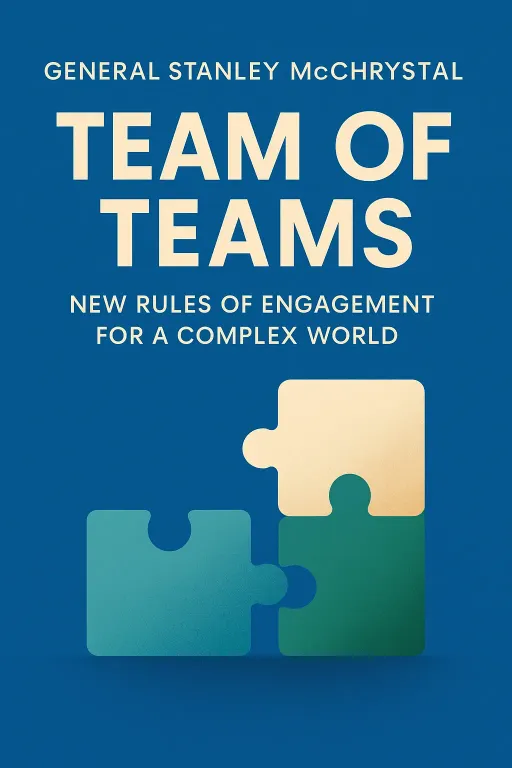
Nova: Absolutely, Atlas. And that naturally leads us to the second key idea we need to talk about, which often acts as a critical enabler for intrinsic motivation: the structure of an organization itself. Even with intrinsically motivated individuals, if the overarching structure is wrong, you're still fighting an uphill battle. This is where General Stanley McChrystal's becomes incredibly relevant.
Atlas: McChrystal's military background gives him a unique perspective. I imagine the stakes couldn't be higher.
Nova: They couldn't. McChrystal commanded the Joint Special Operations Task Force in Iraq, and he faced an enemy unlike any they'd encountered before: a decentralized, agile, and networked terrorist organization. Their traditional, hierarchical command structure, which had worked for decades, was failing.
Atlas: How so? I always thought military operations thrived on strict hierarchy and clear chains of command.
Nova: That was the old model, and it's effective for predictable challenges. But against a highly distributed, rapidly adapting enemy, their old way became a liability. Intelligence was siloed; decisions moved slowly up and down the chain of command, based on a 'need-to-know' basis. By the time a decision was made, the intelligence was often outdated, and the enemy had moved on. The cause was a rigid, top-down structure. The process was information bottlenecks and a lack of horizontal communication. The outcome was an inability to adapt to a nimble, decentralized threat.
Atlas: So, what did they do? How do you fight a networked enemy with a traditional military?
Nova: McChrystal realized they had to become a 'team of teams.' They transformed from a rigid hierarchy to a flexible, decentralized network. This involved two critical components: 'shared consciousness' and 'empowered execution.'
Atlas: Shared consciousness and empowered execution. That sounds like a lot to manage, especially in a high-stakes environment.
Nova: It was a radical shift. For 'shared consciousness,' they started daily video conferences involving thousands of people, from intelligence analysts to frontline operators, sharing intelligence. Everyone had a complete picture of the battlefield, not just their small piece.
Atlas: Okay, a special ops force in life-or-death situations is one thing. But for someone building a business strategy or an independent brand, isn't that level of radical transparency and decentralization incredibly risky? How do you maintain coherence and a unified vision when everyone's making their own calls, especially if you're trying to amplify a unique voice or master client acquisition?
Nova: That's a crucial point, Atlas. It's not about anarchy or everyone doing whatever they want. 'Empowered execution' means pushing decision-making authority down to the lowest possible levels. Because everyone has 'shared consciousness' – they understand the broader mission, the context, the 'why' – they can make smart, localized decisions that align with the overall strategic objective. It's about building trust and shared understanding so that decentralized actions still lead to a unified outcome. The cause was recognizing the enemy's agility. The process was radical transparency and decentralized authority. The outcome? Faster decision cycles, unprecedented success against a networked threat, and a highly resilient organization.
Synthesis & Takeaways
SECTION
Nova: So, when you combine Pink's insights on intrinsic motivation with McChrystal's blueprint for organizational adaptability, you see a powerful synergy. Intrinsic motivation—autonomy, mastery, purpose—thrives in environments of shared consciousness and empowered execution. These aren't just 'soft skills' or nice-to-haves; they are strategic imperatives for resilience and innovation.
Atlas: I guess that makes sense. For our listeners who are architects of systems, historians of past successes, and strategists for the future, the real takeaway is that the 'human element' isn't just about being 'nice' or 'employee engagement' in a superficial way. It's the ultimate competitive advantage, demanding a fundamental rethink of how we lead and organize. It's about trusting your vision, as our growth recommendations suggest, and empowering others to execute on that vision.
Nova: Exactly. It's about focusing on the 'why' and the 'what,' and then trusting people with the 'how.' So, I challenge all of our listeners: identify just one task you delegate this week. Grant the person full autonomy over they achieve the desired outcome. Focus only on the 'why' and 'what.' See what happens.
Atlas: I love that. It's a tiny step that could lead to monumental shifts in trust and innovation. It flips the script from managing tasks to cultivating human potential.
Nova: It’s about building environments where people can truly thrive, innovate, and contribute their best.
Atlas: That’s actually really inspiring.
Nova: This is Aibrary. Congratulations on your growth!









