The Collaboration Paradox: How to Build Teams That Think, Not Just Do
Golden Hook & Introduction
SECTION
Nova: Most leaders believe control and rigid hierarchy are the ultimate keys to efficiency and predictability. But what if the very structures designed to bring order are actually guaranteeing chaos and sluggishness in today's incredibly complex, rapidly changing world?
Atlas: That sounds like a paradox in itself! So, the harder we try to control, the more out of control things actually get? That's going to resonate with anyone who's felt their team spinning its wheels despite all the top-down directives.
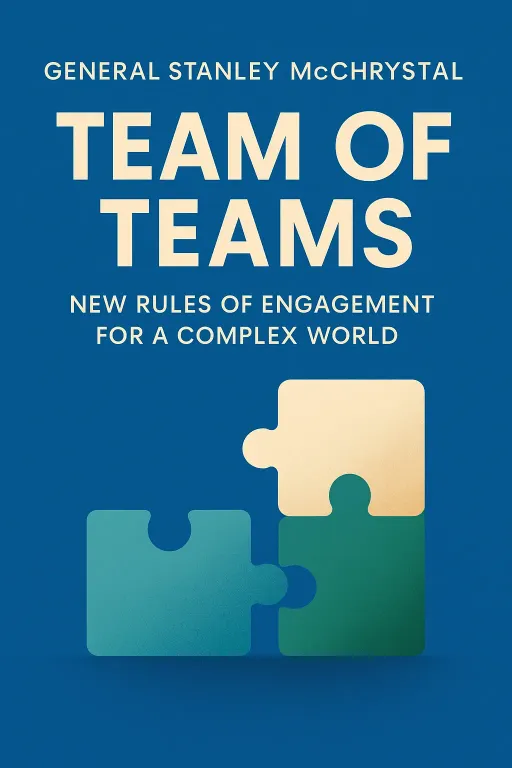
Nova: Exactly, Atlas. And that's precisely the central thesis we're breaking down today, drawing heavily from two groundbreaking works: General Stanley McChrystal's "Team of Teams: New Rules of Engagement for a Complex World" and Daniel Coyle's "The Culture Code: The Secrets of Highly Successful Groups." McChrystal's book, in particular, comes from a truly unexpected place – his experience leading the Joint Special Operations Task Force in Iraq. Imagine a highly hierarchical military organization, steeped in centuries of command-and-control, having to completely reinvent itself to fight a decentralized, adaptive enemy like Al Qaeda. It's a testament to radical change coming from where you'd least expect it, driven by sheer necessity.
Atlas: Wow, that's fascinating how lessons from such high-stakes, life-or-death environments translate to everyday teams and businesses. And Coyle's work, from what I understand, really digs into the human side of making those kinds of teams tick, right? The emotional infrastructure.
Nova: Absolutely. Coyle's research pulls from diverse high-performing groups, from Pixar Animation Studios to Navy SEAL teams, to identify the universal ingredients for building trust and cohesion. Combined, these books offer a powerful blueprint for reimagining how we collaborate. Because the cold fact is, Atlas, modern challenges are just too complex for traditional hierarchies. Your team needs to adapt faster than ever before.
The 'Team of Teams' Paradigm: From Hierarchy to Hyper-Adaptability
SECTION
Nova: So let's start with McChrystal. He argues that the traditional, industrial-era organizational model, designed for predictable tasks and stable environments, is utterly broken in our current landscape. Think of a classic factory line: clear roles, top-down commands, everyone knows their place. It was brilliant for its time.
Atlas: Right, like an orchestra with a conductor, everyone plays their part perfectly, following a single vision. Seems efficient on paper.
Nova: It does. But what happens when the sheet music keeps changing mid-performance, and the stage is constantly shifting? That's the reality today. McChrystal's Joint Special Operations Task Force, or JSOC, was facing an enemy, Al Qaeda, that operated like a distributed network. They were decentralized, agile, and could make decisions at the local level with incredible speed. JSOC, on the other hand, was a collection of highly skilled but siloed units – Delta Force, SEALs, various intelligence agencies – each with its own command chain, its own information systems, and its own way of doing things.
Atlas: So, you're saying they were a collection of perfectly tuned instruments, but they weren’t playing the same song, or even trying to. It’s like a group of virtuosos, but without a shared understanding of the performance.
Nova: Precisely. They were incredibly effective in their individual areas, but the overall organization was too slow, too fragmented to counter Al Qaeda's speed and adaptability. McChrystal realized they were losing because they were optimized for the wrong war. The enemy wasn't a hierarchical army; it was a shapeshifting network. So, he instituted radical changes.
Atlas: Radical changes in the military? That sounds like trying to turn an aircraft carrier on a dime. How do you even begin to dismantle decades, centuries even, of ingrained command-and-control? That’s going to resonate with anyone in a large, established organization.
Nova: It was incredibly difficult, and met with huge resistance. But his core idea was to create a "team of teams." This meant two things: first, fostering "shared consciousness," which involved daily, massive video conferences – sometimes with thousands of participants – where everyone, from intelligence analysts to special operators on the ground, shared information freely and openly. The goal was for everyone to understand the entire operational picture, not just their tiny piece of it.
Atlas: Whoa, thousands of people on a video call? I can barely get five people to agree on a meeting time! That's a huge shift from a need-to-know basis to a basis. But how do you ensure that information isn't just shared, but actually acted upon?
Nova: That brings us to the second pillar: "empowered execution." Once everyone had shared consciousness, the decision-making authority was pushed down to the lowest possible levels. Junior officers, even non-commissioned officers, were empowered to make critical decisions in the field, rather than waiting for top-down approval. The trust was built through that shared understanding. They knew everyone was looking at the same data, had the same goals, and understood the broader context. The outcome was a dramatic increase in operational tempo and effectiveness, turning the tide against Al Qaeda. They literally transformed a slow, rigid force into a highly adaptive network that could out-maneuver its enemy.
Atlas: That's incredible. It's like they realized the conductor needed to trust the individual musicians to improvise brilliant solos, knowing they all understood the symphony's overall theme. For our listeners who are trying to build impact and lasting value, that idea of distributed decision-making, where everyone feels a sense of ownership, is powerful. But how do you cultivate that trust, that shared understanding? It sounds like there's an invisible glue holding it all together.
Cultivating the Collaborative Core: Psychological Safety and Shared Purpose
SECTION
Nova: You've hit on the perfect transition, Atlas. Because for a "team of teams" to truly function, you need more than just structural changes; you need a profound shift in how people interact, which brings us to Daniel Coyle and "The Culture Code." Coyle's research shows that the invisible glue you're talking about is psychological safety, shared vulnerability, and a clear sense of purpose.
Atlas: Psychological safety. That phrase gets thrown around a lot, but what does it really mean in practice? Is it just about being nice to each other?
Nova: It's far more profound than just being nice. Psychological safety is the shared belief held by members of a team that the team is safe for interpersonal risk-taking. It's knowing you won't be humiliated or punished for speaking up with ideas, questions, concerns, or mistakes. It’s the foundation that allows shared vulnerability to thrive. Coyle illustrates this with Google's Project Aristotle, an ambitious internal study to identify what makes a team effective. They looked at everything – skills, personalities, tenure – and found the number one predictor of team success wasn't who was on the team, but how they interacted. Psychological safety was paramount.
Atlas: So, it's not about having the smartest people, but about creating an environment where feels safe enough to smart, to contribute their best without fear. I imagine a lot of our listeners feel like they're in environments where vulnerability is seen as a weakness, especially in competitive fields. How do you flip that script?
Nova: It starts with leadership actively modeling vulnerability. Coyle gives examples of leaders admitting their own mistakes, asking for help, or openly acknowledging uncertainty. These aren't signs of weakness; they're signals that it's safe for others to do the same. When a leader says, "I messed that up, what can we learn from it?" or "I don't have all the answers here, what are your thoughts?" they create an opening for others to step into. It builds trust. This is where shared vulnerability comes in: when people feel safe enough to be themselves, to admit errors, to ask 'dumb questions,' that's where true innovation and rapid learning happen.
Atlas: That’s actually really inspiring. It’s like the leader isn't just the person with all the answers, but the person who creates the space for to find answers together. It’s about building people and purpose, not just products.
Nova: Exactly. And the shared sense of purpose is the third leg of that stool. When everyone understands and believes in the 'why' behind their work, it acts as a powerful motivator and unifier. It gives meaning to the shared consciousness and empowers execution. It's the North Star that guides distributed decision-making. True collaboration isn't just about working together; it's about building a shared understanding and trust that empowers rapid, distributed decision-making.
Synthesis & Takeaways
SECTION
Nova: So, bringing it all together, McChrystal gives us the structural blueprint for agility – the 'team of teams' concept of shared consciousness and empowered execution. But Coyle shows us the cultural operating system that makes that blueprint actually work: psychological safety, shared vulnerability, and a strong sense of purpose. You can't have one without the other for true, impactful collaboration.
Atlas: That makes perfect sense. It’s not just about changing the org chart, but fundamentally changing how we with each other. It’s about building people, not just processes, and trusting their instincts to lead with clarity. What's one tiny step someone listening right now, perhaps feeling overwhelmed by their own rigid structures or lack of team cohesion, can take to start fostering this kind of collaborative culture?
Nova: A fantastic question, Atlas. Here's a tiny step that can have outsized impact: identify one recurring team meeting where you can experiment with a more decentralized agenda. Instead of the leader dictating every topic, let team members set topics and lead discussions. It's a small act of ceding control, but it sends a powerful signal of trust and empowers everyone to contribute more fully. It starts building that shared understanding and sense of ownership.
Atlas: I love that. It’s actionable, low-risk, and immediately puts the principles we discussed into practice. It’s about creating those connections and building lasting value, one meeting at a time.
Nova: Absolutely. Because when you build teams that think, not just do, you unlock incredible potential for impact and growth.
Nova: This is Aibrary. Congratulations on your growth!