Stop Managing Tasks, Start Cultivating Leaders: The Blueprint for Scalable Impact.
Golden Hook & Introduction
SECTION
Nova: What if the very thing we're taught about leadership – being the smartest, having all the answers, always being the one with the grand vision – is actually the fastest way to sabotage our teams?
Atlas: Hold on, are you saying competence is a trap? Because that sounds like a contrarian idea I can get behind.
Nova: It’s not about competence itself, Atlas, but how we wield it. Many leaders, often with the best intentions, unknowingly stunt their team's potential by focusing on being the smartest person in the room rather than empowering others. It creates bottlenecks, limits growth, and frankly, it's exhausting for everyone.
Atlas: Oh, I know that feeling. The weight of being the sole decision-maker, the bottleneck. So, what’s the antidote to this self-imposed leadership trap?
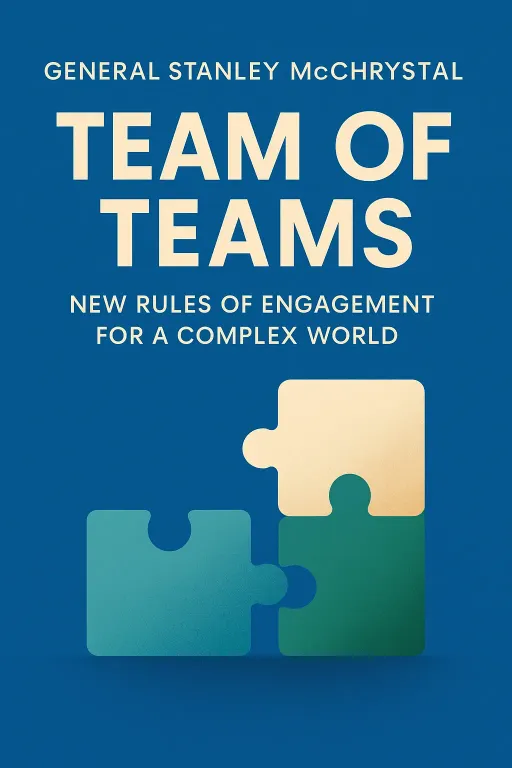
Nova: Well, today we're diving into an incredibly powerful blueprint for scalable impact, drawing heavily from two transformative books: General Stanley McChrystal's "Team of Teams" and Liz Wiseman's "Multipliers." What's fascinating about McChrystal is his background; here's a four-star general, a man who led the Joint Special Operations Task Force in Iraq, literally rewriting the rules of command in the most high-stakes environment imaginable. That's not just theory; that's battle-tested transformation.
Atlas: That makes sense. We're talking about going beyond just managing tasks to truly cultivating leaders, right? It's about amplifying impact through others.
From Command-and-Control to Empowered Execution: The Team of Teams Revolution
SECTION
Nova: Exactly. And that brings us to our first core idea: the revolution from command-and-control to truly empowered execution. Think about the traditional military structure, Atlas. It's the epitome of hierarchy, right? Clear chain of command, information flows up, orders flow down.
Atlas: Absolutely. Precision, discipline, top-down directives. It’s designed for efficiency when the situation is predictable.
Nova: Precisely. But in the mid-2000s, when McChrystal took over JSOTF in Iraq, they were up against Al-Qaeda in Iraq, or AQI. AQI wasn't a traditional army; they were a decentralized, networked, incredibly agile insurgency. They were moving faster than JSOTF could possibly react. Despite having superior technology, resources, and training, JSOTF was losing because their decision-making was too slow. Information had to go up the chain, decisions had to come back down. By the time an order was issued, the intelligence was often stale, and the target was gone.
Atlas: So, the very structure designed for efficiency was creating a fatal delay. It's like trying to fight a swarm of gnats with a single, slow-moving battleship.
Nova: Exactly! McChrystal realized they needed to become as adaptable and agile as their enemy. He didn’t just tweak the system; he fundamentally reimagined it. His radical solution was to dismantle those silos, create what he called "shared consciousness," and push "empowered execution" down to the lowest levels.
Atlas: Wait, hold on. Shared consciousness and empowered execution? In a special ops unit? Isn't that just chaos in disguise? How do you maintain quality or strategic direction when everyone's making decisions without direct oversight? From a strategist's perspective, that sounds incredibly risky.
Nova: It sounds risky, but it's where the genius lies. Shared consciousness didn't mean everyone knew, but everyone understood the: the overall mission, the enemy's capabilities, the strategic intent. They instituted daily "Operations and Intelligence" calls, involving thousands of people across the globe, sharing real-time intel. This created a collective understanding, a common operating picture.
Atlas: That makes sense. Knowing the context allows for better decisions.
Nova: And then came empowered execution. Because everyone had that shared consciousness, they didn't need to wait for orders from the top for every single move. Small teams on the ground, with the most up-to-date information, were empowered to make high-stakes decisions quickly. It's like a jazz band: everyone knows the melody, the key, the rhythm, but each musician has the freedom to improvise, to react to each other in real-time, creating something far more dynamic and effective than if they were just reading sheet music.
Atlas: That's a great analogy. So, the strategic guardrails were in place through shared understanding, which allowed for tactical agility. It’s about decentralizing decision-making without decentralizing purpose. That’s a profound shift for any organization.
Multiplying Talent: Becoming the Leader Who Amplifies Intelligence, Not Just Manages Tasks
SECTION
Nova: And once you have that empowered structure, the next question becomes: what kind of leader thrives within it? How do you lead people who are now empowered to make their own decisions? And that brings us directly to Liz Wiseman's groundbreaking work on "Multipliers."
Atlas: Oh, I love this book. It's about the leaders who make everyone around them smarter versus those who, well, don't.
Nova: Exactly. Wiseman identifies two types: "Multipliers" and "Diminishers." Diminishers are the leaders who, often unintentionally, drain intelligence and capability from their teams. They might be the "idea guy" who always has to have the best idea, or the micromanager who takes over every project, or the hero who swoops in to save the day, subtly implying no one else could have done it.
Atlas: Wow, that sounds like a lot of people I've encountered, or honestly, even aspects of myself sometimes. I can totally see how that stifles initiative. You think you're helping, but you're actually creating dependency. How do you even recognize if you're diminishing, and what does a Multiplier actually?
Nova: A classic Diminisher scenario, and one Wiseman often details, is the well-meaning CEO who thinks they're being helpful by constantly jumping in with "better" ideas or "fixing" team members' work. They believe they're adding value, but what they're actually doing is teaching their team to wait for ideas, to avoid taking risks, and to eventually stop thinking for themselves. The team's collective intelligence shrinks because the leader is unconsciously hoarding it.
Atlas: That's actually really insightful. It's not malicious, it's just a habit of being the "smartest person." So, what's the Multiplier's playbook?
Nova: Multipliers, on the other hand, are talent magnets. They don't just hire smart people; they find the in everyone. They act as liberators, creating an environment where people can do their best work without fear of failure. They're challengers, pushing their teams to think bigger and solve harder problems. They're debate makers, fostering intense but healthy discussions where the best ideas win, not just the leader's idea. And crucially, they're investors, giving people ownership and resources to succeed.
Atlas: That’s a great way to put it. Instead of being the one who solves all the problems, they create a system where the problems solved by everyone. But isn't it faster to just tell people what to do, especially in a high-pressure, innovative environment where time is money? For architects and strategists dealing with tight deadlines, that hand-holding might feel inefficient.
Nova: It might feel faster short-term, Atlas, but that's the illusion. Diminishing creates bottlenecks. It means become the single point of failure, the single source of good ideas. When you multiply, you're building capacity, you're scaling impact. You're not just getting one person's best ideas; you're getting the collective genius of an entire team, amplified. It’s a profound shift from being the source of intelligence to being the catalyst for intelligence.
Synthesis & Takeaways
SECTION
Nova: So, bringing these two powerful ideas together: the "Team of Teams" structure provides the playing field, the empowered, agile environment where decisions can be made quickly and effectively at the edges. And "Multipliers" are the coaches within that field, the leaders who cultivate, amplify, and unleash the full intelligence and capability of every player.
Atlas: So, it's about creating an environment where everyone can lead, and then being the leader who fuels that fire, rather than putting it out. That's a profound shift from the traditional leadership paradigm. It moves beyond just managing tasks to truly cultivating a vibrant ecosystem of talent.
Nova: Absolutely. It directly addresses that cold fact we started with: how leaders unknowingly stunt potential. The solution isn't to work harder or be smarter yourself; it's to create the conditions for others to thrive and lead alongside you.
Atlas: That gives me chills. And it brings us to our tiny step for the week, doesn't it?
Nova: It does. This week, identify one area where you can delegate a strategic decision, not just a task, to a team member. And truly trust their judgment. It’s not about offloading busy work; it’s about empowering someone to think, to own, to lead.
Atlas: That's a powerful challenge, especially for those of us who are used to being in the weeds, or who feel responsible for every strategic outcome. It forces us to step back and trust not just the task, but the thinking behind it. It's about letting go of being the smartest person in the room to instead cultivate a room full of brilliant leaders. What strategic decision will you empower this week?
Nova: This is Aibrary. Congratulations on your growth!