Stop Guessing, Start Structuring: The Blueprint for Intentional Team Growth
Golden Hook & Introduction
SECTION
Nova: Okay, Atlas, the title we’re exploring today is “Stop Guessing, Start Structuring: The Blueprint for Intentional Team Growth.” Give me your five-word review, what immediately jumps out at you?
Atlas: Hmm, I’d go with: Practical, essential, challenging, future-focused, empowering.
Nova: Oh, I like that! Mine would be: Agility, transparency, purpose, evolution, resilience. See, we’re already aligned! Those words truly encapsulate the heart of what we’re diving into today.
Atlas: They really do. This idea of intentional team growth, especially when it comes to structuring, is so crucial for anyone building something meant to last.
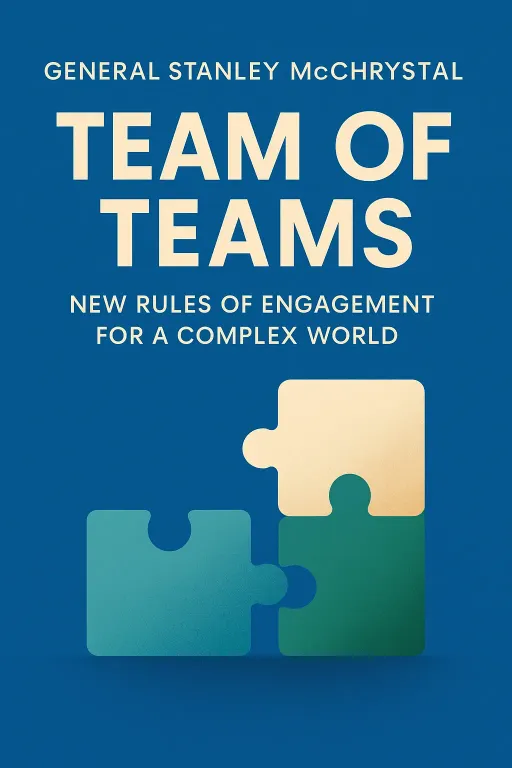
Nova: Absolutely. And the core of our podcast today is really an exploration of how to move beyond outdated organizational structures to build highly adaptive, resilient, and human-centric teams that can thrive in any environment. We’re drawing inspiration from two foundational texts that, while seemingly disparate, offer profound insights: Stanley McChrystal’s “Team of Teams” and Frederic Laloux’s “Reinventing Organizations.”
Atlas: McChrystal, the general? That’s fascinating. How does a military special operations commander’s playbook translate to intentional team growth in, say, a startup or a growing enterprise?
Nova: That's the beauty of it, Atlas! McChrystal's background leading the Joint Special Operations Task Force is precisely why his insights are so potent. He literally had to reinvent how his elite teams operated under intense, life-or-death pressure. And Laloux, a former McKinsey consultant, offers a more philosophical yet equally radical vision for what he calls 'Teal Organizations,' which, I should note, have received both widespread acclaim and some polarizing reviews for their visionary approach.
The Agility Imperative: Why Traditional Hierarchies Are Failing
SECTION
Atlas: Okay, so a general and a consultant walk into a podcast… I’m intrigued. Nova, let’s start with McChrystal. What was the core problem he was trying to solve, and why are traditional hierarchies failing us today?
Nova: He was facing what he called a "cold fact": traditional hierarchical structures were utterly failing to adapt to the fast-paced, complex demands of modern warfare. His top-down command structure, designed for efficiency in predictable environments, was struggling against a decentralized, agile enemy in Iraq. It was a classic "command and control" system trying to fight a "team of teams" and losing.
Atlas: That sounds rough. Like a supertanker trying to outmaneuver a fleet of speedboats.
Nova: Exactly! The old model, while efficient for routine tasks, created information silos, slow decision-making, and a lack of shared context. Leaders at the top simply couldn't know everything, and those on the ground, who have the information, weren't empowered to act. So, McChrystal realized they needed to transform from a top-down command structure to a highly adaptable 'team of teams.'
Atlas: That’s a huge shift. How did he actually do that without everything devolving into chaos? For our listeners who are building robust systems, that sounds like a recipe for disaster.
Nova: It’s a brilliant question, and it speaks to the core of his transformation. They emphasized two key pillars: "shared consciousness" through radical transparency and "empowered execution" through decentralized authority. Picture this: instead of information flowing strictly up and down the chain of command, they implemented daily "Operations and Intelligence" briefings that everyone attended, from top generals to frontline analysts. This wasn't just a status update; it was about ensuring everyone had the same, real-time understanding of the complex, rapidly evolving environment.
Atlas: So, radical transparency. Isn't that just information overload, or worse, a lack of focus? I imagine a lot of our listeners would worry about proprietary data or just plain noise.
Nova: That’s a fair point, but it was about transparency, not just dumping everything. The goal was to build a collective understanding, a sense of shared purpose, so that when decisions needed to be made, everyone understood the larger context. And that led to empowered execution. Instead of waiting for orders, teams on the ground, armed with this shared consciousness, were trusted and to make decisions and act quickly. McChrystal shifted from trying to make the decisions himself, to building a system where decision made by an empowered team was a decision, given the speed required.
Atlas: That’s a real leap of faith for a leader, especially for someone who’s used to being the ultimate decision-maker. It requires a profound trust in your people, doesn't it?
Building for Resilience: The Blueprint for Self-Managed, Purpose-Driven Teams
SECTION
Nova: It absolutely does, Atlas. And that naturally leads us to the second key idea we need to talk about, which often acts as a counterpoint or, rather, a deeper dive into the philosophical underpinnings of such a transformation. If McChrystal showed us the of agility and how to adapt an existing structure, Laloux offers a blueprint for to build it from the ground up, not just adapt.
Atlas: So, Laloux’s “Reinventing Organizations” is less about adapting existing structures and more about a wholesale reimagining?
Nova: Precisely. Laloux explores 'Teal Organizations'—a new paradigm of organizational design characterized by three core breakthroughs: self-management, wholeness, and an evolutionary purpose. Forget traditional hierarchies; in Teal, there are no bosses in the conventional sense. Teams are self-organizing, with individuals holding multiple roles and responsibilities.
Atlas: Wait, no hierarchy? That sounds… ambitious, to put it mildly. For our listeners who are building robust systems, how does that work when things inevitably go wrong? And what about the 'polarizing reviews' you mentioned? Are these ideas truly resilient, or just idealistic?
Nova: That’s a crucial challenge. Laloux doesn't shy away from the radical nature of it. Take self-management. Instead of top-down directives, decisions are made through advice processes, where anyone can initiate a decision after consulting those affected or those with expertise. Think of an organization like Buurtzorg, a Dutch home care provider. Nurses self-organize into small, autonomous teams, managing their own schedules, client care, and even hiring. There are no middle managers. This level of autonomy fosters incredible engagement and responsibility.
Atlas: That’s impressive for a care provider, where the work is often highly relational. But how does that translate to a more complex, product-driven environment? And what about the 'wholeness' and 'evolutionary purpose' you mentioned? They sound a bit abstract.
Nova: They can, but they’re deeply practical. Wholeness is about inviting people to bring their full selves to work, not just their professional masks. It means creating environments where intuition, emotions, and personal growth are valued alongside rational thought. Evolutionary purpose means the organization isn't just a machine for making money; it's seen as a living entity with its own direction, which people discover and serve, rather than being dictated by a strategic plan. The polarizing reviews often come from those who find the ideas too utopian, or struggle with the significant cultural shift required. But the companies Laloux profiles, like Morning Star, the world's largest tomato processor, have achieved incredible scale and efficiency with these principles.
Atlas: Morning Star, processing tomatoes without bosses? That's a powerful counter-example to the skepticism. It really challenges the conventional wisdom that you need a rigid structure to achieve scale and profit. It sounds like both McChrystal and Laloux, despite their different contexts, are pointing to the same fundamental truth: trust and shared purpose are the ultimate drivers of resilience.
Synthesis & Takeaways
SECTION
Nova: Absolutely, Atlas. Whether it's McChrystal’s elite military units adapting to a new threat, or Laloux’s visionary 'Teal Organizations' thriving with self-management, the core message is consistent: moving beyond rigid hierarchies and fostering an environment of trust and shared purpose is how you build a highly resilient and effective team capable of navigating complex challenges and achieving ambitious growth.
Atlas: So, for someone trying to build lasting value and a vibrant community, where do they even begin with such a fundamental shift? It feels like a massive undertaking.
Nova: It can feel that way, but it starts tiny. The first step is to simply begin to decentralize trust. Here’s a tiny step you can take: identify one recurring decision that currently requires your approval. Then, empower a team member to make that decision independently next time, with your support.
Atlas: That’s so concrete and actionable. It’s not about overhauling everything at once, but about taking that first step to build a structure of trust. And it definitely calls back to the idea of trusting your intuition as much as your data, that inner compass guiding your vision.
Nova: Exactly. It's about cultivating that environment where people feel empowered and connected to a larger purpose. That’s how you build not just a team, but a truly resilient organism.
Atlas: I love that. A resilient organism. What a powerful image.
Nova: This is Aibrary. Congratulations on your growth!