

Stop Guessing, Start Designing: The Blueprint for High-Impact Culture.
Golden Hook & Introduction
SECTION
Nova: What if the very structure you've meticulously built for efficiency is actually sabotaging your team's innovation and psychological safety?
Atlas: Sabotaging? That sounds incredibly counterintuitive, Nova. Most organizations strive for efficiency structure, don't they? It's like, the more organized we are, the better we perform.
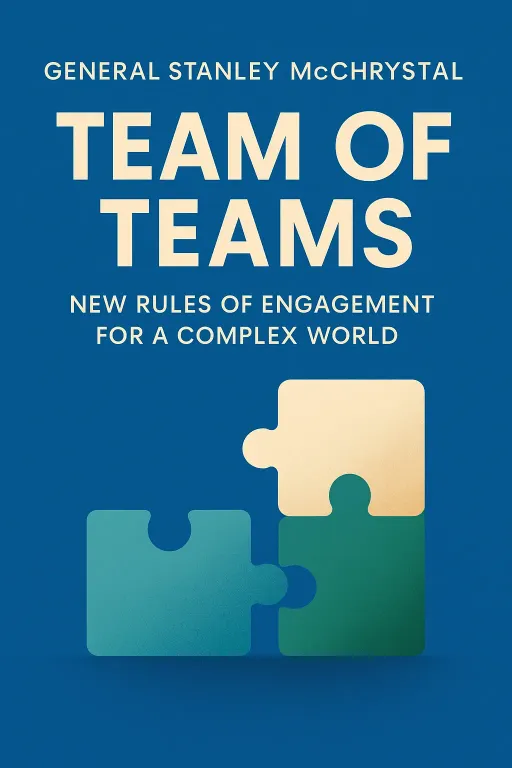
Nova: Exactly. But today, we're diving into insights from two incredible books that challenge that very notion: by Stanley McChrystal and by L. David Marquet. These aren't just business books, Atlas; they're blueprints from environments where failure isn't an option, where adaptability is literally life or death.
Atlas: Oh, tell me more. The stakes sound incredibly high.
Nova: Well, consider McChrystal, a four-star general, who radically transformed an elite military unit. He showed that even in the most highly structured environments, adaptability ultimately trumps rigid hierarchy. And then there's Marquet, a submarine captain, who empowered his crew to such an extent that they could effectively run a nuclear vessel even without him.
Atlas: A submarine without its captain? That's… a lot of trust. I mean, we're talking about a nuclear submarine! So, this isn't about minor tweaks, is it? It sounds like a fundamental shift in how power and responsibility are distributed.
Nova: It is. And it starts with a profound shift in how we even about an organization. Are you ready to rethink some fundamentals?
The Network vs. Machine Metaphor: Decentralization for Agility
SECTION
Atlas: Absolutely. You've definitely piqued my curiosity. Where do we begin with this re-evaluation?
Nova: We begin by understanding that many organizations are still built like machines: top-down, command-and-control, with specialized parts that operate independently. Think of an assembly line. Each person has a specific, defined role. It's very efficient for predictable tasks.
Atlas: That makes perfect sense for a stable environment. When you know exactly what needs to be done, you optimize for that.
Nova: Precisely. But what happens when the environment isn't stable? When it's complex, unpredictable, and constantly changing? That's where McChrystal's insights from become absolutely critical. He was leading the Joint Special Operations Task Force in Iraq, fighting Al-Qaeda.
Atlas: A high-pressure, incredibly dynamic situation, to say the least. Not exactly an assembly line.
Nova: Not at all. Al-Qaeda in Iraq was a decentralized, highly adaptive network. They were agile, constantly evolving, and making decisions at the edges of their organization. McChrystal realized his elite, highly trained military unit – a machine designed for predictable, large-scale warfare – was being outmaneuvered. They were battling a network, and the machine was losing.
Atlas: Wow. That's a stark realization. So, what did he do? You can't just dismantle the military!
Nova: He didn't. He reimagined it. He broke down the rigid silos between intelligence, special forces, and other agencies. He pushed decision-making authority down the chain of command, trusting individuals closer to the action to make critical choices. But the real genius was fostering what he called 'shared consciousness.'
Atlas: Shared consciousness? What does that entail when you're talking about thousands of people spread across the globe?
Nova: Imagine daily video calls involving thousands of people from different agencies and locations, all sharing real-time intelligence, operational updates, and understanding the overall strategic picture. It wasn't about getting permission; it was about everyone knowing what everyone else was doing and why. This created psychological safety because everyone understood the context and felt connected, even when decisions were decentralized.
Atlas: But wait, doesn't that just lead to chaos? Giving up that much control, especially in a military context, feels incredibly risky. How do you maintain psychological safety when everyone's making decisions, and potentially different ones?
Nova: That's the common fear, isn't it? The perceived chaos of decentralization. But McChrystal found the opposite. Shared consciousness and radical transparency chaos. When everyone understands the 'why' behind decisions, when they have context, they can make better, faster, more aligned choices. It built trust. It transformed the JSOTF from a slow-moving giant into an agile, highly responsive network, dramatically improving their effectiveness. It was a complete paradigm shift.
Leader-Leader vs. Leader-Follower: Empowering Every Node
SECTION
Atlas: That’s a powerful shift, moving from a machine to a network. It makes me think about how many organizations still operate on that old 'machine' model, even when they're trying to innovate.
Nova: Exactly. And that notion of pushing decision-making authority down, of everyone understanding the 'why,' is precisely what L. David Marquet masterfully implemented on a nuclear submarine. It's a concept he calls 'leader-leader' rather than 'leader-follower.'
Atlas: Leader-leader? That sounds like a recipe for too many cooks in the kitchen, especially on a submarine where precision is paramount.
Nova: Well, when Marquet took command of the USS Santa Fe, it was the worst-performing submarine in the fleet. His initial instinct, like any good captain, was to command, to tell people what to do. But he quickly realized his crew was disengaged. They simply awaited orders, lacking initiative and ownership. They were operating in a leader-follower paradigm, and it was failing.
Atlas: So, he had a disengaged crew, in a high-stakes environment. What was his radical solution?
Nova: He made a profound shift. He literally told his officers, "Don't ask for permission; tell me your intent." Think about that. Instead of "Captain, may I dive the ship?" it became "Captain, I intend to dive the ship." He pushed technical knowledge and decision-making authority to the lowest possible level. He fostered competence at every level, making it safe for people to take ownership and act.
Atlas: That sounds terrifyingly empowering. What if someone intends to do something wrong? How do you ensure psychological safety when you're giving that much autonomy, especially with potential catastrophic consequences?
Nova: That's where the 'leader-leader' model isn't just about handing over the reins. It's about cultivating competence and clarity. Marquet spent immense effort ensuring his crew had the skills, the knowledge, and the clear understanding of objectives to make those 'intentions' sound. It built profound psychological safety because people were trusted, competent, and empowered to act. They felt intrinsic motivation because they owned their work.
Atlas: That's an amazing story, going from worst to first. But how does that translate to, say, a product development team or a creative agency? It feels very specific to a high-stakes military or naval environment. What about the fear of making a wrong decision when you're used to waiting for instruction?
Nova: That's a crucial question, Atlas. The core idea isn't about a nuclear submarine; it's about creating environments where people lead, not just. It's about competence, clarity, and control – the building blocks of psychological safety and intrinsic motivation in organization. When people are trained, when they understand the mission, and when they're given the autonomy to act, they thrive. It’s about trusting your team to not just execute, but to innovate.
Synthesis & Takeaways
SECTION
Atlas: So, what McChrystal and Marquet ultimately show us is that true innovation and psychological safety aren't about rigid, top-down control.
Nova: Exactly. They’re about distributed leadership and shared understanding. It's about moving beyond simply guessing what your team needs, and starting to truly design a high-impact culture. It’s about building a culture where everyone feels safe not just to speak up, but to and lead.
Atlas: It's moving from 'I'll tell you what to do' to 'I trust you to figure this out and tell me your plan.' That's a powerful shift in mindset, trusting your team to not just execute, but to innovate and lead. It’s about building an organization that’s truly resilient and agile, not just efficient on paper.
Nova: Absolutely. And for our listeners, especially those who are architects of culture and driven by impact, we have a tiny step for you this week: Identify one decision you usually make and delegate it fully to a team member. Really challenge yourself to provide context, but resist the urge to provide instruction.
Atlas: Just context, not instruction. That sounds like a powerful way to start letting go and empowering others to rise. And then, observe the outcome. It's a small act of trust that can ripple through your entire team.
Nova: Precisely. It’s about designing for human potential, not just process optimization. It’s about moving beyond simply guessing what your team needs, and starting to truly design a high-impact culture where everyone feels safe, motivated, and empowered to lead.
Nova: This is Aibrary. Congratulations on your growth!









