

Forging High-Performing Teams
Golden Hook & Introduction
SECTION
Nova: Forget everything you think you know about “team cohesion.” The most powerful teams aren't built on agreement; they're forged in the fires of intellectual friction, embracing the very differences that other groups try to smooth over.
Atlas: Whoa, that’s a bold statement, Nova. We’re constantly told to seek harmony, to build consensus. Are you saying we should actively seek out conflict if we want our teams to excel? That sounds... counter-intuitive, to say the least.
Nova: Absolutely. And it’s a profound shift in perspective, Atlas, one that challenges a lot of conventional wisdom. Today, we're diving into the compelling insights from two groundbreaking books that redefine what it means to build truly high-performing teams. We’re talking about Shane Snow’s, and General Stanley McChrystal’s.
Atlas: Ah, two titans in the field. Snow, a journalist and tech entrepreneur, brings a fascinating blend of storytelling and modern organizational insights. And McChrystal, a decorated military general, offers a perspective forged in the crucible of high-stakes, real-world combat. What an interesting pairing.
Nova: It truly is. Snow, with his background in journalism and tech startups, looks at how diverse, often contrarian, thinkers, when managed correctly, foster innovation and resilience. He’s all about leveraging what he calls ‘cognitive friction’ for superior results. McChrystal, on the other hand, deconstructs how highly adaptable, decentralized networks of empowered teams, much like the modern military units he commanded, can navigate complex, rapidly changing environments far more effectively than rigid hierarchies ever could.
Atlas: So basically, we’re peeling back the layers on how to make teams not just function, but truly by embracing what might seem like their biggest weaknesses. It’s about leveraging internal dynamics and external structures.
Nova: Precisely. And the deep question that connects both of these incredible works, the one we want to explore today, is this: How can you intentionally cultivate both psychological safety intellectual friction within your team to unlock its full potential? It’s a delicate balance, but one with immense payoffs.
The Power of Productive Friction: Embracing Diverse and Contrarian Thinking
SECTION
Nova: Let's start with Shane Snow’s, because it really flips the script on what we think makes a good team. He argues that the best teams aren't necessarily the ones where everyone gets along perfectly or thinks alike. In fact, he suggests the opposite: the most innovative and resilient teams are often those composed of diverse, even contrarian, thinkers, who are encouraged to challenge each other.
Atlas: That makes me wonder, how do you even define "contrarian thinkers" in this context? Is it just people who like to argue, or is there a deeper principle at play?
Nova: That’s a great question, Atlas. It's not about being difficult for the sake of it. Snow emphasizes. It’s about bringing together people with different ways of seeing the world, different problem-solving approaches, different life experiences, and even different personality types. When these diverse perspectives clash, that's where the magic, or what he calls "cognitive friction," happens. It's the spark that ignites new ideas.
Atlas: So, it’s not just about having a diverse team in terms of demographics, but truly diverse thinking styles. That makes sense. But how do you stop that friction from just becoming, well, actual destructive conflict? I can imagine a lot of teams where that would just lead to infighting and resentment.
Nova: You've hit on the crucial point. Snow is clear that this isn't about chaos. It requires a foundation of psychological safety. Team members need to feel safe enough to express their dissenting opinions, to challenge the status quo, and to even make mistakes, without fear of personal reprisal or being ostracized. When that safety exists, the friction becomes.
Atlas: Okay, so psychological safety is the bedrock. It allows for the intellectual sparring without personal attacks. Can you give us an example of a "dream team" that really nailed this?
Nova: Absolutely. One of Snow’s most compelling examples is the early days of. Think about that original cast and writing team: Bill Murray, Gilda Radner, John Belushi, Dan Aykroyd, Lorne Michaels himself. They were a motley crew of wildly different comedic sensibilities, backgrounds, and temperaments. Some were improvisers, others were meticulous writers. Their personalities often clashed, and there was intense competition and debate.
Atlas: Oh, I can just picture the arguments over sketch ideas. The pressure cooker environment.
Nova: Exactly. But within that pressure, and because Lorne Michaels fostered an environment where challenging ideas and pushing boundaries were encouraged, that friction became incredibly generative. They weren't just a collection of funny people; they were a dynamic system where differing comedic visions were forced to collide, refine, and often, beautifully combine. The result wasn't just good comedy; it was revolutionary, boundary-pushing television that defined a generation. Their internal disagreements often led to the most brilliant, unexpected sketches. The cause was this intentional mixing of diverse, contrarian talent. The process involved intense debate and challenging assumptions. The outcome was groundbreaking, resilient, and highly adaptive comedy that could respond to the week's events.
Atlas: Wow, that’s actually really inspiring. It’s like a forge, where the heat and the hammering reshape raw material into something stronger. But for our listeners, how do you actually that kind of productive friction in a more typical team setting? It’s not like most of us are producing a live comedy show every week.
Nova: That’s a fair point. Snow suggests a few things. First, leaders need to actively recruit for cognitive diversity, not just cultural fit. Look for people who ask different questions, who approach problems from unusual angles. Second, create structured opportunities for debate—like devil's advocate roles in meetings, or dedicated brainstorming sessions where challenging ideas is the explicit goal. And finally, model vulnerability yourself. Show that it’s okay to be wrong, to change your mind, and to engage in robust discussion. It’s about creating rituals and norms that make intellectual sparring feel normal and even expected, all within that umbrella of mutual respect and a shared ultimate goal.
Beyond Hierarchy: Building Adaptable, Decentralized Team Networks
SECTION
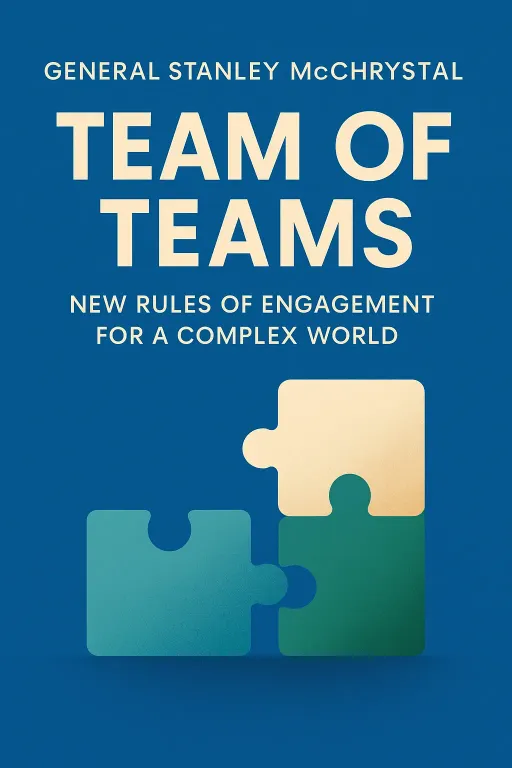
Nova: And speaking of engineering how teams work, sometimes the challenge isn’t just internal dynamics, but the entire organizational structure. That’s where General Stanley McChrystal’s comes in. His experience leading the Joint Special Operations Command, or JSOC, in Iraq, completely reshaped his thinking about leadership and organization.
Atlas: Now that you mention it, I remember hearing about that. His team was up against Al-Qaeda in Iraq, a highly decentralized and agile enemy, and the traditional military hierarchy just wasn't cutting it.
Nova: Precisely. McChrystal describes how the traditional, highly efficient, command-and-control military structure, which had served them well in conventional warfare, was failing against this new, networked threat. They were too slow, too siloed. Information didn't flow quickly enough, and decisions were too centralized. The cause was a mismatch between their rigid, hierarchical structure and the enemy's fluid, decentralized network.
Atlas: So the enemy was basically outmaneuvering them because they were faster and more adaptable. That’s a terrifying thought in a military context.
Nova: It was. And McChrystal realized they had to transform. He understood that efficiency, while valuable, had to be sacrificed for adaptability. He shifted his entire command from a "command of teams" to a "team of teams." This involved two core principles: "shared consciousness" and "empowered execution."
Atlas: Shared consciousness and empowered execution. Can you break those down for us? Because that sounds like a radical departure from what most people imagine military operations to be.
Nova: Absolutely. "Shared consciousness" meant breaking down information silos. Instead of information flowing strictly up and down the chain of command, it flowed the entire network. They instituted daily video conferences involving thousands of people from different units—intelligence analysts, special operators, support staff—all sharing raw, unvarnished intelligence and insights. Everyone knew what everyone else was doing, and why. This built a common understanding of the complex, rapidly evolving battlefield.
Atlas: So, pushing information out to everyone, not just on a need-to-know basis. That's a huge trust leap, isn't it? Giving so many people access to sensitive intelligence.
Nova: It absolutely was. It was about trusting that everyone, from the most junior analyst to the most senior commander, needed the full picture to make effective decisions. And that leads to "empowered execution." Once everyone had shared consciousness, McChrystal pushed decision-making authority down to the lowest possible level. Frontline teams were empowered to make high-stakes calls in real-time, without waiting for multiple layers of approval, because they had the best, most up-to-date information and understood the overarching strategic intent. The outcome was a transformation into a highly effective, adaptable network that could respond with unprecedented speed and precision, ultimately outmaneuvering their complex adversary.
Atlas: That sounds incredibly powerful for a military unit. But how does that translate to, say, a tech startup or a non-profit? We don't exactly have lives on the line every day in the same way.
Nova: That’s a common question, and it’s critical to understand that the principles are universal. The modern business environment, the pace of technological change, the complexity of global markets—these are all analogous to McChrystal’s unpredictable battlefield. Organizations today face "VUCA" environments: volatile, uncertain, complex, and ambiguous. A rigid hierarchy designed for stability and prediction simply cannot keep up.
Atlas: So, for a company, "shared consciousness" might mean truly transparent communication across departments, not just top-down directives. And "empowered execution" means giving project teams the autonomy to make decisions quickly, rather than waiting for endless approvals.
Nova: Precisely. It’s about building trust, fostering transparency, and cultivating a sense of common purpose across a network of specialized teams. Leaders in this model become "gardeners" who cultivate the environment, rather than "chess masters" who move pieces around. They focus on building connections, sharing information, and reinforcing the shared mission, allowing the teams closest to the problems to innovate and adapt. It’s a profound philosophical shift in leadership.
Synthesis & Takeaways
SECTION
Nova: So, when we bring these two ideas together—Shane Snow’s call to embrace intellectual friction and McChrystal’s vision of a decentralized, adaptable team of teams—we see a powerful blueprint for forging high-performing organizations. It’s about being intentional.
Atlas: I guess that makes sense. Both concepts really challenge the idea that harmony and strict control are the ultimate goals. Instead, they champion a different kind of strength, one born from dynamic interaction and distributed intelligence. It's about designing an environment where smart, diverse people can truly thrive and challenge each other.
Nova: Exactly. The deep question we posed earlier—how to cultivate both psychological safety and intellectual friction—is central to both. You need the safety to allow the friction, and the friction to drive the innovation. And you need the trust and shared purpose to empower teams to execute without constant oversight. It’s not about just hiring smart people; it's about designing the system for them to be.
Atlas: That’s actually really inspiring. It means leadership isn't about having all the answers, but about creating the conditions for the best answers to emerge, even if they come from unexpected places or through challenging conversations. It shifts the burden from the leader to the collective.
Nova: And it requires leaders to be vulnerable themselves, to admit they don't have all the answers, and to trust their teams implicitly. It’s a move from rigid predictability to agile responsiveness, from individual genius to collective intelligence.
Atlas: So, for our listeners who are thinking about their own teams, what’s one actionable thought they can take away from this powerful discussion?
Nova: I would say this: this week, identify one assumption your team holds, or one area where everyone seems to agree too readily. Then, gently, intentionally, introduce a contrarian viewpoint or ask a challenging "what if" question. Create a tiny spark of intellectual friction, and see what new ideas emerge. It’s about testing the boundaries of comfort and discovering the power of productive disagreement.
Atlas: What a great challenge. What's one assumption your team holds that you could gently challenge this week? That's going to resonate with anyone trying to break out of groupthink.
Nova: This is Aibrary. Congratulations on your growth!









