Beyond the Org Chart: Building Resilient, High-Performing Teams.
Golden Hook & Introduction
SECTION
Nova: Teams need shared purpose, not charts.
Atlas: Structure changes, people make it work.
Nova: You know, Atlas, that’s such a concise way to frame what we’re diving into today. We’re talking about transcending the traditional organizational chart, those rigid boxes and lines that everyone thinks they understand, but which often become the very thing holding us back.
Atlas: Oh, I love that. It’s like everyone’s been handed this ancient map, and we’re all trying to navigate a hyper-speed future with it, wondering why we keep crashing. But wait, what exactly are we talking about today? Is this a specific book, or a collection of ideas?
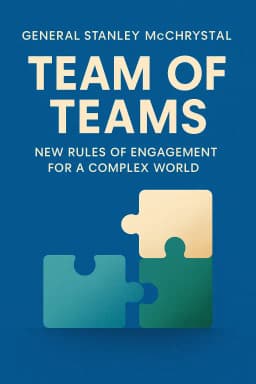
Nova: That’s a great question. We’re synthesizing insights from a powerful body of work that’s fundamentally reshaping how we think about leadership and team dynamics. Think of it as a deep dive into the principles behind building resilient, high-performing teams, drawing heavily from the wisdom of leaders like Stanley McChrystal, who famously led the Joint Special Operations Task Force, and the operational genius detailed in books about Amazon’s unique approach. It’s a collective wisdom about moving beyond the org chart.
Atlas: Okay, so it’s less about one author’s perspective and more about distilling the absolute best thinking on how to get teams to not just survive, but in chaos. I’m curious, why are these old-school charts suddenly so… problematic? Aren’t they supposed to bring order?
The Inadequacy of Traditional Hierarchies & The Blind Spot
SECTION
Nova: Exactly! They designed for order, for efficiency, for predictable environments where you could plan everything months or even years in advance. But here’s the rub: the world doesn't work that way anymore. Our first core idea today is about understanding this critical blind spot. Traditional hierarchies, with their top-down command and control, create bottlenecks. They centralize information, slow down decision-making, and often stifle the very adaptability we need.
Atlas: That makes sense. I can definitely relate. I imagine a lot of our listeners, especially those managing fast-moving projects or leading teams in dynamic industries, feel this constantly. It’s like trying to steer a supertanker through a whitewater rapid. You can have the best captain, but the vessel itself just isn’t built for that kind of agility.
Nova: That’s a perfect analogy. The core of it is that you are building cultures, not just companies. If your structure is inherently rigid, it’s actively fighting against a culture of speed, innovation, and responsiveness. The traditional model prioritizes efficiency through specialization and segmentation, but in a world that demands rapid learning and constant iteration, that very efficiency becomes a liability.
Atlas: So it’s about speed versus control, then? How do you even begin to untangle decades of ingrained hierarchy? For our listeners who have inherited these structures, or are trying to scale a growing organization, this concept might feel impossible to implement. Where do you even start to chip away at something so fundamental?
Nova: The shift isn't about abolishing structure entirely, but rethinking its purpose. It's about how you foster adaptability and speed without losing cohesion. The mistake is assuming that control equals cohesion. Often, it's the opposite. True cohesion comes from something deeper than lines on a chart.
From Command-and-Control to Shared Consciousness & The Shift
SECTION
Nova: And that naturally leads us to our second core idea: the radical shift from command-and-control to what’s called 'shared consciousness' and 'empowered execution.' This is where Stanley McChrystal’s work with the Joint Special Operations Task Force becomes incredibly illuminating. He describes how they transformed from a traditional, hierarchical military command into a 'team of teams' model.
Atlas: Whoa, a military unit, known for its strict command structure, went agile? That’s incredibly counterintuitive! I always picture military operations as the ultimate top-down structure. How did they maintain alignment without a rigid chain of command? Doesn't 'empowered execution' just lead to chaos if everyone’s doing their own thing?
Nova: That’s precisely the genius of it. McChrystal realized their highly specialized, siloed units were too slow to adapt to a rapidly evolving enemy. They were efficient at their individual tasks, but the overall system was failing. The solution wasn't to centralize more, but to distribute intelligence and decision-making. 'Shared consciousness' meant everyone, from the highest-ranking officer to the boots on the ground, had a near-real-time understanding of the entire operational landscape.
Atlas: So, getting everyone on the same page, all the time? That sounds like an impossible amount of information to process. How did they actually achieve that without overwhelming everyone or drowning in data?
Nova: They did it through daily, intensive 'Operations and Intelligence' briefs. These weren't just status updates; they were forums where every unit shared their latest insights, challenges, and understanding of the enemy. It was about creating a common mental model of the battlefield. And then, with that shared consciousness, came 'empowered execution.' Local teams, closest to the problem, were trusted to make rapid decisions without waiting for layers of approval.
Atlas: That’s fascinating. So it’s less about telling people what to do, and more about giving them the context and the trust to figure it out themselves. But what about accountability in that model? If everyone’s empowered, who’s ultimately responsible when things go wrong? And how do leaders, who are used to being the 'chess masters,' transition to this 'gardener' role you mentioned?
Nova: McChrystal explicitly talks about leaders shifting from being 'chess masters' who dictate every move, to 'gardeners' who cultivate the environment for the teams to thrive. Accountability becomes collective, but also highly visible. When everyone knows the overall mission and sees each other's efforts, there's an inherent pressure and drive to perform. The leader's job becomes about ensuring the flow of information, removing obstacles, and reinforcing the shared purpose, rather than micromanaging. It's a profound trust in the intelligence and commitment of the team.
Operationalizing Agility: Principles for High-Performing Teams
SECTION
Nova: This radical transformation isn't just for elite military units. We see similar principles at play in highly successful corporate environments. And that brings us to our third core idea: operationalizing agility with principles that foster high-performing teams, exemplified by companies like Amazon. Colin Bryar and Bill Carr detail Amazon's unique operating principles and organizational design choices in "Working Backwards."
Atlas: Okay, so how does a massive tech company, known for its incredible scale and speed, apply these ideas? Is it about shared consciousness and empowered execution there too? I'm curious about the mechanisms they use.
Nova: Absolutely. At Amazon, 'customer obsession' is the ultimate shared consciousness. It’s the guiding star that aligns every team, every decision. Everyone understands that their primary purpose is to delight the customer. But then, to operationalize empowered execution at scale, they developed concepts like the 'single-threaded leader.'
Atlas: A 'single-threaded leader' sounds almost like a throwback to a traditional role, but with a twist. How does that fit into this 'team of teams' idea? Isn't that just creating new silos? And for our listeners building cultures, how do they foster this customer obsession without losing sight of their internal team's needs?
Nova: That’s a great observation. A single-threaded leader is someone who has 100% focus and ownership over one specific initiative or product. They have the autonomy and resources to move fast, make decisions, and drive that particular outcome. They're not a silo in the traditional sense because they operate within the larger context of customer obsession and are expected to collaborate and communicate across the network, feeding into that shared consciousness.
Atlas: So it’s like having a clear mission specialist, but that specialist is plugged into a highly informed network. It sounds like a delicate balance between autonomy and alignment. It feels like the answer is less about 'the perfect structure' and more about the ongoing process of cultivating shared purpose and trust.
Nova: Exactly. The strategic alignment comes from that deep, almost philosophical commitment to the customer. When everyone truly understands and believes in that guiding principle, the single-threaded leader isn't working in isolation; they are a highly focused agent within a larger, interconnected system driven by a common goal. It’s about designing systems that allow for both autonomy and cohesion, speed and strategic direction.
Synthesis & Takeaways
SECTION
Nova: So, what we’ve really been exploring today is how to empower your teams with greater autonomy and shared understanding, while still maintaining strategic alignment across your organization. It's moving from rigid control to agile, empowered networks that thrive on shared purpose. The deep question isn't whether to have structure, but what kind of structure genuinely enables rather than constrains.
Atlas: That’s a powerful synthesis. It feels like the answer is less about 'the perfect structure' and more about the ongoing process of cultivating shared purpose and trust. For leaders looking to apply this, what's one actionable step they can take tomorrow to start fostering that shared consciousness and empowered execution?
Nova: Start small. Begin by radically increasing transparency within a single team. Share information that usually stays locked up in leadership meetings. And then, empower that team to fully own a specific problem or customer need, giving them the autonomy to experiment and decide. It's about shifting from managing tasks to cultivating an ecosystem where trust and shared understanding are the primary currencies.
Atlas: That's a powerful shift in mindset, from managing tasks to cultivating an ecosystem. It’s about building cultures, not just companies, and understanding that true resilience comes from the collective intelligence and agility of empowered people.
Nova: Absolutely. It’s about designing for adaptability, remembering that the best teams aren't controlled, they're cultivated.
Atlas: I love that. This is Aibrary. Congratulations on your growth!