Beyond the Org Chart: Building Resilient, High-Performing Teams.
Golden Hook & Introduction
SECTION
Nova: Atlas, five words: "Beyond the Org Chart."
Atlas: Culture, not just company, wins.
Nova: Brilliant. Mine: Rigid structure, stifled human potential.
Atlas: Oh, I like that. That’s a powerful distinction right there. We’re talking about something fundamental today, aren't we?
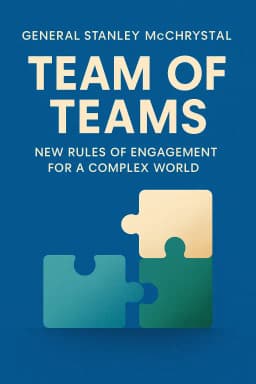
Nova: Absolutely. Today, we're diving into some truly transformative ideas from two seminal books: "Team of Teams" by General Stanley McChrystal and "Working Backwards" by Colin Bryar and Bill Carr. What's so fascinating about McChrystal's work is that it wasn't just theory; he developed it out of sheer necessity while leading the Joint Special Operations Task Force in Iraq. He had to completely reinvent how a military unit operated just to survive and succeed against a highly agile enemy.
Atlas: That’s incredible. So it wasn’t just an academic exercise, it was survival. And Bryar and Carr, from Amazon, they were actually at the ground floor, building the very systems that made Amazon what it is today. So we’re getting the insider’s view of how to scale with intention.
Nova: Exactly. These aren't just management texts; they're battle-tested blueprints. And what they both reveal is a massive blind spot that most traditional organizations have when it comes to building resilient, high-performing teams.
The Blind Spot – Why Traditional Structures Fail
SECTION
Nova: And that blind spot is precisely where we need to start. For decades, the mantra has been efficiency through hierarchy, clear lines of command, specialized silos. You know, the classic org chart. But the truth is, in today's fast-paced, unpredictable world, that very structure, designed for efficiency, often becomes a massive liability.
Atlas: But wait, for so many leaders, isn't hierarchy still the gold standard for efficiency? Like, if everyone knows their place and reports up, things get done, right?
Nova: That’s the conventional wisdom, isn’t it? But imagine a highly efficient, slow-moving battleship trying to catch a swarm of speedboats. Each part of the battleship is optimized, but its overall response time is glacial. That’s what McChrystal found in Iraq. His Joint Special Operations Task Force was comprised of elite units – SEALs, Delta Force, Rangers. Each unit was incredibly efficient, highly specialized.
Atlas: So, the best of the best. You’d think they’d be unstoppable.
Nova: You would. But they were struggling against Al-Qaeda in Iraq, an enemy that was decentralized, agile, and constantly adapting. The JSOTF’s traditional command structure, designed for predictable warfare, meant that intelligence gathered by one unit had to travel up the chain of command, across to another unit’s chain, and then back down. This created silos, delays, and a critical lack of shared understanding.
Atlas: So basically, brilliant individual parts, but a clunky overall machine? Like a Formula 1 car where the pit crew can't talk to the driver during a crucial pit stop, or the engineers can't share telemetry in real-time?
Nova: That’s a perfect analogy. The focus on individual unit efficiency led to organizational ineffectiveness when the environment demanded speed, adaptability, and cohesion across the entire force. They were losing not because they lacked skill, but because their structure prevented them from operating as one cohesive, intelligent entity. This is the fundamental blind spot: optimizing the parts doesn't necessarily optimize the whole, especially when the whole needs to move like a single, responsive organism.
The Shift – From Control to Connectedness
SECTION
Nova: And that clunky machine feeling naturally brings us to the profound "shift" these books advocate: moving from control to connectedness. McChrystal called it a "team of teams."
Atlas: A "team of teams" – that sounds like a buzzword. What does it actually look like in practice? Is it just everyone doing whatever they want, no structure at all?
Nova: Not at all. It’s about two core principles: "shared consciousness" and "empowered execution." To build shared consciousness, JSOTF implemented daily video conferences with hundreds of people, from junior analysts to senior commanders, across the globe. Everyone shared intelligence transparently, irrespective of their rank or unit. This built an unprecedented understanding of the entire operational landscape.
Atlas: Wow. That’s a huge departure from the need-to-know, top-secret mentality you’d expect in the military. It sounds almost… vulnerable.
Nova: It was a massive cultural change. But it meant that when a junior leader on the ground saw an opportunity, they had the context, the "shared consciousness," to understand its broader implications. Then came "empowered execution." Instead of waiting for layers of approval, these junior leaders, closest to the action, were empowered to make decisions.
Atlas: That sounds incredibly risky for a military organization. How do you prevent chaos when you're empowering execution like that? I imagine a lot of our listeners, especially those in high-stakes environments, are thinking about the potential for things to go off the rails.
Nova: This is where Amazon's "single-threaded leader" concept from "Working Backwards" provides a perfect complement. Amazon, facing its own challenges of scaling rapidly and maintaining customer obsession, discovered that when a team had a single leader solely focused on one outcome – a "single thread" – with all the resources and authority needed to achieve it, decisions were made faster and more effectively.
Atlas: Ah, so it's not chaos, it's focused autonomy. Like a perfectly coordinated orchestra, where each section leader has full authority over their part, but they all know the score and are playing towards a shared symphony.
Nova: Precisely. It’s about pushing decision-making power down to the edges of the organization, but within clearly defined boundaries and a deep, shared understanding of the overarching goal. The single-threaded leader is accountable for their specific 'thread' and can move with incredible agility because they aren't bogged down by competing priorities or endless approvals. It's a strategic shift from trying to control every outcome to designing environments where the right outcomes are more likely to emerge through empowered, aligned teams.
Strategic Autonomy – Balancing Freedom and Alignment
SECTION
Nova: Which brings us to the deep question from today's content: How do you embrace this radical empowerment and shared consciousness, this single-threaded focus, without losing strategic alignment across the entire organization?
Atlas: Yeah, that's the million-dollar question for any leader. I imagine a lot of our listeners, especially those building cultures and not just products, are thinking: "How do I trust my intuition when giving this much freedom? What's the secret sauce to ensure everyone's still moving in the same direction?"
Nova: It’s not about magic; it's about designing intentional "mechanisms." For JSOTF, that daily O&I brief was the mechanism that built shared consciousness. It wasn’t just an information dump; it was a ritual that forged collective understanding and trust. For Amazon, it’s their famous 'working backwards' document and the 'six-pager' memo.
Atlas: Oh, the infamous six-pager! I’ve heard about that. Instead of PowerPoint, you write a narrative memo.
Nova: Exactly. These aren't just processes; they're cultural artifacts that force clarity. Before any new product or initiative, a team writes a 'working backwards' press release from the future, imagining the customer's delight. Then, the six-pager forces them to articulate the problem, the solution, the customer benefits, and the metrics. This ensures everyone understands the 'why' and the 'what', even as they decide the 'how'. It's about designing guardrails, not handcuffs.
Atlas: So it's about giving them the context and the tools, then letting them run. It's really about intentional design, isn't it? Building trust into the system itself, rather than demanding it through oversight.
Nova: Absolutely. It’s a strategic shift from trying to control every step of the process to designing environments where the right outcomes are more likely to emerge through empowered, aligned teams. It demands a different kind of leadership, one that fosters shared purpose and deeply trusts its people.
Synthesis & Takeaways
SECTION
Nova: So, what we’ve really seen today is a powerful argument against the comfort of the traditional org chart. The military, Amazon – wildly different contexts, but both discovered that sustainable growth and resilience come from building a culture of trust and shared purpose, not just efficient boxes on a diagram.
Atlas: It’s genuinely thought-provoking. For anyone who cares about building cultures, not just companies, and wants sustainable growth, it's about listening to your team, trusting your intuition, and then designing systems that amplify that trust. It demands a different kind of leadership, one that leads through shared vision rather than rigid control.
Nova: Indeed. It's the leadership that understands the profound impact of people and connection, and how to harness collective intelligence. And if you're curious about how to implement these ideas, we highly recommend diving into "Team of Teams" and "Working Backwards." They offer incredible blueprints for building resilient, high-performing structures, not just in theory, but with real-world, high-stakes results.
Atlas: It challenges you to think differently, to be more intentional about the culture you’re fostering. What structures are you building? And more importantly, what kind of human potential are they enabling or stifling? It’s a question worth asking.
Nova: This is Aibrary. Congratulations on your growth!