Beyond the Org Chart: Building Resilient, High-Performing Teams.
Golden Hook & Introduction
SECTION
Nova: Atlas, quick, how do you fix a broken machine?
Atlas: Hmm, you diagnose the faulty part, replace it, then grease the gears. Why?
Nova: Because that's precisely not how you fix a broken organization, and yet, it's what most leaders try to do.
Atlas: Oh, I like that. So we're talking about more than just a quick tune-up then.
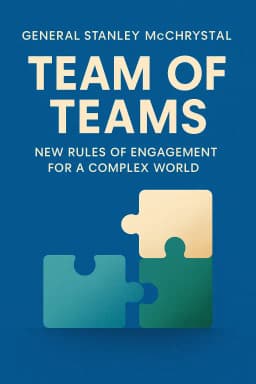
Nova: Absolutely. Today, we're tearing down those old blueprints and rebuilding with insights from two pivotal works: "Team of Teams" by General Stanley McChrystal and "Working Backwards" by Colin Bryar and Bill Carr. Both fundamentally challenge our understanding of organizational design.
Atlas: That's a powerful combination. What’s the thread connecting a military general and Amazon's operational deep dive?
Nova: Well, what's fascinating about McChrystal's book is that it wasn't penned in a boardroom, but forged in the crucible of counter-terrorism operations. It offers a perspective on leadership under extreme pressure that few business books can match. He saw firsthand how traditional hierarchy failed in a fast-moving, unpredictable environment.
Atlas: That makes me wonder, if even the military had to rethink its structure, what does that mean for the rest of us in business?
Nova: Exactly. Today, we’re diving into how to build organizations that are not just efficient, but profoundly resilient, adaptable, and human-centric in a world that demands constant evolution. And to start, we need to talk about the 'blind spot' that most traditional structures carry.
The Blind Spot: Why Traditional Structures Fail
SECTION
Nova: So, the blind spot. It’s this inherent limitation of traditional hierarchical organizational charts. They were designed for a world that was slower, more predictable, where efficiency was king. Think of it like a perfectly tuned, incredibly powerful engine. It runs smoothly, but only if the road is perfectly flat and straight.
Atlas: I can see that. For our listeners managing complex projects, isn't hierarchy supposed to be good for control and clarity? Clear lines of command, knowing exactly who reports to whom. That’s the whole point, right?
Nova: That’s the perceived benefit, yes. But in today's fast-paced, interconnected landscape, that very design creates silos. Information gets trapped, decision-making slows to a crawl, and innovation gets stifled. It fosters a 'culture of compliance' – people just follow orders – instead of a 'culture of contribution' where everyone feels empowered to solve problems.
Atlas: That sounds rough. So basically, the very thing designed to bring order ends up creating chaos and stagnation when things move too fast? I mean, that's actually really profound. I’ve seen critical decisions get stuck in layers of approval, like a game of corporate telephone.
Nova: Exactly! Imagine a critical piece of market intelligence – a competitor moving fast, a sudden shift in customer behavior – bubbling up from a front-line team. In a traditional hierarchy, it has to go up the chain, get translated, approved, then sent back down. By the time a decision is made, the opportunity might be gone, or the threat has already materialized.
Atlas: Oh, I know that feeling. It’s like watching a slow-motion car crash. But how does a leader even begin to untangle that, especially when the instinct is to double down on control when things get chaotic?
Nova: That’s where the insights from McChrystal become revolutionary. He faced an enemy, Al-Qaeda in Iraq, that was incredibly nimble, decentralized, and fast-moving. His highly trained, but traditionally hierarchical, Joint Special Operations Task Force was struggling to keep up. He realized they couldn't out-efficiency a network; they had to become one.
The 'Team of Teams' Revolution: From Efficiency to Adaptability
SECTION
Nova: So, McChrystal realized their perfectly efficient, siloed structure was their Achilles' heel. His solution was radical: transform into a 'Team of Teams.' It wasn't about dismantling hierarchy entirely, but fundamentally changing how information flowed and how decisions were made.
Atlas: Whoa, a 'Team of Teams'? That sounds like a fascinating concept, but what does that actually mean in practice?
Nova: He implemented two core pillars: 'shared consciousness' and 'empowered execution.' Shared consciousness meant breaking down information silos completely. They started holding daily intelligence briefings – not just for commanders, but for hundreds of people across different agencies and ranks. Everyone, from the analyst to the field operative, understood the entire operational picture.
Atlas: Really? Daily intel for hundreds of people? That sounds like an information overload nightmare, and a huge trust leap. I imagine a lot of our listeners would think that's risky for security and efficiency. How did they manage that without things falling apart?
Nova: It was a massive cultural shift. It required immense trust, but it meant everyone understood the 'why' and 'what' of the mission. The second pillar, 'empowered execution,' meant decentralizing decision-making. Instead of waiting for orders from the top, teams on the ground, with their shared understanding, were trusted to make rapid, informed decisions.
Atlas: So it’s like, instead of waiting for the conductor, every musician understands the whole piece and can jump in when needed. That's a great analogy! I can see how that would make them incredibly fast. But then, how do you keep everyone playing the same song, strategically? How do you maintain alignment without rigid control?
Nova: That's the magic. When everyone shares the same understanding of the overarching goal, their individual actions naturally align. It shifts the focus from "doing things right" to "doing the right things". They moved from a predictable, clockwork model to one that was more like a highly coordinated, improvisational jazz band.
Atlas: That’s such a hopeful way to look at it. It implies a much higher level of trust in your people. I mean, to empower teams that much, you really have to believe in their judgment. But how does this translate outside of a high-stakes military context? Like, in a corporate setting, how do you maintain that strategic alignment without having a literal enemy to rally against?
Amazon's Blueprint: Customer Obsession & High-Velocity Mechanisms
SECTION
Nova: That naturally leads us to "Working Backwards" and Amazon's unique approach, which offers a corporate blueprint for balancing autonomy with strategic alignment. Their North Star is famously 'customer obsession.' Every decision, every team, every 'mechanism' they build, is ultimately geared towards serving the customer.
Atlas: Mechanisms? That sounds a bit… mechanical, for building resilient teams. Can you give an example?
Nova: Absolutely. One key concept is the 'single-threaded leader.' This is an individual solely dedicated to one initiative, with clear ownership and the resources to execute it. Imagine the early Kindle development. Instead of a committee, there was one single-threaded leader whose sole job was to make the Kindle a success.
Atlas: Single-threaded leaders? That sounds almost anti-team, like it could create new silos, or burnout for that one person. For our listeners who are talent whisperers, how do you make sure that person isn't just a bottleneck or overwhelmed?
Nova: That’s a fair point. But it's about focused ownership a larger, aligned system, not isolation. It minimizes conflicting priorities and allows for incredible speed. And then, there are the "mechanisms" you asked about. These are repeatable processes that embed their principles into the company's DNA. For example, instead of PowerPoint presentations, they use six-page narrative memos for decision-making.
Atlas: Oh, I’ve heard about those! So everyone reads the memo in silence at the start of a meeting. That’s a mechanism.
Nova: Exactly. It forces clarity of thought, encourages critical thinking, and ensures everyone has the same foundational understanding before discussion begins. It’s a mechanism for high-velocity, high-quality decision-making. These aren't just rules; they're cultural tools that ensure speed, clarity, and customer obsession are baked into how they operate, allowing both autonomy and strategic alignment.
Atlas: Okay, so it's not just throwing people at a problem, it's building a where those people can thrive with clear purpose and less friction. That makes me wonder, how much of this is about the structure itself, and how much is just about the culture you build around it?
Synthesis & Takeaways
SECTION
Nova: It’s absolutely both, Atlas. Both books fundamentally highlight that to build resilient, high-performing teams, you have to move beyond rigid org charts. It’s about fostering shared consciousness, empowering execution, and implementing intentional, customer-obsessed mechanisms. It’s designing for adaptability, not just efficiency.
Atlas: So it's less about the lines on a diagram and more about the flow of information and trust between people. It’s about building a living, breathing network. That’s actually really inspiring for anyone trying to build sustainable growth and impact. Instead of trying to control every variable, we need to empower the collective intelligence. What's one thing our listeners can take away and apply right now to start building that kind of team?
Nova: Start by asking: where are the bottlenecks in information flow in your organization? Where can you push decision-making closer to the problem? That act of questioning alone starts to change the culture. McChrystal said it best: 'We had to unlearn a great deal of what we thought we knew.' That's where resilience begins.
Atlas: Unlearning is often the hardest, but most vital step. What a powerful message for building cultures that truly thrive. This is Aibrary. Congratulations on your growth!