Beyond the Org Chart: Building Resilient, High-Performing Teams.
Golden Hook & Introduction
SECTION
Nova: Atlas, I'm going to throw out some words, and I want you to hit me with the first thing that comes to mind. Ready?
Atlas: Hit me.
Nova: Org chart.
Atlas: Bureaucracy.
Nova: Teamwork.
Atlas: Synergy.
Nova: Adaptability.
Atlas: Unicorn.
Nova: Unicorn! That's a perfect segue into today's topic, because for many, true organizational adaptability feels as mythical as a unicorn. We're diving into the core ideas behind "Beyond the Org Chart: Building Resilient, High-Performing Teams." What's fascinating about this isn't that it's a single book, but rather a powerful synthesis of groundbreaking works, bringing together diverse insights to offer a truly unique perspective on how organizations thrive. It challenges our deepest assumptions.
Atlas: Oh, I like that. A synthesis, not just a single voice. So, what's this deep assumption we're about to challenge, this 'blind spot' you mentioned in our notes, that makes adaptability feel mythical?
The Blind Spot: Why Traditional Structures Fail
SECTION
Nova: Well, the blind spot is precisely that ingrained belief that hierarchy equals control and control equals success. We've been conditioned to think that the more layers, the more rules, the more rigid the structure, the more efficient and manageable an organization becomes. But in today's fast-paced world, that's often exactly what holds companies back. It's like trying to win a Formula 1 race in a horse-drawn carriage. The traditional setup, designed for predictability, struggles immensely when the landscape is constantly shifting.
Atlas: Okay, but isn't an org chart essential for clarity? For many of our listeners building cultures, not just companies, it feels like a necessary evil. How does it stifle growth when it's supposed to create order?
Nova: That’s a great question, and it's where the nuance lies. The problem isn't order itself; it's the and of order. Hierarchies, by their very nature, create silos. They slow down information flow because everything has to go up and down the chain. More critically, they disempower the people closest to the problem, the ones who actually have the most real-time information. It assumes perfect knowledge resides at the top, which is rarely, if ever, true in a dynamic environment.
Atlas: So, it's like trying to navigate a real-time battle with only intelligence from last week's briefing? That sounds incredibly frustrating for anyone trying to move quickly, especially if you're trying to build trust and foster human connection within your teams.
Nova: Exactly! It creates a fundamental disconnect. The very structure meant to provide stability ends up creating friction and inertia. You're building cultures, yes, but if that culture is choked by bureaucracy, you're not going to achieve sustainable growth. That frustration you mentioned? It's a symptom of this blind spot, and it sets the stage for why we need to look beyond. It’s about building cultures that empower, not hinder. And this naturally leads us to our first deep dive into a solution: McChrystal's 'Team of Teams' model.
The 'Team of Teams' Paradigm: Shared Consciousness & Empowered Execution
SECTION
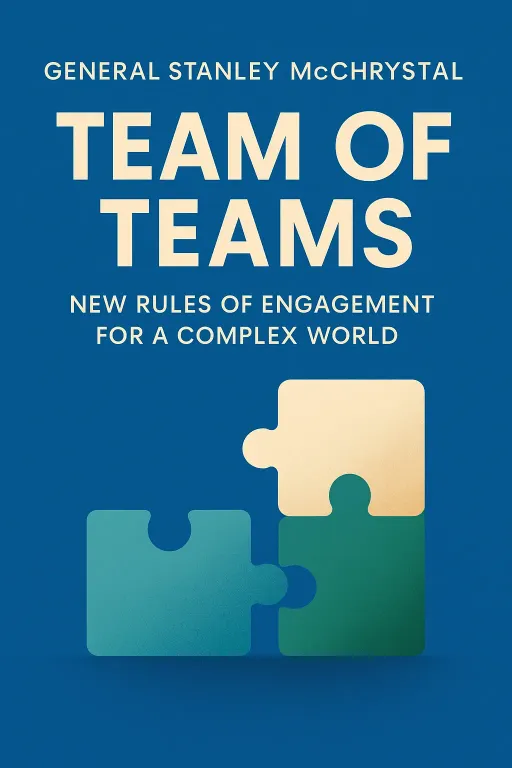
Nova: General Stanley McChrystal, the former commander of the Joint Special Operations Task Force, wrote "Team of Teams" after realizing his highly efficient, hierarchical military unit was actually against a decentralized, agile enemy like Al-Qaeda in Iraq. Think about that: the ultimate command-and-control organization was too slow.
Atlas: Whoa, a military organization, often seen as the ultimate hierarchy, admitting it was too slow? That's a powerful counter-example to the 'control equals order' mindset. I imagine a lot of our listeners, especially those in high-stakes environments, are thinking, 'If they struggled, what hope do I have?'
Nova: That's the exact insight. They realized their problem wasn't a lack of smart people or resources, but a lack of. Their traditional structure, optimized for predictable threats, was crumbling against an unpredictable one. The cause was too many layers, slow decisions, and units that, while individually excellent, operated in silos, unaware of the bigger picture playing out in real time.
Atlas: But how did they fix that? How does 'shared consciousness' actually work in practice? Is it just endless meetings, or something more profound?
Nova: It’s far more profound. It's about radical transparency and deliberate information sharing across units. They instituted daily "Operations and Intelligence" briefings that were open to hundreds of people across the globe, from analysts to special operators. Everyone understood the broader mission and the context, even if it wasn't directly their specific task. It fostered a sense of collective ownership and understanding that transcended individual unit goals.
Atlas: So, it's about trusting your people to make the right calls because they're fully informed and aligned with the larger goal? That sounds like a dream for anyone trying to empower their teams, but also a huge leap of faith for leaders who are used to micromanaging, or who feel they need to control every detail.
Nova: It absolutely is a leap of faith, but it's a necessary one. This radical transparency creates what McChrystal calls "shared consciousness." And from that shared consciousness comes "empowered execution." It means giving teams the autonomy to make decisions based on that shared understanding, rather than waiting for top-down orders. You move from efficiency to adaptability, which is crucial for sustainable growth. It's about building trust, truly hearing your team, and letting them act. And speaking of adaptable, high-performing organizations, let's pivot to Amazon's principles, which offer another fascinating take on this.
Amazon's Operating Principles: Customer Obsession & Single-Threaded Leaders
SECTION
Nova: Our next deep dive comes from "Working Backwards" by Colin Bryar and Bill Carr, two Amazon veterans. They pull back the curtain on Amazon's unique operating principles, and at the heart of it all is relentless customer obsession. That's their North Star.
Atlas: Customer obsession. That sounds simple enough, but I imagine it's executed in ways that are anything but. For someone driven by impact and sustainable growth, how does that translate into organizational design?
Nova: It translates into designing mechanisms that force that obsession into every decision. One of the most powerful mechanisms is the concept of the 'single-threaded leader.' Imagine an individual who is given full authority and responsibility for a specific product or initiative, with a dedicated team, completely free from competing priorities. They are 'single-threaded' because their focus is singular.
Atlas: A single-threaded leader... so it's like a mini-CEO for a specific project? For those trying to refine data-driven decisions and scale with intention, this sounds incredibly powerful for focus. But does it create new silos or power struggles if not managed carefully, especially in a large organization?
Nova: That's a valid concern, and it's why it's paired with Amazon's other mechanisms, like the "narrative memo" instead of PowerPoint, forcing clarity of thought and deep analysis before any decision is made. The single-threaded leader isn't just about giving someone power; it's about cutting through bureaucracy and empowering a single individual to move fast, make decisions, and be accountable. It's within a culture that is relentlessly customer-obsessed and data-driven. It's about designing for speed and accountability, ensuring that every decision serves the customer.
Atlas: It sounds like they're building an organizational immune system against complexity, where each 'single thread' is an agile antibody, constantly innovating and adapting. This really challenges the idea that more layers equal more control. It's about distributed intelligence and empowering those closest to the problem, isn't it?
Nova: Precisely. It's about designing for agility, not just efficiency. It builds on that shared purpose we saw in 'Team of Teams', but with specific, almost surgical mechanisms for scale and innovation. It allows them to experiment with precision, another key for our listeners.
Synthesis & Takeaways
SECTION
Nova: So, bringing all this together, we've seen how the 'blind spot' of traditional hierarchy can stifle adaptability, how McChrystal's 'Team of Teams' showed us the power of shared consciousness and empowered execution, and how Amazon leverages 'single-threaded leaders' for rapid, customer-obsessed innovation.
Atlas: So, it's about shifting from an organization that to change, to one that's to adapt and even change. For a leader looking to build resilient, high-performing teams, this isn't just theory; it's a fundamental mindset shift about trust and distributed intelligence. It's trusting your intuition and combining it with data, as our listener profile suggests.
Nova: Exactly. The deep question we started with was: How can you empower your teams with greater autonomy and shared understanding, while still maintaining strategic alignment across your organization? The answer lies in these models that prioritize adaptability and shared purpose over rigid control. It's a journey from command-and-control to trust-and-transparency, where active listening and truly hearing your team become paramount.
Atlas: That's actually really inspiring. It feels like a pathway to truly sustainable growth, not just for the company, but for the people within it. It's about building trust, truly hearing your team, and experimenting with precision. What a powerful set of insights to take away.
Nova: It is. And it's a reminder that the best structures are those that evolve with the world around them, allowing human potential to flourish.
Nova: This is Aibrary. Congratulations on your growth!