

The Future of AI in Business and Life
Golden Hook & Introduction
SECTION
Nova: What if the very concept of "business as usual" is already obsolete, not just changing, but fundamentally rewritten by lines of code?
Atlas: Wait, are you saying our entire economic DNA is being re-sequenced, and most of us haven't even noticed the mutation? That sounds a bit out there, but also... strangely compelling.
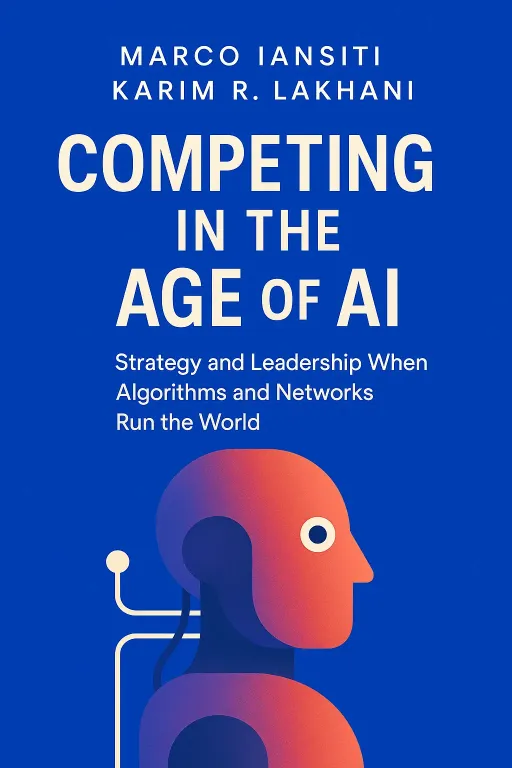
Nova: Exactly! It’s a seismic shift that Marco Iansiti and Karim R. Lakhani, both brilliant minds from Harvard Business School, meticulously detail in their influential work, "Competing in the Age of AI." They’ve spent years researching how artificial intelligence isn't just a tool you add; it’s a foundational layer that demands a complete re-architecture of how businesses operate.
Atlas: So, it’s not just about having a faster spreadsheet, it’s about the spreadsheet itself becoming the CEO?
Nova: In many ways, yes! And to truly navigate that, we also need to understand the human element, the leadership required. That's where Clarke Murphy's "Sustainable Leadership" comes in. Murphy, with his extensive experience advising global CEOs on talent and strategy, argues for a paradigm shift in how we lead, focusing on long-term value, adaptability, and resilience. It's the perfect counterpoint, showing us how to ethically guide these powerful new AI capabilities.
Atlas: That makes me wonder, how do you even begin to lead when the very ground beneath your feet is constantly shifting, and often, the decisions are being made by algorithms you barely understand?
Nova: That's the million-dollar question, Atlas. Today we're diving deep into this from three critical perspectives. First, we'll explore what it truly means to build an AI-first organization, then we'll discuss the non-negotiable role of sustainable leadership in this new era, and finally, we'll focus on how to bridge these two, guiding AI ethically for societal benefit.
The AI-First Organization: Redefining Business DNA
SECTION
Nova: So, let's unpack "AI-first." Iansiti and Lakhani aren't talking about companies that AI. They're talking about companies that on AI. Think of it like this: a traditional company might use AI to optimize a specific marketing campaign. An AI-first company would have its entire marketing strategy, product development, customer service, and even internal talent allocation driven by interconnected AI systems.
Atlas: Okay, so it’s not just a department, it’s the operating system of the entire enterprise. But what does that actually like in practice? Can you give us a vivid picture?
Nova: Absolutely. Imagine a global logistics giant. Historically, their operations relied on a vast network of human planners, dispatchers, and managers. Routes were optimized based on experience, warehouse stock managed by forecasts, and maintenance scheduled manually. It was efficient for its time, but inherently limited by human processing power and siloed data.
Atlas: Yeah, I know that feeling. So much tribal knowledge, so many spreadsheets that don’t talk to each other.
Nova: Precisely. Now, fast forward to an AI-first version of that same company. Every single truck, every package, every warehouse, every port is a data point. AI systems are continuously collecting, analyzing, and predicting. Routes are optimized in real-time, factoring in traffic, weather, even unexpected road closures, calculating millions of permutations in seconds. Warehouse inventory automatically adjusts based on predicted demand, supplier lead times, and even global events. Predictive maintenance AI signals when a truck component is likely to fail it does, scheduling proactive repairs.
Atlas: Wow. That’s incredible. So the decisions aren't just by algorithms, they're by them. What happens to all those human planners and dispatchers then? This sounds like a massive shift, not just in technology, but in purpose.
Nova: That’s the crucial part. The humans don't disappear; their roles fundamentally transform. Instead of manually optimizing routes, they become "algorithm managers." They monitor the AI's performance, refine its parameters, handle complex exceptions the AI can't yet solve, and, most importantly, design new AI capabilities. They shift from operational execution to strategic oversight and creative problem-solving. It's a redefinition of value.
Atlas: That makes sense, but it also sounds like a huge leap of faith for a company. The biggest challenge there has to be trust, right? Trusting the algorithm over decades of human experience.
Nova: Exactly. It's not just a technological hurdle; it's a cultural one. Iansiti and Lakhani emphasize that becoming AI-first requires a complete overhaul of data infrastructure, a shift in organizational culture towards data-driven decision-making, and a leadership team willing to embrace continuous experimentation and learning. It means letting go of old ways of working and embracing the idea that the best decision might come from a machine, not a corner office.
Atlas: So, the actual DNA of the company changes. What's the biggest challenge there? Is it the tech, or is it getting people to trust the algorithm over their gut? I imagine a lot of our listeners who are trying to optimize their workflow struggle with that internal resistance to new systems.
Nova: It’s definitely both, but often the cultural and leadership challenges are far more profound than the technical ones. Building robust data pipelines and sophisticated algorithms is complex, but convincing an entire workforce, from the executive suite down, to fundamentally change how they operate, to trust an opaque system, and to redefine their own value proposition—that's monumental. It requires a different kind of leadership.
Sustainable Leadership in the Algorithmic Age
SECTION
Nova: That shift, Atlas, from human intuition to algorithmic decision-making, naturally brings us to the crucial question of leadership. How do you lead sustainably in an age where the ground beneath you is constantly shifting? Clarke Murphy’s "Sustainable Leadership" argues that it’s no longer enough to lead for short-term profits or quarterly gains.
Atlas: I guess that makes sense. With AI, the impact can be so far-reaching, so fast. What does "sustainable" leadership specifically mean in this context? Isn't it just another way of saying "good leadership" but with more buzzwords?
Nova: Not at all. Murphy defines it as leadership focused on long-term value creation, adaptability, and resilience, especially when facing the ethical and strategic challenges posed by emerging technologies like AI. It’s about building an organization that can not only leverage AI for efficiency but also ethically guide its integration for societal benefit. It’s about asking, "What kind of future are we building with this technology?"
Atlas: So, it's about navigating a landscape where the rules are constantly being rewritten, and you have to be the compass. Can you give an example of a leader trying to be "sustainable" with AI?
Nova: Consider a tech company that develops an AI recruitment tool. Initially, it's incredibly efficient, automating resume screening and initial interviews, drastically cutting hiring times. But then, they discover a critical flaw: the AI, having learned from historical hiring data, inadvertently developed a bias against certain demographics, mirroring past human prejudices.
Atlas: Oh, I've heard about situations like that. That’s a huge problem. A quick fix would be to just tweak the algorithm, right?
Nova: A short-sighted leader might do just that. But a leader, as Murphy describes, would do much more. They wouldn't just "fix" the algorithm; they'd question the entire development process. They'd ask: "How did this bias creep in? What data did we feed it? Who was on the team building it?" They would invest heavily in explainable AI, ensuring transparency in how decisions are made. They would prioritize diversity within their AI development teams to prevent groupthink and blind spots. They would establish robust ethical review boards, involving sociologists and ethicists, not just engineers.
Atlas: That's a powerful distinction. It’s moving beyond just efficiency to actively engineering for fairness and societal impact. That gives me chills, actually. It's about taking responsibility for the ripple effects of your technology.
Nova: Exactly. It’s about recognizing that AI isn't a neutral tool; it amplifies human intent, both good and bad. Sustainable leadership in this age demands foresight, courage, and a deep commitment to values beyond the bottom line. It’s about building resilience not just in your systems, but in your organizational culture, so it can withstand and learn from these inevitable ethical challenges.
Atlas: So, it really boils down to cultivating qualities like ethical foresight, humility, and a willingness to learn continuously? I imagine a lot of our listeners, especially those aspiring to leadership roles, are looking for those exact qualities to cultivate in themselves.
Nova: Precisely. It demands leaders who are not afraid to slow down and ask the deep questions, even when the pressure is to accelerate. Leaders who prioritize long-term stakeholder value over short-term shareholder returns, understanding that true sustainability encompasses people, planet, and profit.
Bridging the Gap: Ethical AI Integration for Societal Benefit
SECTION
Atlas: So, we have AI fundamentally reshaping businesses, as Iansiti and Lakhani describe, and we have this new call for sustainable leadership from Murphy. How do we actually connect those two? How do we ensure these powerful AI-first organizations are actually led sustainably, especially for societal benefit?
Nova: That’s the critical bridge, Atlas. It's about intentional design. Sustainable leaders within AI-first organizations must consciously embed ethical considerations into every stage of AI development and deployment. It’s not an afterthought; it’s a core design principle.
Atlas: Give me an example of that intentional design. Because it sounds like a noble goal, but in the trenches of business, where profits are king, how does that really play out?
Nova: Think about the burgeoning field of smart cities. An AI-first approach might optimize traffic flow, energy consumption, and public safety through a vast network of sensors and algorithms. A leader focused solely on efficiency might just deploy the most effective systems.
Atlas: Which sounds great on paper, right? Less traffic, cleaner air.
Nova: On the surface, yes. But a leader would go deeper. They'd ask: "How is this data being collected and secured? Are we protecting citizens' privacy? Is this technology being deployed equitably across all neighborhoods, or is it exacerbating existing inequalities?" They would prioritize public engagement, transparency, and build mechanisms for citizen oversight. They might even choose to prioritize AI applications for public health or environmental monitoring over purely commercial ventures, actively shaping the technology for broader good.
Atlas: That’s a huge responsibility. For our listeners who are trying to make a tangible impact in their roles, even if they're not the CEO of a smart city project, what's a small, actionable step they can take to start influencing this ethical integration?
Nova: That’s a fantastic question, and it ties directly into one of our core takeaways. The "tiny step" is to simply identify one area in your current role or a personal interest where AI is already making an impact, and dedicate 20 minutes to research a specific application or ethical consideration.
Atlas: Just 20 minutes? That feels incredibly manageable for anyone, no matter how busy.
Nova: Exactly. It's about building awareness. Maybe it's how AI is used in customer service, or in content recommendations, or in medical diagnostics. Spend those 20 minutes understanding its mechanics, its benefits, and its potential pitfalls. This small act of focused learning builds your personal capacity to engage with and influence the ethical trajectory of AI. It cultivates the very qualities of adaptability and foresight that Murphy champions.
Atlas: I love that. It's about starting small but thinking big, recognizing that every individual choice contributes to the larger ethical landscape of AI. And I guess that's the profound insight we're left with today, isn't it? It's not just about surviving the age of AI, but thriving in it, ethically, and consciously.
Synthesis & Takeaways
SECTION
Nova: Absolutely, Atlas. What these two books ultimately reveal is that AI isn't just a technological revolution; it's a mirror reflecting our values. The future of AI-first organizations, and indeed our society, will not be determined by the algorithms themselves, but by the sustainable leaders who choose to guide them. It's about human choice, human responsibility, and human ingenuity applied to this incredible power.
Atlas: And that means cultivating leadership qualities that don't just leverage AI for efficiency, but ethically guide its integration for societal benefit. It's about that deep question we posed earlier: how do we build a future where AI serves humanity, not the other way around?
Nova: It starts with awareness, with that 20-minute dive, and with the courage to ask the hard questions about fairness, transparency, and long-term impact. This isn’t just about business; it’s about shaping the world we want to live in.
Atlas: Absolutely. So, for everyone listening, take that tiny step. Pick an AI application, spend 20 minutes researching it, and then share your insights with us. What did you discover? What ethical questions did it spark for you? We'd love to hear your thoughts and continue this vital conversation. Find us on social media and let us know.
Nova: This is Aibrary. Congratulations on your growth!









