Unlocking Potential: How to Motivate Beyond Incentives.
Golden Hook & Introduction
SECTION
Nova: We've all been told that if you want people to do more, you just offer them a bigger carrot, right? More money, better bonus, shiny new title. That's the conventional wisdom.
Atlas: Right, it's practically etched into every management textbook. "Incentivize, motivate, achieve." It feels like basic human nature, doesn't it? Like, who work harder for more reward?
Nova: Exactly! But what if that conventional wisdom is not just wrong, but actively to performance, especially for the kind of complex, creative work that defines our modern world?
Atlas: Harmful? That's a bold claim. My initial thought is, how could that possibly be true? I mean, we're talking about fundamental psychology here.
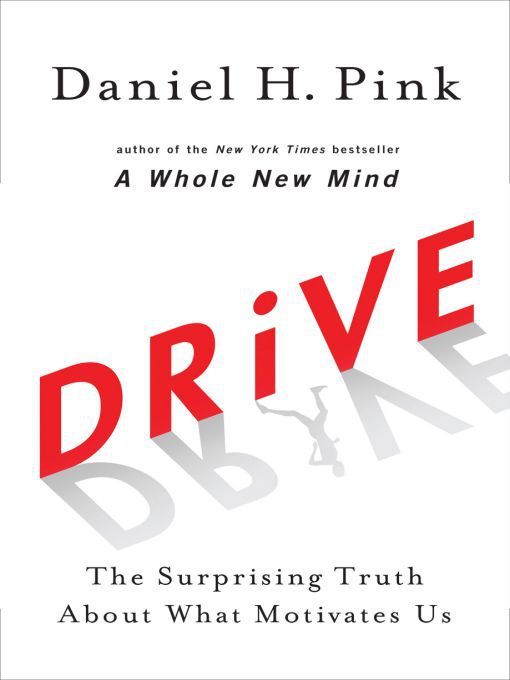
Nova: Well, prepare for a fascinating paradigm shift, because today, we're tearing down that assumption and rebuilding our understanding of motivation with insights from Daniel H. Pink's groundbreaking book, "Drive: The Surprising Truth About What Motivates Us." Pink, who had a fascinating career shift from being a speechwriter and business analyst to deeply exploring the behavioral science behind human performance, brings a truly unique and research-backed lens to this topic.
Atlas: That's interesting, a shift like that usually means he's unearthed something counterintuitive. I'm already intrigued. So, you're saying the very mechanisms we use to motivate people might actually be holding them back?
Nova: Precisely. And it's not just about getting less, it's about actively performance and engagement when the task isn't purely mechanical.
The Counterintuitive Flaw of External Incentives
SECTION
Nova: Let's start with what Pink calls "The Cold Fact." For many 21st-century tasks—things that require creativity, problem-solving, and conceptual thinking, like educating students, designing software, or strategizing for a non-profit—traditional external motivators often backfire.
Atlas: Backfire? That sounds completely illogical. Why would a reward for good work ever make someone do work?
Nova: It's a fantastic question, and the answer lies in some classic behavioral science experiments. One of the most famous is called "the candle problem," originally devised by psychologist Karl Duncker in the 1940s and later replicated by Sam Glucksberg at Princeton.
Atlas: Okay, I'm already picturing a flickering candle. Tell me more.
Nova: Imagine this: You're in a room, given a candle, a box of thumbtacks, and a book of matches. Your challenge is to attach the lit candle to the wall so it doesn't drip wax onto the table below.
Atlas: Hmm, okay. My first thought is... melt the side of the candle and stick it? No, that won't hold. Thumbtacks... maybe tack the candle itself to the wall? That won't work.
Nova: Exactly the kind of initial thinking. The trick is to realize that the box of thumbtacks isn't just a container; it can also be used as a platform. You empty the thumbtacks, tack the empty box to the wall, and then place the candle on it. It requires a cognitive leap, thinking outside the box, literally.
Atlas: Oh, I see! That's clever. It's a classic insight problem.
Nova: Now, here's where Glucksberg's replication comes in. He took two groups. One group was told they were being timed to establish norms. The other group was offered a substantial financial reward: if they were among the fastest 25%, they'd get $5, and if they were the single fastest, they'd get $20.
Atlas: So, the incentivized group should have crushed it, right? More money, more motivation, faster solutions.
Nova: That's what most people predict. But the results were astonishing. The group offered the cash reward took, on average, to solve the problem than the non-incentivized group.
Atlas: Whoa. Seriously? So, the extrinsic motivator, the money, actually their ability to solve the problem. That's genuinely counterintuitive.
Nova: It is. The theory is that the financial incentive narrowed their focus, making them concentrate intensely on the obvious components—the candle, the tacks, the matches—and less likely to see the box as a separate functional object. It dampened their creative, divergent thinking.
Atlas: This is huge for anyone in a leadership position, especially in complex educational systems, where we're constantly asking for innovative solutions to big problems. If we're pushing for those solutions with bonuses or performance metrics alone, we could be actively squashing the very creativity we need.
Nova: Precisely. For simple, mechanical tasks, where there's a clear path and a single right answer, external rewards work perfectly. But for anything requiring conceptual thinking, ingenuity, or problem-solving, they can be a detriment. People need more than just a paycheck; they need purpose.
Unlocking True Drive: Autonomy, Mastery, and Purpose
SECTION
Atlas: So, if the carrot-and-stick approach is, for lack of a better term, broken for complex work, what actually work? What truly drives people to excel, especially in environments where we're trying to unlock potential, like a classroom or an innovative team?
Nova: That's the million-dollar question, and it brings us to Pink's core argument. For 21st-century tasks, intrinsic motivators are far more powerful. He identifies three core drivers: Autonomy, Mastery, and Purpose.
Atlas: Okay, break those down for me. Autonomy sounds like self-direction, but how does that translate into a productive work environment without chaos?
Nova: Autonomy is the desire to direct our own lives. It's about having control over what we do, when we do it, how we do it, and even with whom we do it. Think about "Results-Only Work Environments," or ROWE, where employees have total control over their time and methods, as long as the work gets done. Studies show these environments often lead to increased productivity, higher job satisfaction, and lower turnover.
Atlas: That's a radical idea for many traditional organizations. But from an architect's perspective, I can see how designing for autonomy could foster real ownership. For example, in an educational setting, could a principal grant teachers more autonomy in designing their curriculum units, or choosing their pedagogical methods, rather than strictly dictating every step?
Nova: Absolutely. That's a perfect example. Instead of micromanaging, you're empowering. Next, we have Mastery: the urge to get better at something that matters. This is about continuous improvement, the deep satisfaction that comes from genuinely getting skilled at something challenging. Think of open-source software developers. They dedicate thousands of hours, often for no pay, simply because they love the craft and the challenge of getting better.
Atlas: That resonates. It's not just about getting an A on a test, then, but genuinely enjoying the process of learning, of grappling with a complex subject, and feeling that personal growth. So, for students, it's fostering that intrinsic curiosity and the joy of competence, not just rote memorization for a grade.
Nova: Exactly. The pursuit of mastery itself is inherently motivating, not dependent on external validation. It's about the "flow state" Mihaly Csikszentmihalyi described, where you're so absorbed in a challenging task that time seems to disappear. Finally, and perhaps most profoundly, there's Purpose: the yearning to do what we do in service of something larger than ourselves. This is where Simon Sinek's "Start With Why" beautifully converges with Pink's work.
Atlas: Ah, Sinek. His concept of communicating from the inside out, starting with your 'why,' rather than the 'what.' This makes so much sense for human flourishing.
Nova: It does. Sinek emphasizes that truly inspiring leaders and organizations communicate their deep sense of purpose first. This 'why' resonates with people on an emotional level and fosters loyalty and drive that far transcends what any incentive can achieve. Think of mission-driven non-profits, or companies with a clear social or environmental impact. People don't just work there for a paycheck; they work there because they believe in the cause.
Atlas: So, for leaders, especially in fields like education, which inherently have a huge 'why,' it's about constantly articulating that purpose, making it tangible, and connecting daily tasks back to that larger vision. It's about inspiring teachers and students with they're learning this, or they're striving for excellence, rather than just telling them to do.
Nova: Exactly. When these three elements—autonomy, mastery, and purpose—are present, they create an incredibly powerful motivational ecosystem. You're not just designing a job; you're designing an environment where individuals naturally thrive and contribute their best, because their deepest human needs are being met.
Synthesis & Takeaways
SECTION
Nova: So, what we've really been talking about today is a profound shift in perspective. It's understanding that while external rewards have their place for simple, algorithmic tasks, for anything complex, creative, or knowledge-based, they're not just inefficient, they can be counterproductive.
Atlas: This is more than just a management hack; it's a fundamental re-evaluation of how we structure our organizations and even our lives. For someone trying to refine leadership in complex educational systems, it means moving from a paradigm of control to one of cultivation. It means trusting people to direct their own work, fostering their innate desire to get better, and continually connecting them to the larger, inspiring mission.
Nova: It's about designing workplaces and learning environments that tap into our inherent human drive, rather than trying to bribe or coerce it. Knowing this allows you to create spaces where not just potential, but true human flourishing, can genuinely take root.
Atlas: That's actually really inspiring. It puts the responsibility back on leaders to create those conditions, rather than just dangling another carrot.
Nova: Absolutely. And that leads us to our Tiny Step for this week. We challenge you to identify one area in your work—whether it's with your team, your students, or even in your own personal projects—where you can increase autonomy, foster mastery, or clarify purpose. Just one area, next week.
Atlas: That's a concrete, actionable step that can make a real difference. It's about starting small to build something much bigger.
Nova: Precisely. Thanks for joining us on this deep dive into what truly motivates us.
Atlas: Always a pleasure, Nova.
Nova: This is Aibrary. Congratulations on your growth!