

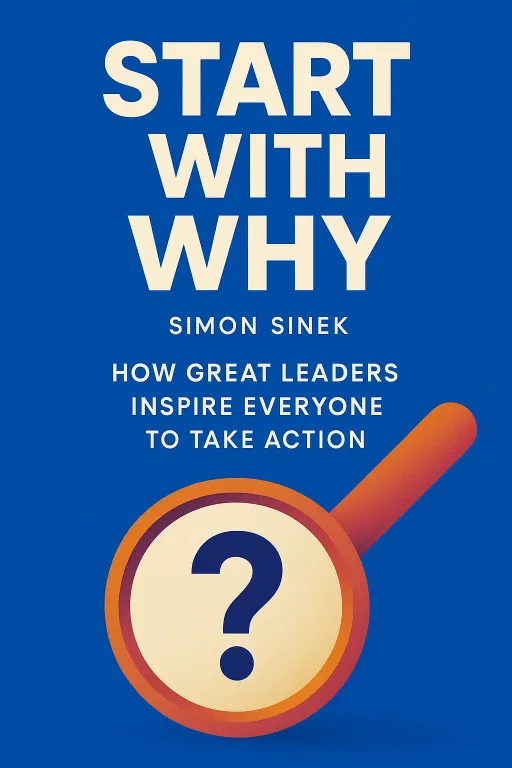
Unleash Your Team's Genius: The Power of Purpose-Driven Leadership
Golden Hook & Introduction
SECTION
Nova: What if the most important thing you're focusing on as a leader is actually holding your team back? We're often taught to obsess over the 'what' and 'how' of our businesses, the deliverables, the quarterly reports, but true, lasting impact might just begin with a single, much simpler question.
Atlas: Oh really? That sounds almost counterintuitive in a world obsessed with metrics and output. Are you saying all my strategic plans might be built on shaky ground?
Nova: Not shaky, Atlas, just perhaps incomplete. Today, we’re diving into the profound insights of Simon Sinek, specifically from his foundational works, "Start with Why" and "Leaders Eat Last." What’s fascinating about Sinek is he’s not just a theorist; he’s an ethnographer. He spent years observing and studying patterns in human behavior within organizations, looking at some companies and leaders thrive with fierce loyalty while others, despite having great products, just... exist.
Atlas: That’s a powerful approach. It speaks to that desire to uncover foundational truths, to understand the 'why' behind success, not just the superficial 'what.' For our listeners who are deeply analytical and aiming to build something truly significant, that kind of insight is gold.
Nova: Absolutely. And that's what we’re exploring today. We’ll first unpack the magnetic power of starting with your 'why'—that core purpose that transcends products or services. Then, we’ll dive into how that 'why' is nurtured and protected by creating what Sinek calls a 'Circle of Safety' within your organization.
The Magnetic Power of 'Why'
SECTION
Nova: So, let’s start with the big one: the 'why.' Sinek introduces this brilliant concept called the Golden Circle. Imagine three concentric circles: the outermost is 'What,' the middle is 'How,' and the innermost, the very core, is 'Why.' Most organizations, most leaders, they start with the 'What.' What do we sell? What do we do? Then maybe they get to the 'How,' how do we do it differently? But very few ever articulate their 'Why.'
Atlas: I can definitely relate to that. When you're trying to launch a new product or build a new team, the immediate pressure is always on the 'what' – what's the feature set, what's the market demand? For our listeners who are builders, that 'what' is their tangible reality.
Nova: Exactly! And that’s where the disconnect happens. Sinek argues that truly inspiring leaders and organizations communicate from the inside out: they start with 'Why.' People don't buy you do; they buy you do it. Think of it like a lighthouse, Atlas. Most companies are like fishing boats, frantically trying to catch fish, focused on the 'what' and 'how' of their nets. But a purpose-driven leader is a lighthouse, shining a clear, unwavering 'why' that attracts the right ships, the right people, and the right opportunities through sheer magnetic pull.
Atlas: That’s a great analogy. So, it’s not just about selling a product, it's about selling a belief. But how does that actually manifest? For someone building a product in a competitive market, isn't the 'what' the most tangible thing to differentiate? How do you even your 'why' when you're so focused on the next quarter's deliverables?
Nova: It’s a profound shift in perspective. Think about Apple. For years, their competitors like Dell or HP would tell you they made: "We make great computers with these specs and these features." And they were fine. But Apple started with their 'why': "Everything we do, we believe in challenging the status quo. We believe in thinking differently." do they do that? By making products beautifully designed and simple to use. do they make? Computers, phones, tablets.
Atlas: Right. And you see the difference. People don't just Apple products; they become part of a tribe. They line up for hours. It’s almost a religious experience for some.
Nova: Precisely! Apple didn't just sell computers; they sold a philosophy, an identity. Their 'why' created a fiercely loyal community, not just customers. They attracted people who believed what they believed. That's the magnetic power. And it means your 'why' doesn't have to be some grand, world-changing statement. It can be deeply personal and specific to your team's unique impact. For instance, a small software company might have a 'why' of "empowering small businesses to compete with giants," and every line of code, every customer interaction, stems from that.
Atlas: I see. So, it's about defining the purpose that fuels the entire endeavor, making it intrinsically motivating. That makes me wonder, once you have that powerful 'why,' how do you protect it? How do you ensure it permeates the entire organization, especially for our listeners who are aiming to build high-performance cultures?
Building the 'Circle of Safety'
SECTION
Nova: That’s the perfect segue, Atlas. Once you have that magnetic 'why,' the next crucial challenge is to protect it, to nurture it within your team. And that's where Sinek's concept of the 'Circle of Safety' comes in. Inside this circle, employees feel safe from internal threats – things like management politics, job insecurity, or fear of making mistakes.
Atlas: So, it's about psychological safety, essentially. Allowing people to be vulnerable without fear of reprisal. That sounds like a dream for many who've worked in environments where fear is a primary motivator. But in a world that often rewards ruthless competition and individual performance, how do you convince leaders to prioritize 'safety' over what some might call 'hard results'?
Nova: It’s about understanding that true, sustainable results come safety, not in spite of it. When people feel safe within their organization, they naturally extend their energy and creativity outwards to confront external threats – the competition, market changes, innovation challenges. If they’re constantly looking over their shoulder, afraid of their own leadership or colleagues, all that energy is wasted on self-preservation. It’s like a tribe. If the members are worried about being attacked by their own chief, they can’t possibly focus on the saber-toothed tiger outside the camp.
Atlas: That’s a vivid image. So, the leader’s role shifts from merely directing tasks to actively creating and maintaining that safety. Can you give an example of a company that truly embodies this? Because for many strategists, it’s about practical implementation.
Nova: Absolutely. Take Southwest Airlines, for instance. For decades, they’ve been known for their incredible employee loyalty and customer service. They cultivate a "family" atmosphere. During tough times, instead of layoffs, they've often found creative ways to cut costs, even taking pay cuts themselves, to ensure no one loses their job. This builds immense trust. When employees feel genuinely cared for and safe, they reciprocate with incredible dedication and discretionary effort. They'll go above and beyond, not because of a bonus, but because they feel connected to the 'why' and protected by the 'how.'
Atlas: I can see how that would build a high-performance culture, which is something many of our listeners are striving for – attracting and retaining top talent. But how does a leader, especially a new one, to cultivate that safety? Is it just about being 'nice'?
Nova: Oh, it’s far more than just being 'nice.' It’s about consistent actions. It’s about leading by example, demonstrating vulnerability, and taking genuine responsibility for your team's well-being. It means admitting when you don't have all the answers, asking for help, and creating systems that reward collaboration over cutthroat internal competition. It's not about being soft; it's about being strong enough to protect your people so they can be their best, most innovative selves. It’s about understanding that your 'why' is only as strong as the environment you create to support it.
Synthesis & Takeaways
SECTION
Nova: So, to synthesize these powerful ideas: the 'why' is your organization's beacon, the guiding light that inspires and attracts. And the 'Circle of Safety' is the protected space you build around that beacon, allowing your team to thrive, innovate, and passionately pursue that 'why' without fear.
Atlas: That makes perfect sense. It sounds like truly visionary leadership isn't just about having a grand plan, but about inspiring a shared belief and then creating the conditions for everyone to contribute to that belief without fear. For anyone looking to build something lasting and significant, this shifts the focus from managing tasks to cultivating genuine human potential.
Nova: Exactly. It's a strategic imperative for building resilient, innovative, and deeply engaged teams, especially in today's uncertain world. And here’s a tiny step you can take this week: articulate your team's core 'why' in one concise sentence, and then share it with them. It’s a small act, but it can be the spark of something truly transformative.
Atlas: And that’s how you begin to build that strong foundation. It's not about perfection on day one, it's about embracing that iterative nature of growth, where every step is learning.
Nova: Exactly. That's the mindset for lasting impact. Congratulations on your growth!
Atlas: This is Aibrary. Congratulations on your growth!









