

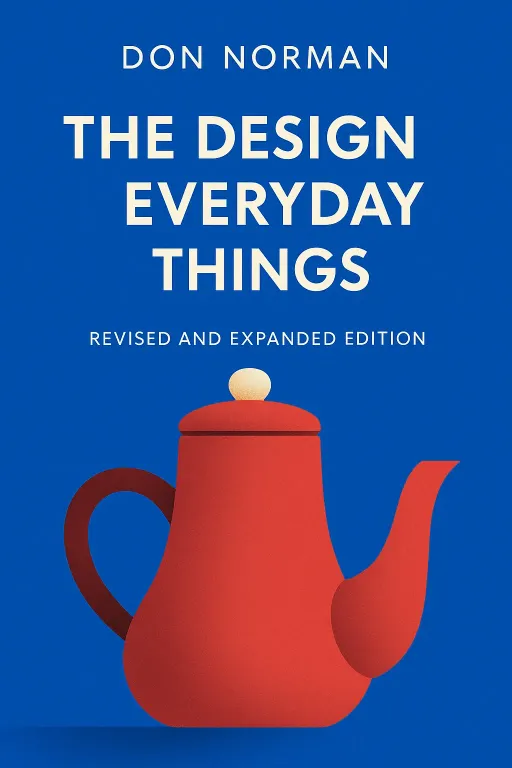
The Overlooked Human Element: Why Empathy is Your Most Powerful Tool in Technology.
Golden Hook & Introduction
SECTION
Nova: Atlas, rapid-fire: "technology!" What's the first thing that comes to mind?
Atlas: Oh man, "endless software updates!" Or maybe the dreaded "spinning beach ball of doom!"
Nova: Exactly! That moment of pure, unadulterated frustration. And that feeling, that universal "ugh" we experience with our tech, is precisely what our discussion today is all about. It’s inspired by the profound insights found in a fantastic synthesis of ideas, an exploration of "The Overlooked Human Element: Why Empathy is Your Most Powerful Tool in Technology."
Atlas: Oh, I love that title. It’s already hitting home. So, it's not just about the lines of code or the shiny new features, but the the tech gives us? That’s already a mind shift.
Nova: Absolutely. And this concept builds on the groundbreaking work of pioneers like Don Norman, a cognitive scientist who fundamentally shifted our understanding of design from mere aesthetics to human experience. And then there's Simon Sinek, who, after his incredibly popular TED Talk, made the concept of starting with "why" a household idea for anyone looking to build purpose-driven work or products.
Atlas: So, we're talking about the psychology behind the gadgets we use every day.
Nova: Precisely. It’s about stripping away the technical jargon and really getting to the heart of what makes technology either a seamless extension of ourselves or a constant source of exasperation. And that brings us to our first deep dive: the idea of invisible design.
The Invisible Design: Anticipating Human Needs
SECTION
Nova: Don Norman, in his seminal work, "The Design of Everyday Things," argues something truly profound: good design is often. You don't notice it because it just. It anticipates your needs, your behaviors, your mental models, making the interaction intuitive and delightful.
Atlas: Okay, but how can something be? Isn't design all about making things look good?
Nova: That's the common misconception, isn't it? But Norman says bad design, on the other hand, is screamingly obvious. It makes you feel incompetent, when in reality, the product itself is poorly designed. Think about the classic "Norman door."
Atlas: A Norman door? Is that like a special kind of door that only Norman can open?
Nova: Not quite! It’s a door whose design gives you no clue whether to push or pull. You walk up to it, you push, it doesn't open. You pull, it doesn’t open. You look around, maybe there's a tiny sign saying "PUSH." You feel a moment of mild embarrassment, maybe a little frustration. You think, "Gosh, I'm so clumsy," or "I'm just not observant."
Atlas: Oh, I know that feeling! Like when you try to use a new coffee machine and you press a button and nothing happens, or it does something completely unexpected. You just stand there feeling utterly foolish.
Nova: Exactly! That feeling of foolishness, that moment of self-blame? That’s 100% the fault of the design. A well-designed door, for example, might have a flat plate on the push side, clearly indicating "push," and a handle on the pull side. You don't even about it; you just act. The design is invisible because it perfectly aligns with your natural actions.
Atlas: So, the goal isn’t to make users feel smart, it’s to make the product so intuitive that the user doesn’t have to at all about how to use it.
Nova: You've got it. It's about designing with – where the object’s physical characteristics suggest its use – and – which are clues that tell you what actions are possible. When you look at a door with a flat plate, it pushing, and the plate where to push. No thought required.
Atlas: That makes so much sense. I’m thinking about all the times I’ve struggled with a remote control that has a hundred tiny buttons, all the same size and color. It's like a puzzle every time I want to change the channel!
Nova: Precisely. A lack of empathy in design leads to those frustrating experiences. The designer got lost in the technical specifications, thinking "more buttons, more features!" without considering the human hand that needs to operate it, the human brain that needs to quickly distinguish between functions. It’s a blind spot.
Atlas: So, it's about anticipating human behavior, even the subconscious stuff. But how does that connect to deeper meaning or purpose?
Starting with the 'Why': Building Resonance and Connection
SECTION
Nova: That’s a perfect segue, Atlas, because while invisible design handles the mechanics of empathy – making things usable – Simon Sinek takes us to the of empathy: understanding the 'why.' In "Start with Why," Sinek argues that most organizations and products communicate from the outside-in: they tell you they do, then they do it, and maybe, as an afterthought,.
Atlas: And we're supposed to flip that? Start with the 'why'? Like, "We believe in empowering individuals, and that's why we make these intuitive devices?"
Nova: Exactly! He suggests that truly inspiring leaders and organizations, and by extension, truly resonant products, communicate from the inside-out. They start with their core belief, their purpose, their 'why.' do they exist? do they do what they do? Only then do they move to the and the.
Atlas: So, it’s not just about selling a smartphone with the fastest processor, it’s about selling a tool that helps you connect with loved ones, capture memories, or unleash your creative potential.
Nova: You’ve hit the nail on the head. Think about a brand like the early Apple. They didn't just sell computers; they sold tools for the "crazy ones," the rebels, the people who wanted to "think different." Their 'why' was to challenge the status quo and empower individuals. That resonated deeply with people on an emotional level, fostering incredible loyalty and a genuine connection that went far beyond mere functionality.
Atlas: I can see that. It's like, instead of just buying a camera, you're buying the ability to preserve your family history, or express your artistic vision. It’s a much deeper connection.
Nova: It is. Because humans don't buy you do; they buy you do it. This human-centric approach helps create products and services that resonate deeply, fostering loyalty and genuine connection. It's empathy at a foundational level, understanding not just what users to do, but what they to be or feel.
Atlas: But wait, isn't that just marketing? Like, putting a nice story around a product?
Nova: That’s a fair question, and it can be misused. But Sinek argues it’s far more profound than just a marketing slogan. It has to be an authentic belief, the guiding principle that informs every decision, from the executive suite down to the individual developer. If your 'why' is truly embedded, it shapes the – your processes, your design philosophy – and ultimately the – the product itself.
Atlas: So, a developer deep in the code, or an engineer designing a circuit board, needs to be constantly asking, "How does this choice reflect our 'why'?"
Nova: Precisely. It’s about ensuring that every technical decision, every feature, every interaction, aligns with that overarching purpose. Because the most successful technology isn't just functional; it's deeply empathetic to the human experience, both in how it works and why it exists.
Synthesis & Takeaways
SECTION
Nova: So, bringing these two powerful ideas together, we see that Don Norman's invisible design gives us the 'how' of empathy – making technology intuitively usable – and Simon Sinek's 'Start with Why' provides the 'purpose' of empathy – creating technology that deeply resonates and connects.
Atlas: It’s like the perfect fusion. One ensures the experience is smooth, and the other ensures the experience is meaningful.
Nova: Exactly. Because what we often overlook in the world of technology, with all its dazzling advancements and complex algorithms, is that fundamental human element. The most powerful tool isn't the latest chip or the most lines of code; it's the profound understanding of human psychology, behavior, and aspiration.
Atlas: That’s actually really inspiring. It makes you realize that every frustrating app, every confusing interface, is a missed opportunity for empathy.
Nova: It is. And the deep question for our listeners today is this: Think about a piece of technology you find consistently frustrating. How might it be different, how might your experience change, if it were designed with a deeper understanding of human psychology, if it truly understood your 'why' and was crafted with invisible empathy? We want to hear your thoughts on that.
Atlas: That’s a powerful challenge. It makes you look at every interaction, every digital touchpoint, differently. It shifts the blame from the user to the creator, and empowers us to demand more.
Nova: It does. Because understanding the human element isn't just good design; it's the foundation of true, impactful innovation. It’s about creating technology that serves us, rather than making us serve it.
Nova: This is Aibrary. Congratulations on your growth!









