The Idea-Action Gap: Bridging Your Thoughts to Tangible Results.
Golden Hook & Introduction
SECTION
Nova: Alright, Atlas, five words. Give me your five-word review of the "idea-action gap" concept.
Atlas: Hmm. Brilliant thoughts, zero actual doing.
Nova: Exactly! And that's what we're tackling today. We're diving into this fascinating chasm between our brilliant ideas and actual, tangible results. And we're doing it with insights from two pivotal thinkers: Allan Dib, with his "1-Page Marketing Plan," and Simon Sinek, who famously urged us to "Start with Why." What’s fascinating about Sinek, actually, is that he wasn't always a leadership guru; he started his career in advertising before an existential crisis led him to question why some organizations thrive and others don't, ultimately leading to his groundbreaking "Golden Circle" idea.
Atlas: Oh, I like that. So it's not just theory; it's born from real-world struggle and curiosity. But Nova, this "idea-action gap," it sounds almost, well, inevitable. Like a law of nature. Is it really?
The Chasm of Ideas: Understanding the Idea-Action Gap
SECTION
Nova: It feels inevitable, doesn't it? That's the cold fact. Our minds are these rich landscapes of possibilities, but the leap from that brilliant concept to a tangible outcome often feels like a vast chasm. It's not a personal failing; it's a deeply human challenge. Think of it like this: your brain is a super-computer generating infinite scenarios, but your body and the real world operate on a single, linear timeline. The disconnect happens when we try to transfer a multi-dimensional vision into a step-by-step reality without a proper translation guide.
Atlas: That makes sense. So it’s not about a lack of good ideas, or even a lack of desire. It’s the translation that’s the problem. For those of us who tend to see connections everywhere, it can be overwhelming.
Nova: Absolutely. I often see people get stuck in what I call "analysis paralysis by perfectionism." They have this grand, perfect vision, and any step that doesn't immediately manifest that perfection feels inadequate. Take the story of "Project Everest." A brilliant entrepreneur had a groundbreaking idea for an eco-tourism venture. He spent months, years even, meticulously planning every detail: the sustainable lodging, the unique local experiences, the marketing angles. He envisioned it perfectly, down to the color of the napkins. But he never launched. The sheer scope of his perfect vision became a paralyzing weight, each detail a potential point of failure if not absolutely flawless. He was so busy perfecting the map, he forgot to take the first step on the journey.
Atlas: Oh man, I've been there. The mental gymnastics of trying to account for every single variable before you even begin. It’s like wanting to build a skyscraper but getting stuck trying to design the perfect doorknob.
Nova: Exactly! The idea-action gap thrives on that kind of visionary paralysis. It's the difference between having an incredible blueprint and actually pouring the concrete. And for many, especially those who love organizing and seeing the big picture, that initial step can feel like walking off a cliff.
Atlas: So it's not just about having a big idea, it's about respecting the process of getting it out of your head and into the world. That's a huge shift in perspective.
Nova: It truly is. It's acknowledging that the journey matters just as much as the destination, and that the first step, no matter how small, is often the most critical.
Blueprint for Action: The Power of Simple Frameworks
SECTION
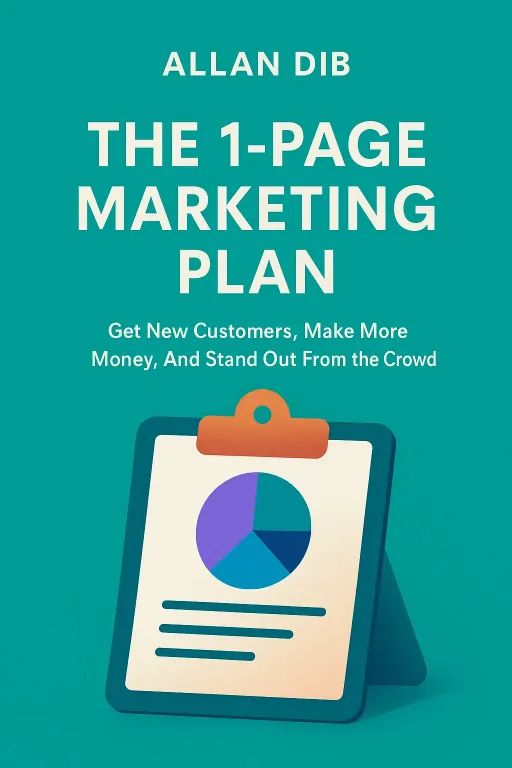
Nova: Which brings us beautifully to our first tactical insight for bridging that chasm: the power of simple frameworks. This is where Allan Dib's "1-Page Marketing Plan" comes in. Dib, a self-proclaimed "rebel marketer," wasn't about complex, academic theories. He was about getting results. His book distills the entire marketing process into nine key squares on a single page. It's deceptively simple, but incredibly powerful.
Atlas: A single page? That sounds almost too good to be true. I mean, for many of our listeners who are navigating career re-entry or exploring new ventures, the idea of simplifying something as complex as marketing could be a huge relief, but also a point of skepticism. How does he manage that?
Nova: That's the genius of it. Dib argues that complexity is the enemy of execution. His framework forces you to break down your grand idea—your "Project Everest"—into manageable, bite-sized steps. It covers "Before," "During," and "After" phases of customer interaction. So, instead of a vague "I need to market my eco-tourism business," it's "Who is my target audience?. What is my unique selling proposition?. How will I reach them?." It's a cascade of clarity.
Atlas: So, it's like a mental pressure-release valve. Instead of the whole mountain, you're just focusing on the next handhold. Can you give me an example of how this applies beyond just marketing?
Nova: Absolutely. Think about a creative project. Let's say you're a writer with a brilliant novel idea. The "1-Page Marketing Plan" can be re-purposed as a "1-Page Project Plan." Instead of "write a novel," it becomes: "My target reader is X. My unique story premise is Y. My first three chapters will cover Z." It forces you to define, distill, and then do. It’s about creating a tangible, visual roadmap. You're not just thinking about the novel; you're outlining the first actionable steps towards its completion. It's the antidote to that 'skyscraper doorknob' paralysis we talked about.
Atlas: That makes so much sense. It feels empowering, actually, to take a huge, nebulous goal and shrink it down to something you can literally see on one page. It legitimizes the small steps, which for someone who values inner wisdom and authenticity, can feel more grounded than just chasing a grand, abstract vision.
Nova: It’s about taking that overwhelming vision and giving it a practical, grounded form. This isn't about limiting your ambition, but channeling it effectively.
Purpose-Driven Execution: Igniting Action with 'Why'
SECTION
Nova: Exactly. And that leads us to our final, and perhaps most profound, insight for bridging the idea-action gap: understanding your 'why.' This is Simon Sinek's groundbreaking contribution. He doesn't just say 'start with why'; he demonstrates that people don't buy what you do, they buy why you do it. This applies equally to your own projects.
Atlas: Okay, so we've got the 'how' with Dib's plan. Now we're talking about the 'why.' For someone driven by meaning, this really resonates. But sometimes our 'why' can feel a bit intangible or even cheesy. How do you make that concrete enough to actually inspire action?
Nova: That's the magic. Sinek's "Golden Circle" framework—Why, How, What—is a powerful tool. Most people start with 'What' they do, then maybe 'How' they do it. But truly inspiring leaders and projects start from the inside out: 'Why' they do it. Their purpose, cause, or belief. Think of Apple. They don't just say, 'We make great computers.' Their 'why' is 'Challenging the status quo and thinking differently.' The 'how' is beautifully designed, user-friendly products. The 'what' is computers, phones, etc.
Nova: Consider a non-profit organization focused on environmental conservation. Many might start with 'What: We plant trees.' But if they start with 'Why: We believe in a future where nature thrives and communities are resilient,' then the 'how' becomes 'mobilizing volunteers, educating the public, advocating for policy changes,' and the 'what' includes tree planting, but also so much more. Their 'why' isn't just a mission statement; it's the emotional core that ignites their team and inspires donors.
Atlas: That’s actually really inspiring. It’s the difference between a task and a calling. It makes the small, sometimes tedious steps of a '1-Page Plan' feel connected to something much bigger. It's not just about planting a tree; it's about building a resilient future.
Nova: Precisely. It transforms mundane tasks into meaningful contributions. When your 'why' is clear, it provides an internal compass, an emotional fuel that helps you push through the inevitable challenges of turning an idea into reality. It ensures your projects aren't just launched, but are infused with purpose and meaning.
Atlas: So it’s about aligning your actions with your deepest values. That has to make the work feel less like a chore and more like a path.
Synthesis & Takeaways
SECTION
Nova: So, Atlas, we've talked about the challenge of the idea-action gap, the tactical frameworks from Allan Dib to break it down, and the profound power of Simon Sinek's 'why' to give it meaning. What's your big takeaway for our listeners today?
Atlas: My big takeaway is that bridging this gap isn't about working harder, but working smarter and with more intention. It's about respecting the complexity of our ideas, but then having the courage to simplify them into actionable steps, all while anchoring them to a 'why' that truly matters to us. It really legitimizes that inner vision, turning it into outer reality.
Nova: Absolutely. And Nova's Take on this is simple: These insights don't just help you launch a business or a project; they help you translate your inner vision into an outer reality across all your creative and organizational interests. It's about bringing your whole, authentic self to the process of creation. So, for our tiny step today, I challenge everyone: take one of your project ideas. Try to articulate its core 'why.' And then, just like a mini 1-Page Plan, outline the very first three steps on a single page. Don't overthink it, just get it down. Let that 'why' fuel those first three steps.
Atlas: That sounds like a powerful way to start. It’s about making that first move, no matter how small, with purpose. I imagine a lot of listeners who are navigating new career paths or exploring vocational changes will find that incredibly grounding.
Nova: Indeed. And we'd love to hear from you. Share your 'why' and your first three steps with us. This is Aibrary. Congratulations on your growth!