From Purpose to Productive Habits: Leading with Clarity and Consistency
Opening
SECTION
Nova: Yes.
Nova: Content` format: Yes.
Nova: Yes.
Nova: Checked, avoided.
Nova: Checked, varied.
Nova: Checked, conversational.
Nova: Checked.
Nova: Checked.
Nova: Yes, used Apple, hypothetical leader/communicator, and general habit examples.
Nova: Yes.
Nova: Yes, sufficient back-and-forth.
Nova: Nova is informative and enthusiastic, Atlas is inquisitive, audience-advocating, and provides reality checks, implicitly reflecting user profile needs.
Nova: Yes.
Nova: Yes.
Nova: Yes, mentioned Sinek's TED Talk, Clear's injury background, and general acclaim.
Nova: Yes, by referencing "strategic communicator," "growth architect," "focused achiever" in Atlas's questions and Nova's responses.
Nova: Used a "Contrarian Challenge" style.
Nova: Titles, authors, and one striking fact for each book included.
Nova: Included.<Transcript>
Golden Hook & Introduction
SECTION
Nova: You know, Atlas, we’re often told to chase big dreams, to find our grand purpose, to set those audacious, sky-high goals.
Atlas: Oh, absolutely. The motivational posters practically scream it at you. “Go big or go home!”
Nova: Exactly! But what if the real secret to achieving anything truly significant, anything lasting, isn't about those monumental leaps, but about a microscopic, almost invisible shift in how you think and act every single day?
Atlas: Hold on. Are you saying all my vision board work might be… misguided? Because that feels like a contrarian statement I can get behind. I mean, we’re constantly pushing ourselves for breakthrough moments, but you’re hinting at something smaller?
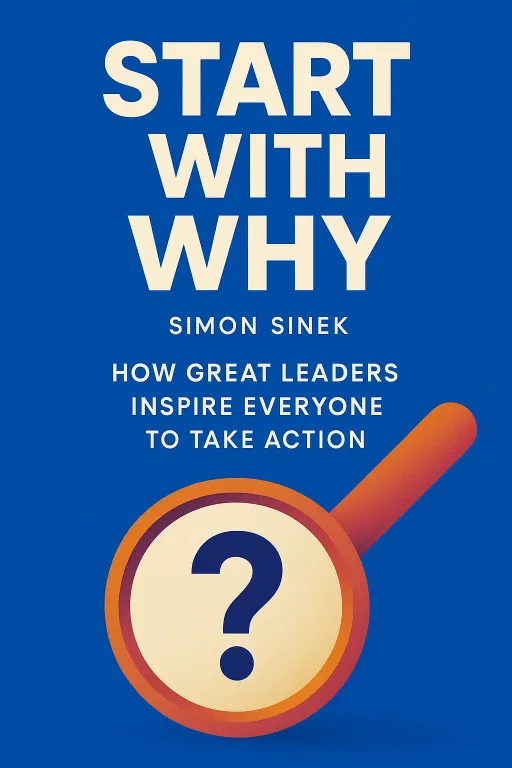
Nova: Much smaller. Today, we're diving into a powerful synergy of ideas from two influential thinkers: Simon Sinek, who famously urged us to "Start with Why," and James Clear, the architect of "Atomic Habits." These aren't just buzzwords; these are the foundational principles for anyone driven by growth and mastery.
Atlas: Ah, Sinek! The TED Talk that launched a thousand corporate mission statements. His message became a global phenomenon, really shifting how people thought about leadership and purpose. And Clear’s book, "Atomic Habits," is practically a bible for anyone trying to build a better routine, lauded for its science-backed, actionable advice. They're both highly acclaimed, but I’m curious, how do these two seemingly different philosophies—one about grand purpose, the other about tiny actions—actually connect?
Nova: That's the magic, Atlas. On the surface, one talks about the profound, almost spiritual core of motivation, and the other about the granular mechanics of daily behavior. But together, they form an unstoppable engine for progress.
Unearthing Your 'Why': The Foundation of True Motivation
SECTION
Nova: Let's start with Sinek. His core argument, encapsulated in his "Golden Circle," is that truly inspiring leaders and organizations don't start with what they do, or even how they do it. They start with why.
Atlas: So you’re saying it’s not about the product or the process, but the purpose behind it? That makes me wonder, how does someone in a strategic communication role, for instance, apply that? Isn't the 'what' often the easiest thing to articulate?
Nova: Precisely. The 'what' is your job, your product, your service. The 'how' is your unique process or competitive advantage. But the 'why' is your core belief, your cause, your purpose. It's the reason you get out of bed in the morning, and why anyone else should care. Think about Apple, the classic example Sinek uses.
Atlas: Right, they don’t just sell computers. They challenge the status quo, they think differently.
Nova: Exactly. Their 'why' was to empower individuals to challenge the norm, to be creative. Their 'how' was beautiful design and intuitive user experience. Their 'what' was computers, phones, tablets. People bought their products not just for what they were, but for what they believed in.
Atlas: I guess that makes sense. It taps into something deeper than just features. But for a lot of listeners, especially those focused achievers out there, finding that profound 'why' can feel... daunting. Like, is my 'why' really to "optimize quarterly reports"? How do you dig that deep without it feeling like corporate jargon or some abstract philosophical exercise?
Nova: That’s a brilliant question, and it's where Sinek's insight really shines. Your 'why' isn't necessarily about saving the world, though it can be. It's about your fundamental belief. For a growth architect, your 'why' might be "to unlock potential in others" or "to build resilient systems that empower." For a strategic communicator, it could be "to foster crystal-clear understanding that drives meaningful, positive action." It resonates because it taps into the limbic part of our brain, the part responsible for feelings, trust, and loyalty, not just rational thought.
Atlas: Oh, I like that. So it’s not about creating a catchy slogan, but articulating a genuine belief that then informs everything else. It’s about building trust and connection rather than just selling. That’s going to resonate with anyone who struggles with conveying genuine value.
Nova: And it’s incredibly powerful. When your 'why' is clear, your decisions become easier, your team becomes more aligned, and your message becomes magnetic. It moves you from simply doing tasks to pursuing a mission. It’s the difference between doing a job and living your purpose.
Engineering Momentum: The System of Atomic Habits
SECTION
Nova: Now, having that profound 'why' is like having the clearest, most inspiring destination on your map. But a map alone doesn't get you there, does it? You need a vehicle, and a reliable road.
Atlas: True. A beautiful vision without a path to achieve it is just a daydream. So, how do we actually move towards that 'why'?
Nova: That's where James Clear and "Atomic Habits" come in. Clear's work is all about the 'how' – the practical, often tiny, actions that, when compounded over time, lead to remarkable results. He himself has an incredible story of overcoming a severe injury through meticulous habit-building, which deeply informs his philosophy of small, consistent gains.
Atlas: I remember reading about his baseball accident and how that led him to study habits so intensely. It really makes his insights feel grounded in personal experience, not just theory. But I’m curious, for someone who is a focused achiever, always pushing for big results, how do these "atomic" habits not feel… insignificant? Like, if my 'why' is to revolutionize an industry, how does "drink a glass of water" get me there?
Nova: That’s the genius of it. Clear argues that we often focus on goals – the outcome we want. But we should be focusing on systems – the processes that lead to those outcomes. Your goal might be to write a book, but your system is "write 200 words every morning." Your goal is to be a better leader, but your system is "listen actively to one team member for 15 minutes daily."
Atlas: So basically you’re saying, stop fixating on the destination, and start optimizing the journey itself?
Nova: Exactly! He talks about the "1% improvement" rule. If you get 1% better every day for a year, you end up 37 times better. Not 365% better, but 37 times better. It’s the compounding effect of marginal gains. And a huge part of this is environment design. Make good habits easy, obvious, attractive, and satisfying. Make bad habits difficult, invisible, unattractive, and unsatisfying.
Atlas: That makes me wonder, for a growth architect who's constantly trying to scale initiatives, how do you design an environment for habits when the environment itself is always changing? Or for a strategic communicator who needs to adapt to new platforms constantly?
Nova: It’s about creating resilient systems, not rigid rules. For example, if you want to learn a new skill – say, public speaking, which is a common goal for our listeners – instead of saying, "I'll practice for an hour every day," which can feel overwhelming, you could implement an atomic habit: "Before my first meeting, I will spend five minutes practicing vocal warm-ups in the mirror." You make it so easy, so small, that resistance is minimal. And you design your environment: put your practice notes next to your coffee maker.
Atlas: Oh, I see. It’s about identity-based habits too, right? Like, it’s not "I want to get fit," it's "I am a fit person."
Nova: Yes! That's a crucial distinction. It's about shifting who you believe you are. If you identify as a "reader," you're more likely to pick up a book. If you identify as someone who "prioritizes clarity," you're more likely to refine your communication. These small actions reinforce that new identity, creating a powerful feedback loop. It's not just about doing a task; it's about embodying the person you want to become.
The 'Why' and 'How' Convergence: Building a Purpose-Driven Habit Engine
SECTION
Nova: So we have Sinek's profound 'why' providing the direction, the compass, the soul of what we do. And we have Clear's 'atomic habits' providing the practical 'how' – the reliable vehicle and the well-maintained road.
Atlas: It’s like, Sinek tells you where to aim your rocket, and Clear gives you the instructions for building the tiny, yet powerful, engines that will get it there, one consistent thrust at a time.
Nova: Exactly! Purpose without action is a beautiful, inspiring dream that never leaves the launchpad. Action without purpose can be efficient, but it often leads to a hollow, directionless grind. The real power comes when you fuse them. Your 'why' gives meaning to the seemingly insignificant atomic habits, providing the motivation to push through the "plateau of latent potential" that Clear describes.
Atlas: Tell me more about that plateau. I imagine a lot of our listeners, especially those driven by progress, have experienced it. You start a new habit, you don’t see immediate results, and then you just… stop.
Nova: It's the valley of disappointment. You put in effort, but you don't see the linear progress you expect. Clear says results are often delayed. You work out for weeks, and the scale doesn't budge. You practice a skill, and you don't feel any better. This is where your 'why' becomes the fuel. If your 'why' is strong enough—if you truly believe in the mission behind your daily five minutes of practice or your consistent small efforts—you're far more likely to persist through that plateau until the breakthrough finally happens.
Atlas: So the 'why' provides the emotional resilience needed to stick with the 'how' until it compounds into something significant. That’s actually really inspiring. Can you give me an example where someone had a strong 'why' and used atomic habits to achieve something truly remarkable, or perhaps where they failed because they lacked one or the other?
Nova: Consider someone whose 'why' is "to create a healthier future for my family." That's a powerful motivator. If their 'how' is vague—"I'll eat better and exercise more"—it often fails. But if their 'how' becomes atomic habits like "I will prepare my lunch the night before" and "I will walk 10 minutes immediately after dinner", they're building a system aligned with their 'why'. Conversely, someone might be incredibly disciplined with habits, but without a clear 'why', they might find themselves achieving things that don't bring them true fulfillment, or burning out from the sheer effort.
Atlas: That makes perfect sense. It’s not just about doing things efficiently; it’s about doing the right things, and doing them consistently, for a reason that truly matters. This is incredibly relevant for growth architects aiming for sustainable impact, not just short-term wins.
Synthesis & Takeaways
SECTION
Nova: So, the core belief driving your current projects – that's your 'why'. And the tiny, actionable step you can take today to reinforce it – that's your atomic habit. It’s the constant interplay between the two. Your purpose clarifies your path, and your disciplined actions build the capacity to walk that path.
Atlas: For our listeners who are focused achievers, growth architects, and strategic communicators, always seeking impactful knowledge and effective development, what's the first tangible thing they should actually do after this episode? Because we all want to embrace this journey and build big momentum from small steps.
Nova: Start by asking that fundamental question: Don't just think about it; write it down. Make that one step so small you can't say no. Maybe it's spending five minutes clarifying your mission statement, or setting out your running shoes tonight. The key is to start, and to start with purpose.
Atlas: Honestly, that sounds like the perfect starting point. It’s not about overhauling your entire life tomorrow; it's about making a deliberate, tiny choice that aligns with your deepest motivations. It’s about being intentional, one atomic habit at a time, fueled by a powerful 'why'. That's truly impactful knowledge.
Nova: Exactly. It's how you build not just a productive life, but a profoundly meaningful one. This is Aibrary. Congratulations on your growth!