Beyond the Spreadsheet: The Human Side of Connection in Business.
Golden Hook & Introduction
SECTION
Nova: What if the biggest mistake businesses make isn't about their product, their pricing, or their strategy, but about something far more fundamental, something they often ignore?
Atlas: Oh, I know this one! It's forgetting to offer free snacks in the breakroom, right? Or maybe not having enough ergonomic chairs?
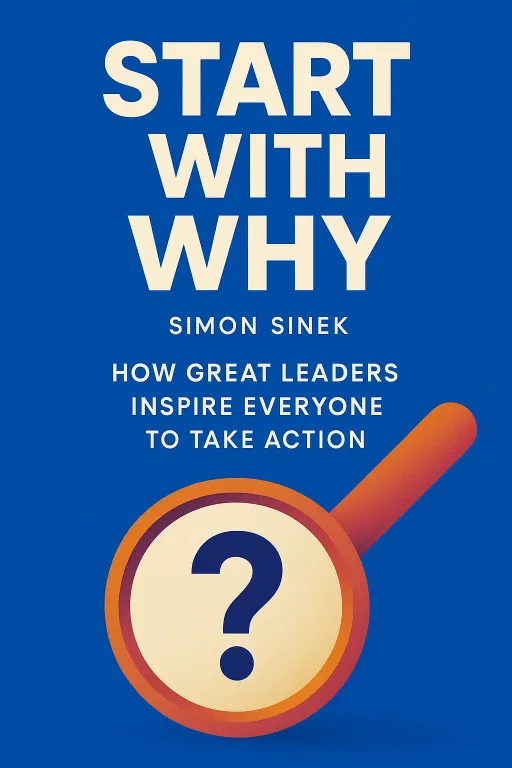
Nova: Close, but no cigar, Atlas. We're talking about something far deeper, something that Simon Sinek brilliantly unpacks in his foundational book, "Start with Why." Sinek, an ethnographer by trade, not your typical business consultant, brought this incredibly human-centric lens to understanding organizational success. And we'll pair that with Daniel Pink's "Drive," which really gets into the nitty-gritty of what truly motivates us beyond those surface-level incentives.
Atlas: So, it's not about the snacks, but the soul of the operation? I'm intrigued. Tell me, what's this 'why' Sinek is so passionate about?
Deep Dive into Core Topic 1: The Power of 'Why' in Business & Life
SECTION
Nova: Sinek argues that truly inspiring leaders and organizations all operate from the inside out, starting with their 'why.' Most companies, most of us even, focus on we do, or we do it. But the 'why' is that core purpose, that cause, that belief that drives everything. It's not about profit, that's a result, a consequence of doing the 'why' well.
Atlas: So you’re saying it's not just a catchy mission statement? Like, 'Our why is to make money and be the best!'? Because honestly, I hear a lot of that, and it doesn’t exactly light a fire under me.
Nova: Exactly. It's not a slogan you slap on a wall. It's the deep, authentic conviction. Think about Apple. In the late 90s, when they were struggling, they weren't just saying, 'We make great computers.' Their 'why' was much bigger: to challenge the status quo, to empower individuals to think differently, to innovate against the giants. what resonated with people. When they launched the iPod, people didn't just buy a portable music player; they bought into that idea of challenging the music industry, of having 1000 songs in their pocket, of thinking differently. The 'what' was the iPod, the 'how' was its sleek design and intuitive interface, but the 'why' was deeper. It was about individual empowerment and pushing boundaries.
Atlas: That’s a great way to put it. I can see that. So, it's about connecting with people's beliefs, not just their needs or what product they want. But how does a company, or even an individual, its 'why'? Is it like an archaeological dig for corporate soul?
Nova: Sometimes it feels like it! It requires deep introspection, often asking 'why' five times, like a persistent toddler, until you get to that fundamental core. It's about finding that authentic truth that existed before the products or services were ever conceived. When a company clearly articulates its 'why,' it acts like a magnet. It attracts employees who believe in that 'why,' who feel a personal resonance with it, and it attracts customers who share that belief. This fosters loyalty and connection far beyond what any price point or feature list ever could. People don't buy you do, they buy you do it.
Deep Dive into Core Topic 2: Unlocking Intrinsic Motivation: Beyond Carrots and Sticks
SECTION
Nova: And that naturally leads us to Daniel Pink's "Drive," which really complements Sinek's work by showing us to build environments where that foundational 'why' can truly flourish. Pink challenges the traditional carrot-and-stick approach to motivation that so many businesses still rely on.
Atlas: Wait, hold on. You're telling me money isn't the ultimate motivator? Because my landlord would beg to differ. And honestly, my bank account occasionally does too.
Nova: Well, money certainly matters, of course, for baseline satisfaction and security. But Pink reveals what truly engages us, what unlocks our best work and deepest commitment, especially for tasks that require creativity and problem-solving. He identifies three key intrinsic drivers: autonomy, mastery, and purpose. Autonomy is our desire to direct our own lives, to have control over our work. Mastery is the urge to get better at something that matters to us. And purpose, well, that's the yearning to do what we do in service of something larger than ourselves, to contribute to something meaningful.
Atlas: So basically, you’re saying if you give people a sense of control, a chance to improve their skills, and a reason to care deeply about what they're doing, they'll be more motivated than if you just dangle a bonus in front of them? That sounds a bit out there for some traditional businesses, which operate on very strict hierarchies and external rewards.
Nova: It sounds revolutionary, but the evidence is compelling. Think about the phenomenon of Wikipedia. Thousands, even millions, of people contribute their time and expertise, often for free. Why? Not for money, but for mastery, autonomy, and purpose. That's a powerful, real-world example of intrinsic motivation in action, scaling globally.
Atlas: That’s a perfect example. I can definitely relate. It’s like, you want to feel like you're building something, creating something, or contributing to something bigger, not just clocking in your hours. So, these two ideas, Sinek's 'why' and Pink's intrinsic motivators, they really fit hand-in-glove, don't they? They speak to a deeper human need than just transactional relationships.
Synthesis & Takeaways
SECTION
Nova: Absolutely. Sinek gives us the foundational 'why' – the north star, the reason we exist and what we believe. Pink then shows us the fuel and the most effective map to get there by tapping into our innate human drivers. When businesses align their 'what' and 'how' with a clear, authentic 'why,' and then empower their people with genuine autonomy, opportunities for mastery, and a connection to that larger purpose, they create something far more resilient, innovative, and inspiring than just a profitable enterprise. They build true connection, a shared sense of meaning that extends from the employee to the customer. This goes a long way towards healing that feeling of disconnect we started with.
Atlas: That's actually really inspiring. It brings us back to that initial feeling of disconnect you mentioned at the top of the show. It’s not just about the numbers, it’s about the human element, the shared belief, the profound satisfaction of contributing to something meaningful. So, if listeners are feeling that disconnect in their own work or entrepreneurial journey, what's one immediate thing they can do to start bridging that gap?
Nova: I’d say, reflect on your personal 'why.' Take some time to truly articulate it. How does it align with your current work or entrepreneurial goals? Is there a gap between what you're doing and why you're doing it? Because understanding your own purpose is the first, most crucial step to finding or creating an environment where you can truly thrive and connect, where your work feels less like a task and more like a calling. It's about finding that deep resonance, both for yourself and with others.
Atlas: That gives me chills. A powerful thought to end on, Nova. Thank you for shedding light on these profound ideas and showing us a path to deeper connection.
Nova: My pleasure, Atlas. Always a joy to explore these big questions with you.
Atlas: This is Aibrary. Congratulations on your growth!