Beyond the Product: How to Build a Movement, Not Just a Feature.
Golden Hook & Introduction
SECTION
Nova: What if I told you that the secret to truly revolutionary products isn't about what they do, but why they exist? That building a better feature might actually be the slowest path to lasting impact?
Atlas: Whoa, hold on, Nova. That's a pretty bold claim. Most of us are taught to focus on features, on the 'what' and 'how' of our products. Are you saying that's... wrong?
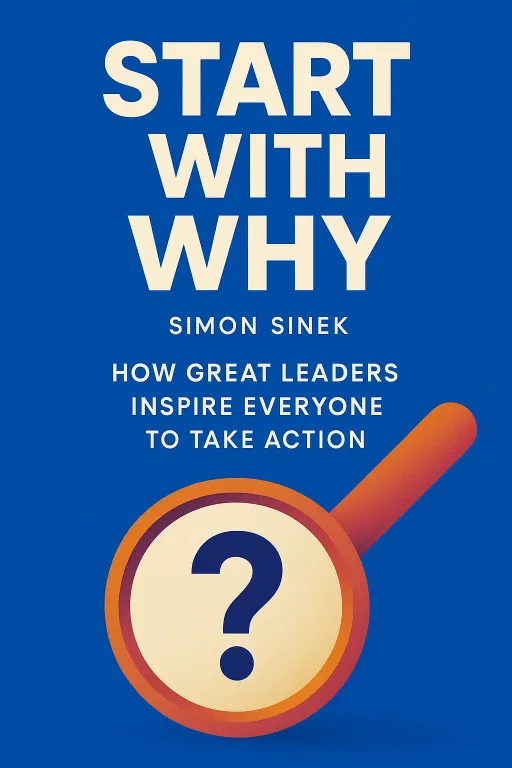
Nova: Not wrong, Atlas, but perhaps incomplete. It's like trying to build a skyscraper starting with the penthouse suite. You might get a beautiful top floor, but without a solid foundation, it's never going to stand tall or inspire awe. And that's exactly the powerful insight we're diving into today, straight from the mind of Simon Sinek and his transformative book, "Start with Why: How Great Leaders Inspire Everyone to Take Action."
Atlas: Ah, Sinek! I know his name, of course, from his incredibly popular TED Talk. The one that really helped bring this idea into the mainstream.
Nova: Exactly. Sinek, originally an advertising executive, observed a pattern in truly inspiring organizations and leaders that transcended their industries. He saw how they communicated from the inside out, starting with their purpose, their 'why.' It's a framework that fundamentally shifts how we think about connection and loyalty.
Atlas: So, you're saying that feeling of disconnect we sometimes get, even when we know our product is good, that feeling that our teams or users aren't fully aligned... that often stems from this missing 'why'?
Nova: Precisely. It’s that deep, foundational 'why' that resonates on a much deeper level than any list of features ever could. That's where movements are born, not just market share.
The Power of 'Why': Building Movements, Not Just Products
SECTION
Nova: Think about it this way, Atlas. Sinek's famous "Golden Circle" shows us that most companies communicate from the outside-in: 'Here's what we do, here's how we do it, want to buy it?' But truly inspiring leaders, they flip it. They start with 'Why.'
Atlas: So, they lead with their purpose, their belief, their cause?
Nova: Absolutely. Take Apple, for example. They don't typically start by saying, "We make great computers with beautiful designs." They start with something like, "Everything we do, we believe in challenging the status quo. We believe in thinking differently." That's their 'why.'
Atlas: And then the 'how' and 'what' naturally follow. So, "The way we challenge the status quo is by making our products beautifully designed and simple to use", "and we happen to make great computers".
Nova: Exactly! When they communicate their 'why' first, they're not just selling a product; they're inviting you to join a movement, to align with a belief system. And that taps into the limbic brain, the part of our brain responsible for feelings, trust, and loyalty. It's not about rational choice; it's about gut feeling.
Atlas: That makes so much sense. I imagine a lot of our listeners in EdTech, who are constantly innovating and developing new tools, might feel this disconnect. They have incredible products, but the widespread adoption or deep alignment isn't always there. Is it because they're leading with the 'what' – the amazing new AI feature – instead of the 'why' – the transformative learning experience they're trying to create?
Nova: Often, yes. If you're an EdTech leader, an architect of new learning experiences, you might be so focused on the elegance of your solution, the technical brilliance of your AI, that you forget to articulate the profound 'why' behind it. Why are you doing this? What problem are you solving for humanity? What future are you trying to build?
Atlas: But wait, for a leader trying to innovate in a competitive space, isn't it easy to lose sight of that 'why' when you're constantly chasing funding, battling deadlines, and responding to market demands? It feels like the 'what' becomes all-consuming out of necessity.
Nova: It absolutely can be. It takes discipline and courage to keep that 'why' front and center. But here's the thing: when your 'why' is clear, it becomes a filter for every decision. Does this new feature align with our 'why'? Does this partnership further our 'why'? If not, maybe it's a distraction, not an innovation.
Atlas: So, the 'why' isn’t just marketing fluff. It's a strategic compass. For our listeners who are navigating disruptive innovation and trying to integrate AI ethically, understanding their core 'why' could be the difference between creating something truly impactful and just another fleeting trend.
Nova: Exactly. It's the difference between a product that gets used and a movement that changes lives. In EdTech, the 'why' is often inherently powerful: democratizing knowledge, fostering critical thinking, empowering future generations. But if that 'why' isn't explicitly communicated, it gets lost.
Atlas: I can see how that would provide a much stronger foundation, especially when you're thinking about scaled product strategy. You're not just scaling a tool; you're scaling an ideology, a belief system.
Nova: It’s about inspiring widespread adoption and scaling influence by providing a clear framework for communicating purpose. It creates deep loyalty and engagement that no feature list can replicate. When people buy into your 'why,' they become advocates, not just customers. They become part of your movement.
Synthesis & Takeaways
SECTION
Nova: So, the profound insight here is that your 'why' isn't just a feel-good statement. It's the very core of your ability to inspire, to lead, and to create something that transcends the transactional. It’s what allows you to build a movement, not just another feature.
Atlas: That gives me chills. It’s not just about what you make; it’s about what you you can make possible. And for anyone building in EdTech, where the stakes are so high for the future, that 'why' is paramount. It’s the strategic bedrock for navigating disruption, ensuring ethical integration, and truly elevating your enterprise influence.
Nova: Absolutely. It's the difference between being a commodity and being a cause. So, for our listeners, I challenge you this week: take a moment to write down the core 'why' behind your work in EdTech. How does it connect to a larger purpose that can truly inspire others?
Atlas: That’s a powerful call to action. It forces you to look beyond the immediate and towards the enduring.
Nova: It does. Because when you start with why, you don't just build a better product; you build a better future.
Atlas: That's a fantastic thought to leave us with.
Nova: This is Aibrary. Congratulations on your growth!