Beyond the Bottom Line: Cultivating Purpose for Sustainable Growth.
Golden Hook & Introduction
SECTION
Nova: Most people think they know what really motivates them, or their teams. They think it's about bonuses, promotions, or hitting quarterly targets. But what if those things are actually us from the true wellspring of human potential? What if the real secret to sustainable growth and profound impact lies in something far simpler, yet deeply overlooked?
Atlas: Oh, I love that. Are you saying all my carefully constructed incentive programs are just… noise? That's a bit out there, but I'm intrigued.
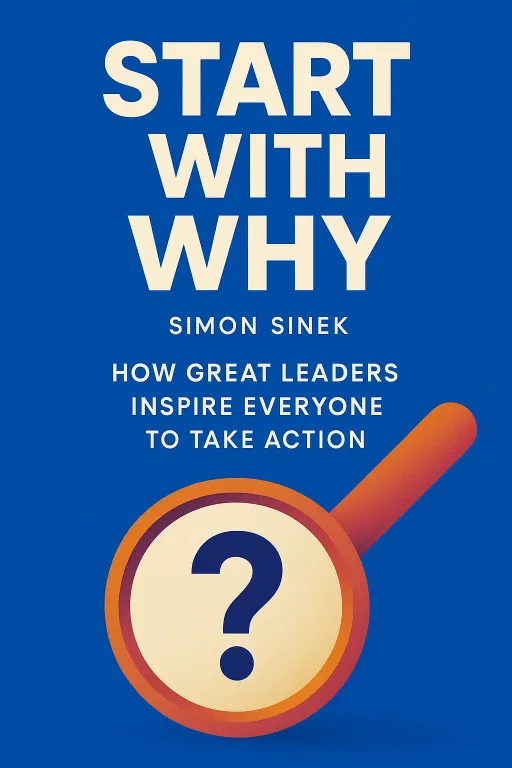
Nova: Exactly! Today, we're diving into the transformative ideas from Simon Sinek's "Start With Why" and Daniel H. Pink's "Drive." Sinek's work, famously born from one of the most influential TED Talks ever, fundamentally reshaped our understanding of leadership, illustrating why some organizations inspire and others don't. And Pink's "Drive" built on decades of psychological research, becoming a seminal work on motivation by challenging the very core of traditional management thinking. These aren't just business books; they're manifestos for deeply meaningful engagement.
Atlas: That's a perfect example of shifting perspective. So, how do we even begin to unearth this 'why' that's supposedly more powerful than all the traditional carrots and sticks?
Nova: Well, Atlas, that leads us directly to our first big idea: the profound power of 'why' itself.
The Power of 'Why': Beyond the What and How
SECTION
Nova: Sinek introduced this concept he calls the Golden Circle. It's made up of three layers: the 'What' on the outside, the 'How' in the middle, and the 'Why' at the very core. Most organizations, and frankly, most people, communicate from the outside-in. They tell you what they do, then how they do it, and maybe, if there's time, why they do it.
Atlas: Right, like, "We make great smartphones", "with cutting-edge technology", and maybe a vague "to connect people".
Nova: Precisely. But Sinek argues that truly inspiring leaders and organizations communicate from the inside-out. They start with their 'Why.' They articulate their purpose, their belief, their cause. Then they explain how they bring that 'why' to life, and finally, what products or services result from it.
Atlas: So, you're saying it's about selling a belief system, not just a product? That's a great way to put it.
Nova: Think about Apple, for instance. They don't just sell computers. They don't just say, "We make beautifully designed, user-friendly devices." Their 'why' is to challenge the status quo, to think differently. Every product, every advertisement, every interaction stems from that core belief. People line up for days, not just for a gadget, but for a piece of that belief, that identity. They feel a deep, emotional connection that transcends mere functionality. That’s the power of starting with ‘why.’
Atlas: I can see that. But for someone trying to cultivate a global ecosystem, like many of our listeners, how do you articulate a 'why' that resonates across diverse cultures and isn't just a corporate mission statement that sounds hollow? Isn't it easy for that 'why' to become diluted or just sound like a marketing slogan?
Nova: Absolutely. The key is to find the universal human truth behind your specific actions. Apple’s ‘why’ — challenging the status quo — taps into a deep human desire for progress and self-expression. For a global architect, it might be about elevating human potential, fostering sustainable prosperity, or ensuring technology serves humanity. It's about finding that core principle that transcends borders, that deeper impact you're striving for. It's not about what you, but the that drives your doing.
Atlas: That makes me wonder, though, how does this concept apply to the individual? Because many listeners, especially those in demanding roles, often feel that disconnect you mentioned earlier between what they do and why they do it. What's the healing moment here for them?
Nova: That's a crucial question, Atlas, because the 'why' isn't just for organizations; it's deeply personal. And this is where Daniel Pink's insights in "Drive" become incredibly powerful, showing how purpose acts as a catalyst for sustainable motivation and growth, especially when traditional incentives fall short.
Purpose as a Catalyst: Autonomy, Mastery, and Sustainable Growth
SECTION
Nova: Pink argues that for complex, creative work, the traditional "carrot and stick" approach to motivation, what he calls Motivation 2.0, is actually counterproductive. Instead, he introduces Motivation 3.0, built on three pillars of intrinsic drive: Autonomy, Mastery, and Purpose.
Atlas: Autonomy, Mastery, and Purpose. I like that. So, what do those look like in practice?
Nova: Autonomy is the urge to direct our own lives, to have control over our tasks, time, technique, and team. Mastery is the desire to get better and better at something that matters, that feels meaningful. And Purpose is the yearning to do what we do in the service of something larger than ourselves, to contribute to something significant.
Atlas: So, you're saying money is important, but only up to a point, and then these internal drivers take over? That's incredible.
Nova: Exactly. Think about the world of open-source software, like Linux or Wikipedia. Millions of people contribute their time, their expertise, their incredible skill, often for free. They're not getting bonuses or promotions from a traditional employer. They're driven by the sheer mastery of coding, the autonomy to choose their projects, and the profound purpose of creating something universally accessible and beneficial to humanity. The innovation and dedication you see there often surpass what you find in highly-funded, profit-motivated corporate ventures.
Atlas: That's a perfect example. So, you're saying these volunteer-driven, purpose-led movements are actually out-innovating highly-funded, profit-motivated corporate ventures because they tap into that deeper well? For someone focused on nurturing innovation and building ethical strategies, especially in areas like AI, how do you design an environment that fosters this kind of intrinsic drive? How do you give people autonomy and mastery within a structured corporate setting without chaos?
Nova: Excellent point. It's about shifting from a command-and-control mindset to creating an environment of 'optimal challenge.' It means clearly communicating the overarching 'why' of the project – perhaps it's about making AI equitable, or harmonizing global insights for local impact – and then giving people ownership over 'how' they achieve it. It's about providing opportunities for continuous learning and skill development – fostering mastery – and crucially, connecting their daily tasks to that larger, ethical impact. It’s about trust, fundamentally.
Atlas: I can definitely relate. It feels like this is key to preventing burnout, especially in fast-paced, high-stakes environments. If you're just chasing the 'what,' it's exhausting. But if you're connected to the 'why,' even the grind feels meaningful.
Synthesis & Takeaways
SECTION
Nova: Exactly, Atlas. The feeling of disconnect between what we do and why we do it is a direct path to burnout and a lack of true innovation. But when you fuse Sinek's foundational 'why' with Pink's drivers of autonomy, mastery, and purpose, you create an unstoppable engine. It's about building ecosystems, as you often say, not just companies, but thriving, purposeful communities.
Atlas: That’s such a hopeful way to look at it. It transforms work from a chore into a calling, for individuals and organizations alike. It makes me wonder, for our listeners who are global architects, nurturing innovators, ethical strategists – those pushing boundaries in AI or cross-cultural leadership – what's the one thing they can do this week to start cultivating their 'why' or fostering it in their teams?
Nova: Take five minutes. Just five. And reflect deeply on your core 'why' for your work. Don't think about the tasks, or the bottom line, but the profound impact you want to have. How does that 'why' align with your daily actions? If it doesn't, that's your starting point for change. It’s about building a better world, for your daughter, for everyone, one purposeful step at a time.
Atlas: I love that. It’s a powerful invitation to introspection that can spark monumental change.
Nova: Absolutely.
Atlas: This is Aibrary. Congratulations on your growth!