Beyond the Obvious: Unlocking Creativity with Lateral Thinking.
Golden Hook & Introduction
SECTION
Nova: What if the most logical, step-by-step way you've been taught to solve problems is actually holding you back from your greatest breakthroughs?
Atlas: Oh, I like that. That's going to hit home for a lot of our listeners who are constantly pushing for efficiency and the "right" answer. But wait, Nova, are you saying that sometimes, being logical is a disadvantage? That sounds almost counter-intuitive to everything we're taught in business and leadership.
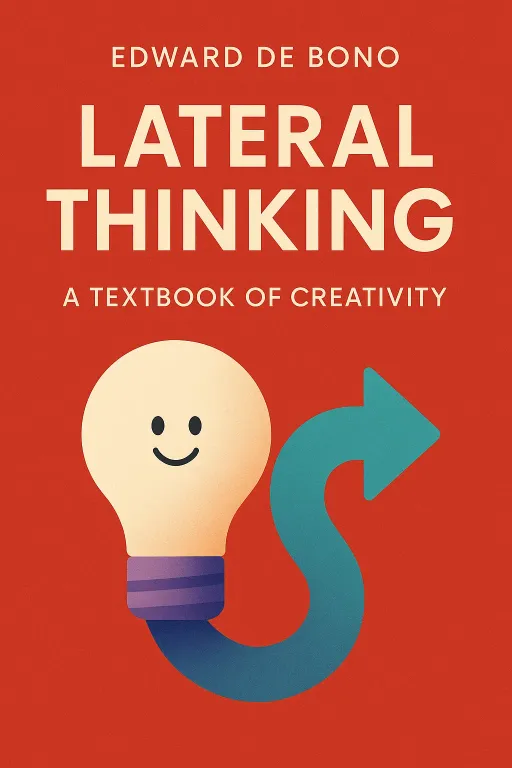
Nova: Absolutely, Atlas! It's a profound challenge to our default thinking, and it's exactly what we're exploring today. We’re diving into the revolutionary ideas of Edward de Bono, specifically from his seminal works like and. De Bono didn't just write about creativity; he literally invented the term 'lateral thinking' and reshaped how the world approaches problem-solving, making him a true pioneer in cognitive science and a profound influence on global innovation. He showed us that sometimes, the direct path isn't just inefficient; it's a dead end.
Atlas: That's incredible. I mean, to invent a whole new way of thinking… that’s a legacy. But for our strategic builders and empathetic leaders listening, what does that actually for how they tackle their daily challenges? Because I imagine many of them, myself included, often find ourselves trapped by what feels like the 'only' way to approach a problem.
Nova: Exactly. And that's where we hit our first blind spot. We're so conditioned to what de Bono calls "vertical logic." Think of it like digging a hole deeper and deeper in the same spot. You'll eventually get a very deep hole, but what if the treasure was actually five feet to the left?
Unmasking the 'Blind Spot' of Vertical Logic
SECTION
Atlas: That’s a great analogy! So, we're not just digging; we're essentially committed to a specific trajectory, even if it's not yielding results. What are the subtle traps of this vertical thinking that we often fall into without even realizing it?
Nova: The biggest trap is what I call "the illusion of progress." We’re moving, we’re working hard, we’re following a perfectly logical sequence, but we’re not getting closer to a solution, just solution. Vertical logic excels at developing ideas, but it's terrible at generating new ones. It’s about building on what exists, refining it. Imagine a team trying to improve a product. They focus on faster processing, more features, sleek design. All vertical improvements. But what if the entire of the product needs rethinking? What if the problem it solves isn't the real problem?
Atlas: That’s going to resonate with anyone who’s ever been in a meeting where everyone agrees on the 'next steps,' but deep down, you feel like you're just rearranging deck chairs on the Titanic. So, for our listeners who are leading teams, how does this blind spot manifest in their day-to-day? Because efficiency is often paramount.
Nova: It manifests as "analysis paralysis" or, worse, "solution paralysis." You gather all the data, you analyze it meticulously, you follow every logical step, and you still end up with a mediocre solution, or worse, no solution at all. Let me give you a classic example, a riddle that perfectly illustrates this. Imagine you have six matchsticks. Your challenge is to arrange these six matchsticks to form four equilateral triangles.
Atlas: Six matchsticks, four equilateral triangles. Okay, my brain immediately goes to laying them flat on a table. I’m picturing two triangles, maybe trying to stack them… but that doesn’t feel right. I can see how that would get frustrating very quickly. I'm already feeling that "illusion of progress" you mentioned, trying variations of flat shapes.
Nova: And that’s exactly what vertical logic does! You're trying to solve it within the implicit constraint of a two-dimensional plane. You’re digging deeper in the same spot. Most people will try to form squares, or rhombuses, or two triangles side-by-side. They get stuck because their minds are locked into a flat surface. The cause of the frustration is the unseen assumption.
Atlas: Ah, the unseen assumption! That's powerful. So, the process is: I’m trying to solve a problem, I'm following what seems like the most logical path based on my past experiences, but I’m implicitly limiting my options without even knowing it. And the outcome is usually frustration or a suboptimal solution. Why is it so hard to break free from that pattern? Why don't we just the other options?
Nova: It's all about pattern recognition, Atlas. Our brains are incredible pattern-matching machines. We see a problem, we immediately try to fit it into a known pattern, a successful past experience. It’s efficient, but it’s not innovative. We fear the unknown, the illogical. We're judged on being "right," not on being "different." This comfort with the known path, even if it's a suboptimal one, is a powerful psychological barrier. It fundamentally challenges our linear approach to problems, revealing the power of creative detours.
Atlas: That's going to resonate with anyone who struggles with navigating change in their organizations. It’s not just about finding the right answer; it’s about challenging the of the question itself. So, if vertical logic is so ingrained, how do we even begin to see beyond it? What's the fundamental shift we need to make to avoid these blind spots?
Embracing Movement: Lateral Thinking and the Six Thinking Hats
SECTION
Nova: That's where Edward de Bono's genius truly shines. He gave us a name and a method for that shift: Lateral Thinking. It's not about digging deeper; it's about digging. It's about "movement, not judgment." The goal is to generate new ideas by looking at problems from fresh, often unconventional angles, even if they initially seem illogical. It’s about creating new patterns, not just refining old ones.
Atlas: Movement, not judgment. That sounds almost counter-intuitive to how we're trained to think. We're taught to evaluate, to judge, to critique. Can you give us a concrete example of how lateral thinking actually? Because for a strategic builder, the proof is in the practical application.
Nova: Absolutely. Let's go back to our matchstick problem: six matchsticks, four equilateral triangles. The lateral thinking solution involves moving out of two dimensions. You arrange three matchsticks on the table to form an equilateral triangle. Then, you take the remaining three matchsticks and stand them up, connecting their tops to form a pyramid, or a tetrahedron. Each face of that tetrahedron is an equilateral triangle. You've created four equilateral triangles in three dimensions.
Atlas: Whoa, that's incredibly powerful! I was so fixed on the table, on the flat surface. It’s like you're not just solving the problem; you're redefining the very space in which the problem exists. That’s a complete paradigm shift! It feels a bit like magic, but I can see how it’s just about changing your perspective. But how do you that systematically? How do you teach yourself, or your team, to consistently think outside the assumed box like that?
Nova: That’s where de Bono's other brilliant contribution comes in: the "Six Thinking Hats." It's a framework designed to make lateral thinking accessible and systematic, especially for teams. Instead of everyone thinking in different directions at once, the hats encourage parallel thinking. Each hat represents a different mode of thinking, and when everyone "wears" the same hat, they're all focused on that one mode.
Atlas: Okay, so tell me about these hats. This sounds like a powerful tool for team dynamics, especially for empathetic leaders trying to get diverse perspectives without derailing the conversation. How does this help prevent groupthink and ensure everyone feels heard, even if their idea is 'out there'?
Nova: It's transformative for team collaboration. Imagine you're in a meeting.
Atlas: That’s brilliant! It depersonalizes the thinking. It’s not "Bob is always negative" or "Sarah is always dreaming." It's "Okay, everyone put on your Black Hat; let's poke holes in this." That must create such a safe space for diverse ideas, allowing empathetic leaders to truly hear all perspectives without immediate judgment. It would totally change the dynamic of a brainstorming session.
Nova: Exactly! It prevents arguments and ensures that every aspect of a problem is thoroughly explored. It forces you to move through different modes of thinking, intentionally shifting your perspective, which is the essence of lateral thinking. It’s about movement, not judgment, on a team level. It fundamentally challenges our linear approach to problems, revealing the power of creative detours.
Synthesis & Takeaways
SECTION
Nova: So, what we've really been talking about today is the liberation from our own mental ruts. Our linear default, our vertical logic, is efficient for known paths but utterly fails us when the path itself needs to be invented. De Bono's methods aren't just clever tricks; they're about fundamentally rewiring how we engage with challenges, moving us from being stuck to being truly generative.
Atlas: For our strategic builders and empathetic leaders, this isn't just about solving a single problem; it's about building a more resilient, innovative, and less burn-out prone approach to leadership itself. Imagine the energy saved when you stop banging your head against a wall and simply look for a different wall, or maybe no wall at all! It's about finding elegant solutions that sometimes appear completely out of left field, which can lead to sustainable success.
Nova: Absolutely. And it's a powerful tool for preventing that burnout. Instead of feeling like you have to force a solution through sheer effort, lateral thinking offers a playful, expansive way to discover unexpected answers. So, my concrete actionable step for our listeners is this: the next time you're stuck, instead of pushing harder down the same path, ask yourself: "What's the, most irrelevant thing I could try?" Or, "If this problem were a color, what color would it be, and what does that tell me?"
Atlas: And for those facing a current problem, what if you approached it not with judgment, but with playful movement? What new angles would emerge if you allowed yourself to think sideways? That's actually really inspiring. It frames problem-solving as an adventure, not a chore.
Nova: It truly is. The greatest breakthroughs often come not from better logic, but from a bolder leap of imagination. It’s about giving yourself permission to explore the unconventional.
Atlas: This is Aibrary. Congratulations on your growth!