Architecting the Future: Digital Strategy & Organizational Agility
Golden Hook & Introduction
SECTION
Nova: What if the biggest obstacle to your company’s digital future isn't a lack of cutting-edge technology, but a lack of courage?
Atlas: Whoa, that's a bold statement, Nova! I mean, we're constantly bombarded with news about the latest AI, quantum computing, blockchain... it feels like technology is challenge. Are you saying we're looking in the wrong place entirely?
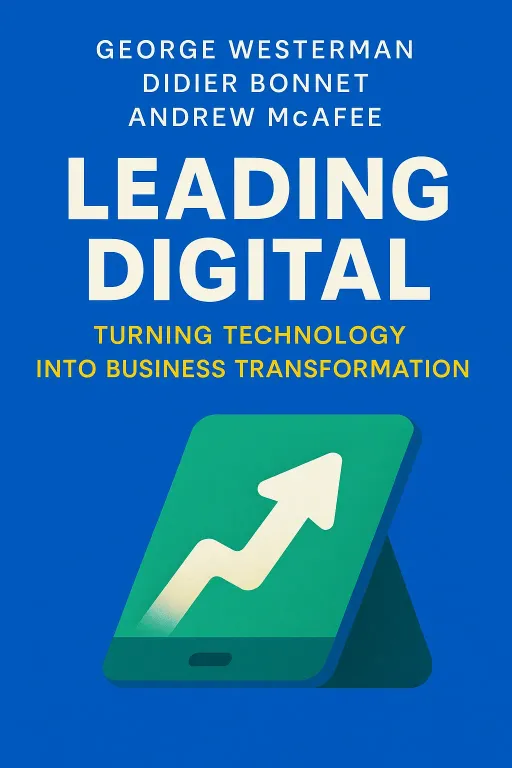
Nova: Absolutely, Atlas. That’s precisely what two incredibly insightful sets of authors argue. Today, we're diving into the profound ideas from "Leading Digital" by George Westerman, Didier Bonnet, and Andrew McAfee, and then building on that with "Rewired" by Eric Lamarre, Kate Smaje, and Rodney Zemmel.
Atlas: Okay, so we're talking about heavy hitters here. Westerman and McAfee, both from MIT, and the "Rewired" authors from McKinsey. That’s a serious intellectual pedigree right there.
Nova: Exactly. These aren't just academic musings; they’re grounded in serious observation and research. "Leading Digital," for instance, came from extensive research across 400 global companies, moving past the buzzwords to uncover what drives successful digital transformation. It's widely lauded for its practical, evidence-based approach to understanding digital maturity. "Rewired," then, serves as a powerful follow-up, a McKinsey perspective on to build the agile organization needed to sustain that transformation. They’re essentially giving us the blueprint for not just to do, but to fundamentally change an entire enterprise.
Atlas: That makes sense. It’s like one book lays out the destination, and the other gives you the detailed map for the journey. I’m curious, though, if the core challenge isn’t tech, what is it? Because for a lot of our listeners, especially those who are curious technologists, the tech like the biggest hurdle.
Deep Dive into Core Topic 1: The True Nature of Digital Transformation
SECTION
Nova: Well, that leads us directly into our first big idea: the true nature of digital transformation. Most companies, and even individuals, mistakenly equate digital transformation with simply new technology. They think, "We need a new app, or we need to move to the cloud, or we need AI!" And poof, they're digitally transformed. It's a common trap.
Atlas: I know that feeling! It’s like buying a fancy new blender and expecting to be a gourmet chef overnight. You still need the recipes, the skills, the ingredients… and maybe even the courage to try a new dish.
Nova: Precisely! Westerman, Bonnet, and McAfee make it crystal clear: successful digital transformation is a holistic shift. It’s built on three pillars that go far beyond just the tech: leadership, customer experience, and operational processes. They found that companies failing to transform often poured millions into new software, hired top tech talent, but saw no real change in performance or market share because they missed these foundational elements.
Atlas: So basically, you’re saying you can’t just bolt on digital. It has to be woven into the very fabric of the company, from the top down and the inside out?
Nova: In essence, yes. Let me paint a picture. Think about a fictional retail giant, let’s call them "MegaMart." In one scenario, MegaMart decides to "go digital" by launching a shiny new e-commerce app. They spend a fortune, get a slick interface, and impressive marketing. But their internal operations—their ancient inventory system, their slow, siloed delivery network, their disconnected customer service teams—remain unchanged. What happens? Customers get frustrated when the app promises next-day delivery but the internal system can’t fulfill it, or they can’t return an online purchase in-store. The app fails to deliver on its promise, customer satisfaction plummets, and MegaMart concludes "digital doesn't work for us."
Atlas: Oh, I've seen that play out in real life! It’s like putting a racing stripe on a horse and buggy. It might look faster, but it’s still a horse and buggy, and the customers eventually realize it.
Nova: Exactly! Now, consider another fictional retailer, "FlexiFashion." They also launched an e-commerce platform, but their leaders understood it wasn't just about the website. They looked at the customer journey: how people discover products, how they buy, how they receive them, and how they get support. They bravely re-engineered their entire supply chain to be faster and more flexible, empowering store associates with tablets to check inventory across all locations, and integrated customer feedback loops directly into product development cycles. Their digital transformation was about their entire business model around the customer, using technology as an enabler, not the end goal. That’s what digital maturity truly looks like.
Atlas: That’s a great example. It really highlights how the leadership mindset is the true starting point. It’s not just delegating to the IT department and hoping for the best. For a driven achiever, who really wants to see tangible results, how do you even begin to shift that kind of ingrained mindset in a large organization? It sounds like a truly Herculean task to get everyone on board.
Nova: It absolutely can be. The book emphasizes that it starts with understanding that digital maturity isn't just about having the technology, but about having the best for leveraging technology to enhance customer experience and streamline operations. It requires leaders to be visionaries, to understand that digital isn't just a cost center, but an opportunity to fundamentally rethink their value proposition and how they operate. It’s about being brave enough to challenge decades of ingrained processes and instigate real, systemic change. It’s a continuous journey of learning and adaptation, and that leads us perfectly into our second big idea.
Deep Dive into Core Topic 2: Architecting Agility: The Engine of Continuous Digital Evolution
SECTION
Nova: So, once you understand the true scope of digital transformation, the next question is: how do you actually build an organization that can this continuous evolution? Because the digital landscape never stops changing. This is where "Rewired" by Lamarre, Smaje, and Zemmel from McKinsey really shines. They offer a powerful perspective on building what they call an "agile organization."
Atlas: "Agile" is a word I hear thrown around a lot. Sometimes it feels like a buzzword, especially in tech circles. What does it mean to be an agile organization, beyond just adopting a new project management methodology or using sticky notes on a wall?
Nova: That’s a crucial distinction, Atlas, and one "Rewired" clarifies beautifully. Organizational agility isn't just about "doing Agile" in software development teams. It’s about fundamentally rewiring your entire operating model, culture, and capabilities. It’s characterized by continuous adaptation, truly empowering teams with autonomy and accountability, and relentlessly leveraging data to respond rapidly to market shifts and customer needs. It’s about building a system that can constantly learn and evolve, rather than just executing a fixed plan.
Atlas: Okay, so it’s not just about sprints and stand-ups; it’s about the whole company being able to pivot quickly and intelligently. Can you give me an example of what that looks like in practice, especially for a large, established company?
Nova: Let’s imagine a traditional automotive manufacturer, we’ll call them "DriveCo." Traditionally, they operate in deep, rigid silos: design, engineering, manufacturing, sales, marketing, all separate. Developing a new car model takes years, with sequential handoffs between departments, leading to massive delays and cost overruns. When a new competitor emerges with an innovative electric vehicle that captures significant market share, DriveCo is too slow, too cumbersome to react effectively. Their processes are designed for stability, not speed.
Atlas: That sounds like a lot of companies I know. The sheer inertia of a big, established organization can be crippling. It’s like trying to turn a supertanker on a dime.
Nova: Right. Now, imagine "InnovateAutos." They've "rewired" their organization for agility. Instead of deep silos, they have cross-functional teams focused on specific customer needs or product lines—say, a "Urban Mobility Solutions" team or a "Luxury EV Experience" team. Each team might consist of designers, engineers, marketing specialists, and even manufacturing experts, all working together from day one, with a shared vision. They have clear, challenging objectives, and they’re empowered to make decisions quickly, without waiting for layers of approval. They constantly analyze real-time market data—customer preferences, competitor moves, technological advancements—and can rapidly prototype, test, and iterate on new features or even entirely new vehicle concepts. This allows them to launch new products in months, not years, and adapt their offerings based on immediate feedback.
Atlas: But wait, "empowering teams" sounds great on paper, but in a large, established company, isn't that just a recipe for chaos? What about accountability, or making sure everyone's pulling in the same strategic direction? That’s something a driven achiever would definitely be concerned about.
Nova: That’s a really insightful question, and it's a common misconception. True empowerment in an agile organization isn't a free-for-all. It comes with clear guardrails and a robust framework. Teams are empowered a defined purpose and strategy, with transparent goals and clear metrics for success. There's a strong emphasis on transparency, shared metrics, and continuous feedback loops. Leaders shift from being command-and-control figures to being enablers and coaches, removing obstacles for their teams and ensuring alignment. It requires a high degree of trust, psychological safety, and a culture that views failure as a learning opportunity.
Atlas: That makes sense. It’s not just about giving people freedom; it’s about giving them freedom that promotes collaboration and responsiveness. So, bringing it back to our listeners, especially the curious technologist or focused learner, how can individuals, even those not in formal leadership, contribute to this "rewiring" process? What are the practical steps they can take to embody these principles, even if their whole organization isn't fully agile yet?
Nova: That's the deep question, isn't it? It starts with embodying the principles yourself. Even if you're not the CEO, you can champion customer-centricity in your daily tasks. Look for ways to streamline your own operational processes, or those within your immediate team. Be the person who leverages data to make better, faster decisions, even if it's just analyzing the effectiveness of your own workflow or projects. Most importantly, you can foster a culture of continuous learning and adaptation within your sphere of influence. Be open to new ideas, experiment with new tools or approaches, learn from failures quickly, and share those lessons openly with your colleagues.
Atlas: So, it's about being an "agile individual" first, and letting that energy ripple outwards. That’s actually really inspiring. It means you don't have to wait for permission to start making a difference and contributing to the larger transformation.
Nova: Exactly. It's about demonstrating the value of these principles through your own actions, creating small pockets of agility and digital leadership that can eventually influence the larger system. It's about seeing yourself not just as an executor, but as an architect of the future, right where you are.
Synthesis & Takeaways
SECTION
Nova: So, bringing it all together, what "Leading Digital" and "Rewired" teach us is that digital transformation is not a one-time project; it's a continuous state of evolution. And the engine that powers that evolution is organizational agility. It's about leadership having the courage to look beyond technology, to the people, processes, and customer experiences that truly define success.
Atlas: That’s such a powerful reframe. It changes the conversation from "Are we digital enough?" to "Are we enough?" And for our listeners, whether they're a curious technologist or a driven achiever, it offers a roadmap for personal growth too. It’s about embracing that journey of continuous learning and being the change agent, no matter your role. That's a huge takeaway.
Nova: Absolutely. The journey to digital maturity and organizational agility is ongoing. It requires a mindset that values experimentation over perfection, collaboration over silos, and learning over stagnation. It's about building a future where your organization, and you as an individual, can not just survive, but truly thrive in an ever-changing world. It's about embracing that journey.
Atlas: That’s actually really inspiring. It means every small step we take to be more adaptive, more customer-focused, more data-driven, contributes to something much larger. It really does start with us, doesn’t it?
Nova: Indeed. Embrace the journey, and watch the momentum build.
Nova: This is Aibrary. Congratulations on your growth!