Redefining Leadership and Conscious Collaboration
Golden Hook & Introduction
SECTION
Nova: Imagine you are walking into a high-stakes office, and instead of a chain of command, you see a living, breathing ecosystem. No managers breathing down necks, no rigid silos, just a group of people moving with the fluid coordination of a flock of birds. It sounds like a tech utopia, but it is actually a blueprint for the future of work.
Atlas: That sounds fantastic in a manifesto, Nova, but in the real world, the moment things go sideways, people start looking for a boss. That is the default setting for most of us. We crave the safety of a hierarchy because it feels like someone is in charge of the chaos.
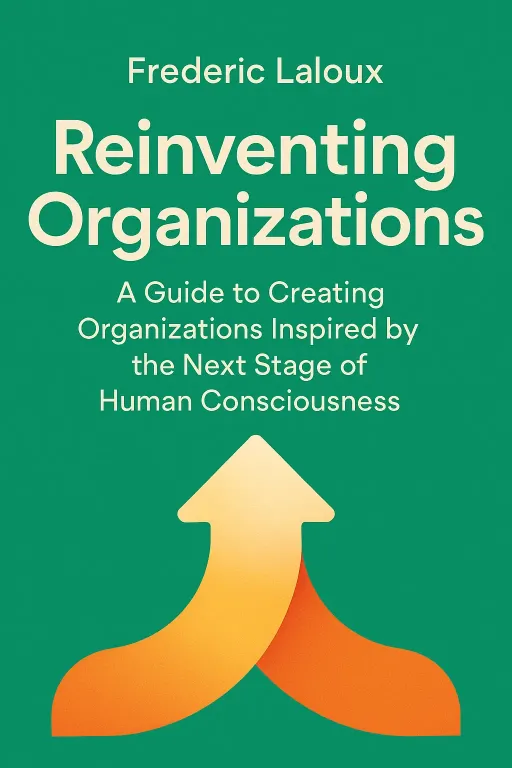
Nova: That is exactly the friction point we are tackling today. We are looking at how to move from that rigid, machine-like structure to something organic and alive. We are diving into two essential texts. First, Reinventing Organizations by Frederic Laloux, which completely changed how we think about corporate structure. And second, Leadership from the Inside Out by Kevin Cashman, which argues that you cannot change the organization until you change the person running it.
Atlas: I have heard the term Teal Organizations thrown around in boardrooms, usually by people who just want to sound innovative. But I am curious about the substance. Laloux was a McKinsey consultant, right? He spent years looking at what actually works in the corporate world.
Nova: He was. And that is what makes his work so compelling. He did not come at this as a theorist sitting in an ivory tower. He was inside the machine, watching it grind people down. He realized that the way we run companies—with these heavy, top-down hierarchies—is a relic of the industrial age. It is designed for efficiency, not for human flourishing. When he started researching companies that operated differently, he found they functioned more like organisms than clocks.
Atlas: So, he looked for the exceptions to the rule.
Nova: Exactly. And then you have Kevin Cashman, who comes at this from the angle of an executive coach. He worked with thousands of leaders and realized that even if you install the perfect organizational structure, it fails if the leader has not done their own internal work. You can put a person in a self-managing environment, but if they are terrified of losing control, they will try to recreate the hierarchy the moment a crisis hits.
The Shift to the Living Organism
SECTION
Atlas: Let’s pull on that thread of the living organism. I think most people reading Laloux would struggle with the idea of a company without a clear manager. If I am an employee, and I do not have a boss telling me what to do, how do I know if I am doing the right thing? Does that not just lead to total anarchy?
Nova: It is a common fear. But Laloux argues that self-management is not about having no structure. It is about having a different kind of structure. Think about your own body. You have a brain, but your heart, your lungs, and your immune system are not waiting for a memo from the brain every time they need to do their job. They have autonomy, but they are all aligned toward the survival and health of the whole system.
Atlas: That is a clean analogy. But in a company, people have conflicting interests. The marketing team might want to spend the whole budget, and the finance team wants to save it. Without a boss to arbitrate, how do they resolve that?
Nova: They use a process that Laloux highlights, which is often called the advice process. In these Teal organizations, you do not need permission from a manager to make a decision. You only need to seek advice from the people who will be affected by that decision and the people who have expertise in that area. You are responsible for the outcome, but the power to act is distributed.
Atlas: So, the power to act is distributed, but the responsibility remains with the individual. That is a massive shift. Most people are conditioned to avoid responsibility because they are afraid of the consequences if they get it wrong. In a traditional company, if you ask for permission and it goes wrong, you can blame the boss. If you make the decision yourself, you are holding the hot potato.
Nova: You hit on the exact psychological barrier. That is where the transition from Laloux to Cashman becomes critical. You cannot just flip a switch and tell people to be self-managing. If they are not confident in their own character, their own purpose, and their own self-awareness, they will crumble under that responsibility.
Atlas: That makes sense. I have seen this in my own professional life. You give someone freedom, and they freeze because they have spent twenty years being told exactly what to do. They do not know how to trust their own judgment.
Nova: And that is the tragedy of the traditional workplace. We train people to be followers, and then we are surprised when they do not act like leaders when we finally give them the chance. Cashman’s work suggests that we have been looking at leadership backward. We treat it like an external performance. We think leadership is about what you do, how you speak, and how you manage the bottom line. But he makes the case that true executive presence is an internal alignment.
The Internal Anchor
SECTION
Atlas: Let’s unpack that internal alignment. When you say internal, are we talking about emotional intelligence? Or is it something deeper?
Nova: It is deeper. Cashman talks about a hierarchy of mastery. It starts with self-awareness, then moves to character, then purpose, and finally, it cascades out into the organization. If you are not anchored in your own values, you are just reacting to the environment. And if you are just reacting, you are not leading. You are just a leaf blowing in the wind.
Atlas: I like that. A lot of leaders I have observed are basically professional firefighters. They spend their entire day putting out blazes that they probably helped start by not being clear about their own purpose. So, if I am a leader in this new, self-managing world, what does my day actually look like? If I am not giving orders, what am I doing?
Nova: You are building the container. You are fostering the environment where people can exercise that autonomy. You are the gardener, not the factory foreman. You are checking the soil, the light, and the water, not trying to force the plant to grow in a specific way.
Atlas: That sounds nice, but let's be pragmatic. Suppose I am in a high-pressure environment. A project is failing. The deadline is tomorrow. My team is stressed. If I take the gardener approach, I might lose the project. Does Laloux or Cashman have an answer for the moments where the house is actually on fire?
Nova: They do. And this is where the nuance comes in. They are not saying you abandon all direction. They are saying you shift from command-and-control to clear, purpose-driven guidance. In those moments of crisis, the leader’s role is to clarify the purpose and the constraints. You say, here is the destination we need to reach, and here are the boundaries we cannot cross. Then, you step back and trust the team to find the best route.
Atlas: So, you define the "what" and the "why," but you let them figure out the "how."
Nova: Exactly. And the reason that works is because of what Cashman emphasizes. When you define the purpose clearly, you are appealing to the team’s intrinsic motivation. People do not want to be cogs in a machine. They want to be part of something that matters. When you give them the "why," they will often find a "how" that is more creative and efficient than anything you could have dictated to them.
Atlas: It sounds like a massive trust exercise. And trust is the hardest commodity to manufacture in a business.
Nova: It is. And it is the most valuable one. Think about the energy wasted in traditional organizations. You have people spending hours preparing for meetings just to impress their bosses. You have people hiding mistakes because they are afraid of the consequences. That is a massive tax on productivity. When you move to a self-managing, purpose-driven model, that tax disappears. That energy goes back into the work.
Bridging the Gap
SECTION
Atlas: I am thinking about the listener who is stuck in a very traditional, hierarchical company. They are hearing this and thinking, this sounds great, but I am not the CEO. I cannot reinvent my organization. What do I do on Monday morning?
Nova: That is the most important question. You do not need to be the CEO to start this shift. You can start with your own sphere of influence. Cashman would say you start by mastering your own internal landscape. Ask yourself: what is my purpose? How am I showing up for my team? Am I a source of anxiety, or am I a source of clarity?
Atlas: And what about the Laloux side? How do I bring that into a team that is used to being told what to do?
Nova: You start with the Tiny Step. This is the perfect entry point. Instead of solving a problem for a team member, ask them: "What would you do if you had full ownership of this decision?"
Atlas: I love that. It is a simple question, but it is dangerous. It forces them to stop looking at you for the answer and start looking at the problem.
Nova: It is a forcing function for growth. When you ask that, you are signaling that you trust them. You are signaling that you value their judgment. And most of the time, they will come back with a solution that is just as good as yours, or even better. And if they come back with a bad solution, that is a coaching moment. You ask, "What data do you have to support that?" or "What are the risks you see?" You guide them to the answer rather than giving it to them.
Atlas: It sounds like a way to build a micro-culture of autonomy within a larger, more rigid system. You are creating a pocket of sanity.
Nova: Precisely. And those pockets grow. People notice when a team is performing better, when they are less stressed, and when they are actually solving problems instead of passing them up the chain. Success is the best advertisement.
Atlas: It makes me think about the long-term legacy. If we keep operating as machines, we are eventually going to burn out. The human element is the only thing that is truly renewable.
Nova: That is the core of it. We are in a transition period where we are realizing that the old model of management—which was really just a form of control—is hitting its limits. We have more information, more complexity, and more volatility than ever before. A rigid machine cannot handle that. It breaks. An organism adapts.
Synthesis & Takeaways
SECTION
Atlas: So, we have explored the shift from the machine to the organism. We have talked about the inner work required to lead that change. If I had to boil this down for someone who wants to take action today, what is the key takeaway?
Nova: It is that leadership is not something you do to other people. It is something you cultivate within yourself, which then allows others to step into their own power. The most powerful thing you can do is to stop being the bottleneck.
Atlas: I like that. Stop being the bottleneck. It is simple, but it is hard to do because it requires letting go of the ego. It requires admitting that you do not need to be the smartest person in the room.
Nova: And that is the ultimate test of character that Cashman talks about. Can you find your value in the success of others, rather than in your own ability to control the outcome?
Atlas: That is a high bar. But it is the only way to build something that actually lasts. I think that is a perfect place to leave our listeners. Start by asking the question. Start by giving ownership. Start by looking inward.
Nova: It is the only way to move forward. Thank you for diving into this with me today. It is a journey, and we are just scratching the surface.
Atlas: Always a pleasure to break these things down. This is Aibrary. Congratulations on your growth!