Beyond Assumptions: Diverse Lenses for Leadership
Golden Hook & Introduction
SECTION
Nova: Alright, Atlas, rapid-fire word association for 'leadership'. Go.
Atlas: Pressure. Spotlight. Decisions. Loneliness. Impact.
Nova: Whoa, 'loneliness' right in the middle there. That's a deep cut, but it actually perfectly sets the stage for today's deep dive. Because leadership, the real kind, is rarely what the glossy magazines make it out to be.
Atlas: No kidding. That feeling of being solely responsible, of having to project absolute certainty even when you’re grappling with uncertainty… it’s a universal experience for anyone in a high-stakes role.
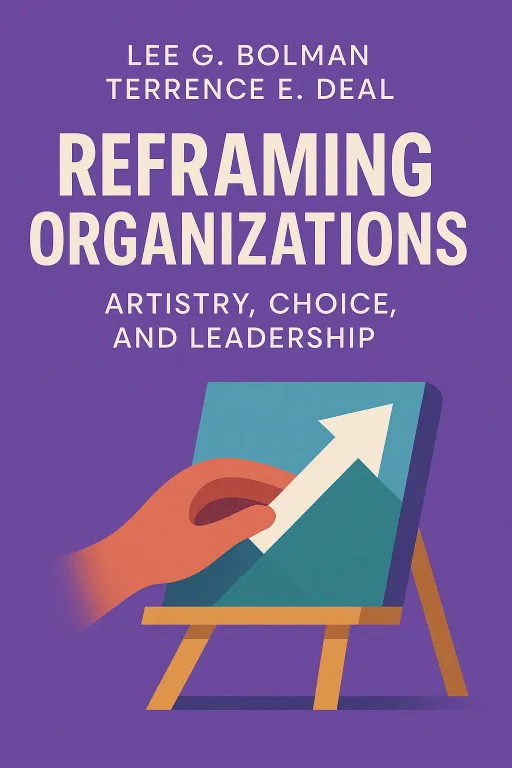
Nova: Absolutely. And that's exactly what we're dissecting today, pulling back the curtain on what it truly means to lead effectively and authentically. We're drawing insights from two incredibly powerful books: Lee G. Bolman and Terrence E. Deal's classic, "Reframing Organizations," and Jeffrey A. Kottler's wonderfully candid, "What You Don’t Know About Leadership, but Probably Should."
Atlas: Bolman and Deal's work is a foundational text in organizational studies, praised for giving leaders a practical diagnostic toolkit, almost like an X-ray vision for organizational problems. It’s widely taught in business schools for its enduring utility.
Nova: That's right. And then we have Kottler, who comes from a background in psychology and counseling, which allows him to bring this incredibly human and often vulnerable perspective to the leadership conversation, directly challenging those traditional, idealized narratives we so often encounter. Today, we're blending these two—the art of seeing clearly, and the courage of leading authentically.
Deep Dive into Core Topic 1: The Four Frames of Leadership
SECTION
Atlas: So, Nova, when you think about 'impact' as a leader, what's the first thing that comes to mind when you're facing a really tough organizational challenge? Often, my initial instinct is to look for a broken process or a structural issue.
Nova: That’s a common and very rational starting point, Atlas. And it's precisely where Bolman and Deal begin to challenge our single-lens thinking. They argue that leaders often view complex problems through just one frame, missing crucial aspects. They offer four distinct "frames"—Structural, Human Resource, Political, and Symbolic—to give us a much more comprehensive way to diagnose what's going on. It’s like having four different pairs of glasses, each revealing a different layer of reality.
Atlas: Four pairs of glasses? That sounds like a lot to juggle when you're in the thick of a crisis. How do you even know which one to pick?
Nova: Well, the power isn't in picking one, it's in. Let's take a common scenario: a rapidly growing tech startup that's suddenly struggling with missed deadlines and internal friction.
Atlas: Okay, I can picture that. High-pressure environment, fast growth, things start to fray.
Nova: Exactly. Now, if the leader only uses the, they'd look at the organization like a machine. They'd focus on the blueprint: are roles clearly defined? Are reporting lines efficient? Is the workflow optimized? They might decide they need to create new departments or implement stricter protocols.
Atlas: That makes perfect sense. Streamline, clarify, optimize. That’s the logical approach.
Nova: It is. But what if they do all that, and the problem persists? That’s when the becomes essential. Here, the organization is seen as a family, or a team. The leader asks: Are employees' needs being met? Do they feel empowered, engaged, and supported? Is there trust? Maybe those missed deadlines aren't about a faulty process, but about burnout, skill gaps, or a lack of psychological safety.
Atlas: Ah, so it’s shifting from "what's broken in the system" to "what's going on with the people." That's a huge difference, and it moves beyond just the visible symptoms.
Nova: Precisely. But even with structural and human resource solutions, sometimes issues linger. That brings us to the. This lens views the organization as an arena, a competition for scarce resources, power, and influence. The leader might discover that different departments have conflicting agendas, or certain individuals are protecting their turf, sabotaging changes. It’s about understanding power dynamics, alliances, and conflict.
Atlas: That sounds a bit cynical, but I can absolutely see how unspoken power struggles could derail even the best-laid plans. Especially in an environment where resources are tight.
Nova: It's not cynical, it's realistic. And finally, there's the. This is where the organization is seen as a temple, a tribe, a culture built on shared meaning, myths, and rituals. The leader asks: What are our core values? What stories do we tell ourselves? What are the unwritten rules? Perhaps that tech startup, despite its stated values of collaboration, inadvertently rewards individual heroism, creating a culture where asking for help is seen as weakness.
Atlas: So it's like peeling back layers, from the tangible structure to the unspoken culture. For leaders who are used to just fixing 'the problem' directly, this sounds like a massive shift in mindset. It demands a much deeper, more nuanced understanding of the entire ecosystem.
Nova: It absolutely does. It transforms blind spots into strategic advantages because you’re not just seeing problem; you’re seeing of interconnected challenges.
Deep Dive into Core Topic 2: The Uncomfortable Truths of Leadership
SECTION
Nova: Exactly, Atlas. And once you start seeing the full picture, with all its messiness, that's where Jeffrey Kottler steps in. Because seeing clearly often means confronting what we'd rather not see about leadership itself.
Atlas: You mean, the idealized version versus the messy reality?
Nova: That’s it. Kottler, drawing on his deep psychological insights, really challenges the heroic, almost superhuman, notions of leadership. He strips away the glossy veneer to expose the inherent paradoxes, the personal struggles, and the sheer 'messiness' that are part and parcel of the role.
Atlas: That leader's story hits close to home for anyone navigating high-stakes roles. It’s like we're all expected to be superheroes, but underneath, we're just trying to keep it together. How do you even begin to confront that kind of 'uncomfortable truth' when the pressure to perform is so immense?
Nova: Kottler argues that this pressure to perform, to always be strong and in control, is precisely the problem. He highlights the, where leaders are expected to command, yet often feel profoundly powerless over complex external forces. There's also the, the constant tension between being true to yourself and fulfilling the often rigid expectations of the leadership position.
Atlas: I know that feeling. It's that internal battle between who you authentically are and who you feel you to be for your team, your board, your stakeholders. It can be exhausting.
Nova: And that exhaustion often leads to the Kottler talks about: the self-doubt, the isolation, the imposter syndrome that many leaders quietly battle. He illustrates this with stories of leaders who appear confident externally, but are battling immense internal doubt and exhaustion. They maintain a facade, believing any crack in their armor would signal weakness.
Atlas: Wow, that’s actually really inspiring to hear it articulated so clearly. Because for many of us driven by a desire for mastery and impact, vulnerability can feel like a weakness. It’s a profound shift to consider that acknowledging imperfection could actually build resilience.
Nova: It’s a complete reframing. Kottler emphasizes that true strength comes not from denying these uncomfortable truths, but from acknowledging them. It's about self-awareness, empathy for your own struggles, and cultivating a more realistic, and ultimately more sustainable, approach to leadership. Embracing that messiness allows for more authentic connection with your team, too, because they see a human being, not just an unapproachable title.
Synthesis & Takeaways
SECTION
Nova: So, Atlas, when we bring these two brilliant perspectives together, what emerges is a really powerful dual approach to leadership. Bolman and Deal give you the diagnostic tools to see the organizational landscape with unparalleled clarity, from every angle.
Atlas: And Kottler then reminds us that while we're using those tools, we need to be radically honest about the human element, both in the people we lead and in ourselves. It's about finding previously unseen solutions, but also being honest about the 'uncomfortable truths' within ourselves that might be blocking us from even seeing those solutions, or implementing them effectively.
Nova: Exactly. True leadership effectiveness, the kind that creates meaningful impact and fosters authentic connection, comes from this powerful blend: intellectual rigor in understanding the system, combined with radical self-awareness and vulnerability in understanding yourself and others. It’s about building resilience not by ignoring struggle, but by confronting it, both in the organization and within.
Atlas: That's a profound understanding. It’s not just about what you as a leader, but who you when you're doing it, and how honestly you're willing to look at both. It’s about leveraging diverse lenses to navigate complex challenges, while nurturing your own well-being to sustain that journey.
Nova: Absolutely. So, for our listeners out there, what 'uncomfortable truth' about your own leadership are you willing to confront this week? And which of Bolman and Deal's frames might offer you a fresh perspective on a challenge you thought you already understood?
Atlas: A powerful challenge, Nova. Because real growth often starts not with new answers, but with better questions.
Nova: Absolutely. This is Aibrary. Congratulations on your growth!