

From Overwhelmed to Purpose-Driven
Golden Hook & Introduction
SECTION
Nova: What if I told you that being perpetually "busy" isn't a badge of honor, but a cleverly disguised trap? And that the true path to profound impact and deep satisfaction might actually involve doing?
Atlas: Whoa, doing less? For many of our listeners, especially those driven to achieve and make a real difference in their demanding fields, that sounds almost… counter-intuitive, if not outright heretical. We’re conditioned to believe more effort, more hours, more output equals more success.
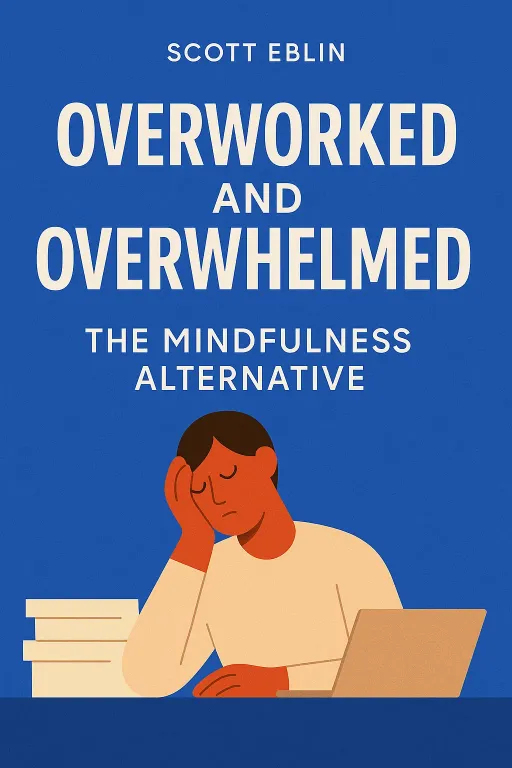
Nova: Exactly, Atlas. That relentless drive, that feeling of being caught on a hamster wheel of demands, is precisely the territory we’re exploring today. We’re pulling insights from two incredibly powerful books: Scott Eblin’s “Overworked and Overwhelmed,” which squarely tackles the relentless pace of modern professional life, and Nikos Mourkogiannis’s “Purpose,” a profound exploration into what truly drives organizational and personal greatness.
Atlas: Oh, I love that pairing. It’s almost like they’re two sides of the same coin, aren’t they? One diagnoses the illness of feeling constantly underwater, and the other offers a deeply fulfilling, perhaps even radical, cure. I imagine a lot of our listeners, the focused navigators and mindful achievers out there, feel that constant pull of too much to do, trying to keep all the plates spinning.
Nova: Absolutely. And they’re not alone. Eblin’s work highlights that this isn't just about poor time management; it's a systemic issue for high-achieving professionals who often find themselves trapped by the very success they've created. They’re excellent at what they do, so more gets piled on.
Atlas: That makes me wonder, how does someone even begin to break free from that cycle when the demands feel external and relentless? It’s one thing to to regain control, another entirely to do it when your inbox is overflowing and your calendar is a battlefield.
The Overwhelm Trap: Reclaiming Control
SECTION
Nova: That’s the core challenge Eblin addresses. He doesn't just say "work smarter, not harder." His approach is much more nuanced, focusing on strategies to regain control and reduce stress by shifting how we and to those excessive demands. Think of Sarah, a brilliant healthcare administrator. She started her career passionate about improving patient outcomes, but over the years, her role morphed.
Atlas: Right, like many in the healthcare sector, I imagine. High stakes, constant pressure, new regulations every other week.
Nova: Precisely. Sarah found herself drowning in meetings, regulatory paperwork, budget reviews, and endless emails. She was technically successful—promotions, accolades—but she felt completely disconnected from her initial purpose. She was always reacting, always putting out fires, feeling like a victim of her own success, utterly overwhelmed. The pressure was immense. She’d wake up already feeling behind.
Atlas: Oh, I know that feeling. It’s like you’re running a marathon, but someone keeps moving the finish line further away, and also adding obstacles. So, what did Eblin suggest for someone like Sarah? How do you even begin to untangle that knot of demands?
Nova: Eblin’s first step is really about conscious choice. He encourages professionals to identify where they are spending their time versus where they to spend it, aligning with their highest value contributions. For Sarah, this meant a radical re-evaluation. She realized she was saying 'yes' to every request, every meeting, every project, out of a sense of obligation or fear of missing out.
Atlas: But wait, how do you just saying yes when these demands often come from above, or from critical stakeholders? That sounds a bit out there for someone in a high-pressure environment. It’s not always a choice, right?
Nova: That’s a crucial point. Eblin isn't advocating for outright refusal, but for strategic re-negotiation and boundary setting. He suggests identifying your 'vital few' priorities—the 20% of activities that generate 80% of your impact—and then actively protecting time for those. For Sarah, this meant having candid conversations with her team and superiors. She proposed delegating certain tasks, streamlining approval processes, and even respectfully declining non-essential committee work, framing it in terms of her ability to deliver on her responsibilities.
Atlas: So basically you’re saying it's about being proactive about your boundaries, rather than just passively accepting everything? That’s a great way to put it. It’s like choosing your battles, but also choosing your focus.
Nova: Exactly. It’s about regaining agency. Eblin emphasizes that stress often comes from a perceived lack of control. By consciously choosing where to direct your energy, even in small ways, you begin to chip away at that feeling of being trapped. Sarah started blocking out "deep work" time in her calendar, something she never thought possible. She also began to delegate more effectively, empowering her team in the process. It wasn't an overnight fix, but it was a deliberate shift from reactive overwhelm to proactive management.
Atlas: I can see how that would be a relief. It’s not just about getting more done, but about feeling like you're steering the ship again, instead of just bailing water. That’s a powerful distinction.
Purpose as the Antidote: From Success to Impact
SECTION
Nova: And that naturally leads us to the second powerful idea we need to discuss, which often acts as the deeper, more profound antidote to overwhelm. What if the solution isn't just about managing the external chaos, but finding an internal compass that makes the chaos less… chaotic?
Atlas: An internal compass. I’m curious, how does that work? When you’re already swamped, finding a 'purpose' can feel like another item on an endless to-do list, a luxury for when you finally have time to breathe.
Nova: That’s a common misconception, Atlas. Nikos Mourkogiannis, in his book “Purpose,” argues that identifying and aligning with a clear, ethical purpose isn't a luxury; it’s the engine of true organizational and personal greatness. It shifts your focus from mere success—like Sarah's initial promotions and accolades—to deeply fulfilling impact.
Atlas: In other words, moving beyond just climbing the ladder to actually asking you’re climbing it, and what you’re building at the top.
Nova: Precisely. Mourkogiannis makes the case that purpose isn't just a mission statement on a wall; it’s a deeply held conviction that guides every decision, every action. It provides a moral compass and an intrinsic source of energy. Let’s consider two different leaders, both in demanding tech roles. One, David, is driven purely by market share, quarterly profits, and personal wealth. He's successful by traditional metrics, but constantly stressed, always chasing the next big win, feeling the same kind of overwhelm Sarah did.
Atlas: That sounds like a lot of people in high-growth industries. The goalposts keep moving, and the pressure never lets up.
Nova: Exactly. Now, imagine Maria, another leader in a similar tech space. She’s equally ambitious and drives a successful company, but her core purpose is to leverage technology to create accessible educational opportunities for underserved communities. Her company generates profit, yes, but that profit is a means to an end, not the end itself.
Atlas: So you’re saying Maria still faces challenges, still has deadlines and demands, but her underlying motivation is different?
Nova: Fundamentally different. When market conditions are tough, David sees existential threats to his personal success. Maria, while concerned, sees challenges to her. Her team, inspired by that purpose, rallies differently. They find creative solutions because the behind their work is so much stronger than just the. Mourkogiannis argues that this kind of purpose provides resilience, clarity, and a powerful, new source of energy that acts as a profound antidote to overwhelm. It’s not about having fewer demands, but about having a compelling reason those demands.
Atlas: Wow, that’s actually really inspiring. So, for our listeners who are feeling overwhelmed, how do they begin to find Maria moment, their own core purpose, especially if they’re just trying to get through the day? It can feel so abstract.
Nova: That’s where the practical application comes in. Mourkogiannis suggests it starts with deep reflection on your core motivations. What truly matters to you? What kind of impact do you genuinely want to make, beyond your job description? For Sarah, our healthcare administrator, her purpose was rekindled when she remembered her initial passion for improving patient lives. She started seeking out projects that directly contributed to that, even small ones.
Atlas: So it’s not about a grand, sudden revelation. It can be a gradual process, connecting the dots of your existing work to a deeper meaning. That makes sense. It's like re-framing your daily tasks from mere obligations into contributions to something bigger.
Nova: Absolutely. It’s about asking: "How does this small task I'm doing today, this email, this meeting, this report, align with a deeper personal or organizational purpose?" When you connect that small task to a greater 'why,' it transforms from a drain on your energy into a source of fulfillment. It's a healing moment, recognizing that your work isn't just about surviving, but about thriving with intention.
Synthesis & Takeaways
SECTION
Nova: So, what we’ve seen today is this incredible journey from simply managing the symptoms of overwhelm, as Scott Eblin helps us do, to fundamentally transforming our experience of work and life by aligning with a clear, ethical purpose, as Nikos Mourkogiannis illuminates.
Atlas: And the synergy between these two ideas is profound. Eblin gives us the tools to create space and regain control, while Mourkogiannis provides the compass to fill that space with meaningful direction. It’s not just about doing less, but about doing what truly matters, with intention.
Nova: Exactly. The pressure will always be there, especially for high-achievers. But when you re-frame your work around a strong purpose, it changes everything. That purpose doesn't eliminate the demands, but it provides a powerful antidote to the feeling of overwhelm, offering a new, intrinsic source of energy and resilience. It's about finding that deep reason to push through, transforming a chore into a contribution.
Atlas: That’s a hopeful way to look at it. It’s about moving from being a victim of circumstance to being the architect of your impact. For anyone feeling the weight of the world on their shoulders right now, that shift in perspective alone can be incredibly liberating.
Nova: Absolutely. And our tiny step for today, our actionable takeaway, is simple but powerful: we invite you to reflect on your core motivations in your current role. Can you identify just one small task you'll do today that directly aligns with a deeper personal or organizational purpose? It could be as simple as writing an email with renewed clarity, or approaching a meeting with a specific, purpose-driven outcome in mind.
Atlas: Think about it. That one small shift can start to ripple outwards, transforming your entire experience. We’d love to hear what you discover. Share your reflections with us on social media; let's build a community around finding purpose amidst the demands.
Nova: This is Aibrary.
Atlas: Congratulations on your growth!









