Bottom-Up Innovation Systems
Golden Hook & Introduction
SECTION
Nova: Forget the executive retreat brainstorms for a moment. The next multi-million dollar idea for your business? It’s probably already sitting, unsaid, in the mind of your newest recruit or your most seasoned warehouse operator.
Atlas: Whoa, really? That’s a bold claim, Nova. I mean, we’re taught to look to the C-suite for vision, for strategy, for those big, disruptive ideas that reshape industries. Are you saying we’ve been looking in the wrong place entirely?
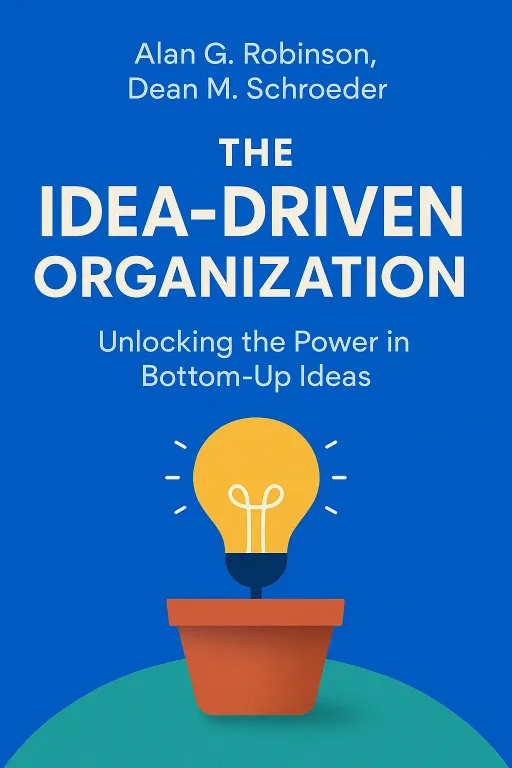
Nova: Not entirely the place, Atlas, but certainly not the place. Today, we’re unpacking a concept that truly challenges conventional wisdom about where innovation originates, drawing heavily from two incredibly insightful books: by Alan G. Robinson and Dean M. Schroeder, and by William C. Taylor. Robinson and Schroeder, after decades of deep dives into operational efficiency, delivered a bombshell: most organizations are leaving a staggering 80% of their improvement potential completely untapped.
Atlas: Eighty percent? That number alone should make any strategist or builder sit up and pay attention. For anyone striving for scalable success, that's not just a missed opportunity; it's practically a goldmine waiting to be discovered.
Nova: Exactly. And Taylor’s work then complements this by showing us what kind of leadership it takes to actually that gold. He highlights how the most successful leaders aren’t just smart strategists; they’re radical thinkers, willing to challenge every industry convention and seek inspiration in the most unexpected places. It’s about being brave enough to implement those radical changes, no matter where the idea came from.
Atlas: So, we’re talking about unlocking growth by marrying the wisdom of the crowd with the courage of leadership. That sounds like a powerful combination, especially when you’re trying to build resilient organizations.
Nova: Absolutely. It’s about creating systems that empower every employee to contribute ideas, while simultaneously fostering a leadership mindset that’s audacious enough to transform those ideas into tangible, radical improvements.
The Untapped Goldmine: Empowering Front-Line Innovation
SECTION
Nova: So, let’s dive into that 80% statistic. Robinson and Schroeder didn't just pull that number out of thin air. They found that in organization after organization, the vast majority of opportunities for improvement – whether it's reducing waste, enhancing customer experience, or streamlining a process – are best identified, and often best solved, by the people closest to the actual work.
Atlas: I can see that. The people on the ground, day in and day out, they’re the ones who feel the friction points, see the inefficiencies, and hear directly from the customers. They have an intimate understanding of the operational realities that a CEO, however brilliant, simply can’t possess from an executive suite.
Nova: Precisely. Think about it: a front-line service agent, after handling hundreds of calls about a specific product feature, develops an almost intuitive sense of where the design is failing, or where a communication breakdown is happening. A factory worker, performing the same task thousands of times, notices a subtle wobble in a machine or a slight inefficiency in a material flow that could save millions if addressed.
Atlas: But wait, if these ideas are so valuable, why aren’t organizations already tapping into them? Is it just a lack of communication channels, or something deeper? For a builder focused on efficient systems, this sounds like a fundamental flaw in how we design workplaces.
Nova: That’s a crucial question. It’s often a combination of factors. Historically, many organizations operate on a "command and control" model, where ideas are expected to flow top-down. There’s a perception that "thinking" happens at the top, and "doing" happens at the bottom. This creates a psychological barrier. Employees might feel their ideas aren't valued, or they might not even know to submit them, or worse, they might have tried and been ignored.
Atlas: I know that feeling. I imagine a lot of our listeners have experienced that, where they see a clear solution but the organizational inertia or hierarchy just swallows it whole. So, it's not just about having the ideas; it’s about having a to capture and act on them consistently.
Nova: Exactly. Robinson and Schroeder advocate for what they call "idea-driven management." It’s not just a suggestion box; it’s a culture where identifying problems and proposing solutions is part of everyone’s job description. It involves training, clear processes for submission and evaluation, rapid feedback loops, and most importantly, actually the good ideas.
Atlas: Can you give an example? Like how does this play out in a real-world scenario that isn't just a fleeting suggestion?
Nova: Absolutely. Imagine a large logistics company. For years, their delivery drivers had a specific, minor issue with the handheld devices they used for package scanning. It wasn't a critical bug, but a recurring glitch that added about 15 seconds to each delivery. On its own, 15 seconds seems negligible.
Atlas: But wait, if you multiply 15 seconds by hundreds of drivers, making hundreds of deliveries a day… that adds up fast. That's a significant operational drag.
Nova: Precisely! One driver, tired of the constant annoyance, sketched out a simple software tweak during his lunch break. He submitted it through the company's newly implemented "idea system." Within a week, it was reviewed by a small cross-functional team, prototyped, and tested. The fix was implemented company-wide within a month. That seemingly small, front-line idea, born out of daily frustration, ended up saving the company hundreds of thousands of dollars annually in fuel costs and operational efficiency, not to mention significantly improving driver morale.
Atlas: That’s a perfect example. It highlights how clarity of purpose and efficient systems can turn what seems like a minor annoyance into a huge competitive advantage. For anyone building a business model, optimizing those micro-efficiencies is absolutely critical for scalable success. It’s not just about the grand, disruptive innovations; it’s about the continuous, iterative improvements that keep you ahead.
Nova: And that iterative learning is key. It’s about building a muscle within the organization where everyone is constantly looking for ways to make things better, safer, or more efficient. It democratizes innovation.
Brave New Leadership: Cultivating Radical Change
SECTION
Nova: Now, while empowering everyone to generate ideas is foundational, it’s only half the equation for sustainable growth. That’s where William C. Taylor’s comes in. Because what good are brilliant ideas from the front lines if leadership isn't brave enough to actually implement them, especially the truly radical ones?
Atlas: That’s a fair point. For a strategist, the thought of implementing radical change in an established business can be daunting. There’s risk, there’s inertia, there’s the "but we’ve always done it this way" mentality. How does a leader overcome that, especially when the ideas might challenge the very core of their business model?
Nova: Taylor argues that the most successful leaders are those who are willing to completely break free from industry conventions. They don't just optimize within the existing framework; they question the framework itself. And a key part of that is looking for inspiration their own category.
Atlas: Outside their category? So, a bank looking at how a video game company fosters community, or a hospital studying how a high-end restaurant delivers personalized service? That sounds… counter-intuitive, if not outright risky, for some.
Nova: That’s exactly the kind of thinking Taylor champions. It moves beyond benchmarking competitors to completely reimagining what's possible. For instance, consider a traditional retail chain that was struggling with in-store customer engagement. Instead of looking at other retailers, their brave CEO visited a top-tier circus and a major music festival.
Atlas: A circus and a music festival? That’s definitely outside the box! What did they find?
Nova: They realized that these events excel at creating immersive, memorable experiences, building anticipation, and fostering a sense of community and wonder. The CEO then challenged his team to integrate elements of "spectacle" and "community-building" into their stores. They started hosting interactive workshops, collaborating with local artists for live performances, and even redesigned their store layouts to be more fluid and experiential, like a festival ground.
Atlas: Wow. That’s a massive leap. And I imagine there would have been a lot of internal pushback. "We sell clothes, not entertainment!" or "That's not what customers expect from us." For a builder, that level of disruption to established processes can feel like chaos.
Nova: Precisely. That's where the "brave" part of radical leadership comes in. It requires not just vision, but immense courage to champion ideas that might initially seem outlandish or financially unproven. It demands leaders who are not afraid to be wrong, who are willing to take calculated risks, and who can inspire their teams to embrace discomfort and experimentation.
Atlas: So, it’s not just about having a great idea, it’s about having the conviction to see it through, even when it feels like you're swimming upstream. And this ties back to our user profile: the visionary leader isn’t just seeing the future; they’re actively creating the conditions for others to see and build it, and then having the guts to back it up. That's true business model innovation.
Nova: And it requires building a culture of psychological safety where employees feel comfortable suggesting these radical, outside-the-box ideas, knowing they won’t be immediately shot down. It's a feedback loop: empowered employees generate more ideas, and brave leaders create the space for those ideas to flourish and transform the organization.
Synthesis & Takeaways
SECTION
Nova: So, what we’re really talking about today is a powerful synergy. Sustainable growth isn't just about one brilliant mind at the top, nor is it just about collecting a thousand small suggestions. It’s about merging the two.
Atlas: It truly is. It's about recognizing that clarity and scalable success come from truly listening to the people closest to the action, and then having the strategic courage to implement those insights, even if they challenge every convention. For anyone driven by growth and building resilient organizations, this isn't optional; it's foundational.
Nova: Absolutely. The takeaway from Robinson, Schroeder, and Taylor is clear: to drive sustainable growth, you must establish systems that empower every employee to contribute ideas. And simultaneously, cultivate a leadership stance that is brave enough to implement radical changes, drawing inspiration from anywhere and everywhere.
Atlas: It’s about embracing the power of iterative learning, right? Every step forward counts, whether it’s a 15-second process improvement from a delivery driver or a complete reimagining of the customer experience inspired by a circus. It all fuels sustainable growth.
Nova: Indeed. It’s a call to action for leaders to shift from being command-and-control figures to being cultivators of courage and curiosity, empowering their entire workforce to be agents of change. And for every employee, it's an invitation to recognize their own power to shape the future of their organization.
Atlas: That's actually really inspiring. It means everyone has a role to play in designing the future of commerce, in their own way.
Nova: Couldn't have said it better myself, Atlas. It's about unlocking the collective genius.
Nova: This is Aibrary. Congratulations on your growth!