The Human Element in Tech-Driven Work
Golden Hook & Introduction
SECTION
Nova: Atlas, I want to play a quick game. If I say "failed tech project," what's the first thing that comes to mind that people usually blame? Give me a witty, slightly sarcastic one-liner.
Atlas: Oh man, a failed tech project? Hmm. It’s always the software, right? Or the hardware. Or the "tight deadlines" that somehow only appear the project is already late. Definitely not the fact that Brenda from accounting accidentally deleted the main server with a rogue email attachment.
Nova: Exactly! That's the go-to, isn't it? We immediately look for the technical glitch, the process breakdown, the code that didn't compile. But what if I told you that the vast majority of problems in project management, especially in tech, aren't technological at all?
Atlas: Really? That sounds a bit out there. It feels like we're always chasing the next bug fix or the perfect agile methodology.
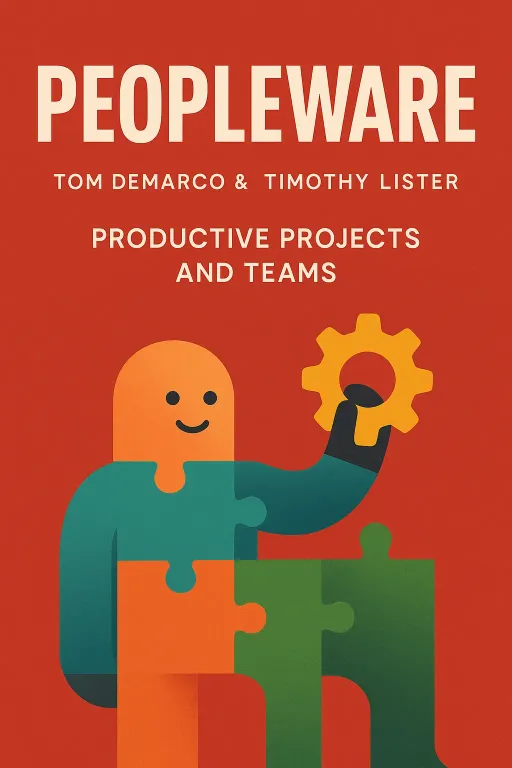
Nova: Well, prepare to have your conventional wisdom challenged because today we're diving into a truly foundational book: "Peopleware: Productive Projects and Teams" by Tom DeMarco and Timothy Lister. These aren't abstract theorists, by the way. DeMarco and Lister are seasoned software engineers and consultants who, over decades, observed countless real-world projects, seeing firsthand why some soared and others crashed. Their conclusion was revolutionary then, and it remains profoundly relevant today.
Atlas: So, they're saying the problem isn't the bytes and the code, it's... us? The humans actually building the stuff?
Nova: Precisely. They argue that the major problems in project management are not technological but profoundly sociological. It’s a counter-intuitive idea that flips the script on how we typically approach efficiency and innovation in tech-driven work.
The Myth of Technical Problems: Why Peopleware Says It's Always About the Humans
SECTION
Nova: "Peopleware" really makes a compelling case for prioritizing people over processes. Think about it: how often do we hear about a project failing because the code was inherently flawed, versus a project failing because the team was burnt out, miscommunicated, or constantly interrupted?
Atlas: I can definitely relate to that. My inbox alone feels like a constant interruption machine. But I guess that makes sense. We always look at the tangible things—the tech stack, the budget, the timeline. It’s easier to point to a line of buggy code than to admit the team morale is in the basement.
Nova: Exactly! DeMarco and Lister highlight how human factors—things like team dynamics, the physical office environment, and individual motivation—are the true determinants of project success or failure. They share anecdotes of projects with all the "right" technical solutions in place, state-of-the-art tools, brilliant individual engineers, yet they still floundered.
Atlas: Okay, so what kind of "sociological" issues are we really talking about here? Give me a concrete example. Is it just like, people being grumpy?
Nova: It goes deeper than grumpiness. Imagine a brilliant team of developers, highly skilled, working on a critical system. Management decides to move them into a noisy, open-plan office, hoping to foster "collaboration." But these are "thinking workers"—they need deep concentration. They’re constantly interrupted by conversations, phone calls, impromptu meetings. Their productivity plummets, not because they're less skilled, but because their environment actively prevents them from doing their best work.
Atlas: Wow. That's a powerful image. It’s like giving a surgeon the best tools but making them operate in a crowded, loud cafeteria. They have the skill, but the environment completely undermines it.
Nova: That’s a perfect analogy, Atlas. The book is filled with observations like this. They talk about "flow state," that deep, immersive concentration where true creative work happens. And how easily that state is broken by constant interruptions, by the anxiety of being watched, or by unrealistic, constantly shifting deadlines.
Atlas: So, it’s not about finding the most technically gifted individual, it’s about creating a habitat where good thinking worker can actually and produce their best work? That feels very different from the usual "grind harder" mantra.
Nova: It absolutely is. And it’s why they call their strategies "counter-intuitive." The conventional approach is often to add more process, more oversight, or more technology to solve a problem. "Peopleware" suggests we need to step back and look at the human system. If the human system is broken, no amount of technical wizardry will fix it.
Atlas: That makes me wonder, how much of what we perceive as "technical debt" or "project delays" is actually just a symptom of underlying human and environmental problems? It's a huge shift in perspective.
Cultivating the 'Thinking Worker': Creating Environments Where Genius Thrives
SECTION
Nova: And that naturally leads us to the second key idea: if the problems are sociological, then the solutions must also be sociological. DeMarco and Lister offer compelling, often surprisingly simple, strategies for fostering productive teams and creating a work environment where these "thinking workers" can truly thrive.
Atlas: Hold on, "counter-intuitive" strategies for management. Does that mean bosses should just... leave people alone? That sounds risky in a deadline-driven, highly competitive world. Management usually feels the need to be involved, not less.
Nova: It’s not about absence, it’s about a different kind of presence. One of their core ideas is providing quiet, private space. Not necessarily individual offices for everyone, but at least environments that allow for sustained concentration. They advocate for protecting people from interruptions, fostering a culture of trust rather than micromanagement, and giving teams significant autonomy over how they approach their work.
Atlas: But isn't that a luxury? In many startups or fast-paced environments, it's all about open communication, quick pivots, and constant collaboration. How does "being left alone" fit into that?
Nova: "Peopleware" argues that true collaboration often requires periods of deep individual work first. You can't effectively brainstorm or integrate ideas if you haven't had the uninterrupted time to form those ideas in the first place. They cite cases where companies saw dramatic improvements in quality and delivery simply by providing more private, controllable workspaces and by reducing forced overtime.
Atlas: So, it’s not about working hours; it’s about making the hours you work incredibly effective. And that means respecting the need for deep focus. That's actually really inspiring. It’s like, instead of trying to squeeze more juice out of a lemon, you're cultivating a whole orchard by providing the right soil and light.
Nova: Precisely! They emphasize that management’s primary role isn't to be a taskmaster, but to be an enabler—to remove obstacles, to provide the resources, and crucially, to create a psychologically safe environment where people feel trusted and valued. It’s about building a culture where individuals feel empowered to innovate and take ownership, rather than just following orders.
Atlas: That gives me chills, honestly. It implies a fundamental trust in your team members, which is often missing in high-pressure environments where fear of failure can dominate. It's almost a philosophical shift in how we view work itself.
Nova: It is. They suggest that the best teams often act like well-oiled social organisms, self-organizing and self-correcting, but only when given the space and trust to do so. This approach, they contend, leads not just to happier employees, but to vastly superior project outcomes and higher quality products. It's the ultimate win-win, even if it feels counter-intuitive to managers trained in command-and-control styles.
Synthesis & Takeaways
SECTION
Nova: So, what DeMarco and Lister reveal in "Peopleware" is a profound truth: the most sophisticated technology in the world is still built, maintained, and often derailed by human beings. Our capacity for brilliance, innovation, and collaboration is immense, but it's also incredibly fragile and dependent on the environment we create.
Atlas: That makes so much sense. Whether you're a manager wrestling with project delays, or just someone on a team feeling the squeeze, understanding this means you can start looking beyond the surface-level "technical" problems and pinpoint the real, human roadblocks. It's about questioning the default assumptions.
Nova: Absolutely. The book is a powerful reminder that if we want truly productive, innovative, and sustainable work, we have to start by designing for the human element first. It's not just a nice-to-have; it's the fundamental lever for success.
Atlas: And it’s a timeless lesson. Even as technology evolves at breakneck speed, the core of what makes humans thrive—or falter—in a work environment remains surprisingly consistent. Maybe the best tech solution isn't a new piece of software, but a quiet room and a trusting boss.
Nova: A powerful thought to leave our listeners with.
Atlas: Indeed. We encourage all of you to reflect on your own work environments. What "sociological" factors are at play that might be impacting productivity or morale?
Nova: This is Aibrary. Congratulations on your growth!