The Strategic Integrator's Edge: Mastering Decision-Making Under Uncertainty
Golden Hook & Introduction
SECTION
Nova: Most people think of decision-making as a quest for certainty. You gather all the data, you weigh the facts, and then you make the 'right' call. What if that entire premise is fundamentally flawed, especially when the stakes are highest?
Atlas: Hold on, Nova. That sounds almost… heretical. For anyone operating in high-stakes environments, like macro trading or leading a large organization, the entire game feels like it's about reducing uncertainty, finding that 'sure thing.' Are you saying we've been chasing a phantom?
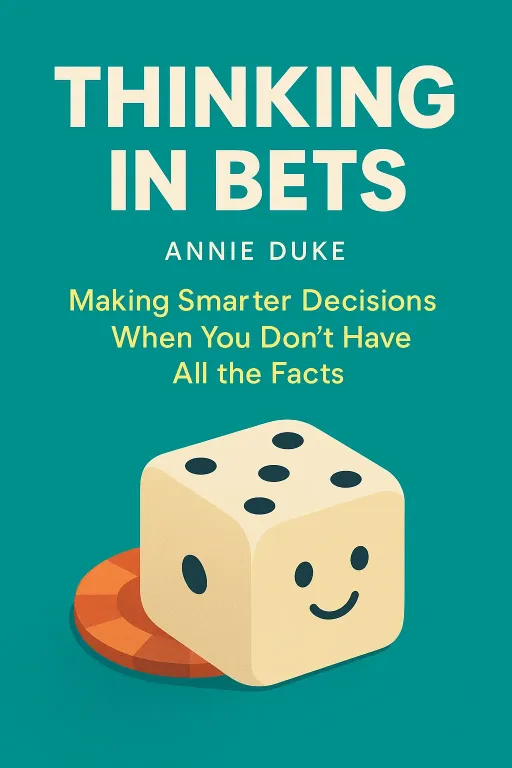
Nova: Absolutely. And it's a phantom that leads us astray more often than we realize. Today, we're diving into two groundbreaking works that dismantle this illusion and offer a far more robust path to better judgment: Annie Duke's "Thinking in Bets: Making Smarter Decisions When You Don't Have All the Facts" and "Noise: A Flaw in Human Judgment" by Daniel Kahneman, Olivier Sibony, and Cass R. Sunstein. What's fascinating about Duke is her background as a professional poker player. She brings a battle-tested perspective from a world where uncertainty is the only constant, directly applying high-stakes probabilistic thinking to strategic decisions. Kahneman, of course, is a Nobel laureate, and 'Noise' continues his groundbreaking work on understanding our cognitive blind spots.
Atlas: Okay, so these aren't just academic musings. These are insights from people who live and breathe high-risk, high-reward scenarios. For someone who seeks mastery, who wants to integrate better decision-making into both their trading and their leadership, how do these ideas bridge that gap? How do they help someone who needs to be both a precise analyst and an influential leader?
Nova: Excellent question, Atlas, because they fundamentally challenge our intuitive approach to judgment. Today we'll dive deep into this from two perspectives. First, we'll explore the power of 'thinking in bets' to embrace probabilities in an uncertain world. Then, we'll discuss the hidden enemy of 'noise' and how it distorts our decisions, offering practical tools to sharpen your judgment in high-stakes environments.
Deep Dive into Core Topic 1: Embracing Probabilities – The 'Thinking in Bets' Mindset
SECTION
Nova: So, let's start with Annie Duke. Her core argument is that we need to stop judging the quality of a decision by its outcome. A good decision can lead to a bad outcome because luck plays a massive role. Conversely, a bad decision can sometimes lead to a good outcome purely by chance.
Atlas: Wait, that’s counterintuitive. Our entire society, especially in finance, is built on results. If you win, you're brilliant; if you lose, you made a mistake. Are you saying we should ignore the results? Like, if a trader makes a risky bet that pays off big, we shouldn't necessarily celebrate their decision-making process?
Nova: Exactly! That's what Duke calls "outcome bias." We look at a positive outcome and retrospectively declare the decision brilliant, even if the odds were terrible. Imagine a poker player who goes all-in on a terrible hand and wins because of an improbable river card. Was that a good decision? Absolutely not. It was a high-risk, low-probability gamble that happened to pay off.
Atlas: But how does this really apply when you're making a multi-million dollar trading decision, where the stakes feel so much higher than a poker game? It feels like you certainty there. You're analyzing market trends, economic indicators, geopolitical events… you’re looking for the 'sure thing' to protect your capital and your team.
Nova: And that's the trap. The 'sure thing' is almost always an illusion, especially in complex systems like markets. The key is to recognize that every decision, no matter how much data you have, is a bet. It has a probability of success and a probability of failure. The skill isn't in finding certainty, it's in accurately assessing those probabilities and making the choice that offers the best expected value over the long run, even if it doesn't pay off every single time. Think of it like this: a truly skilled trader might make ten trades. Seven are high-probability, well-researched decisions, but two of those seven still lose due to unforeseen market shifts. Then, they might make three low-probability, speculative trades, and one of those accidentally hits big. If you only look at the outcomes, it’s a mixed bag. But if you analyze the, the probabilistic thinking, you see a consistently good decision-maker, even with occasional losses.
Atlas: I guess that makes sense, but it’s hard to shake that feeling. For leaders, the pressure to always be 'right' is intense. If you tell your team, "This is a 70% chance of success," it doesn't sound as confident as "This succeed." How does one practically assign probabilities to something as complex as a new market entry or a strategic pivot, especially for someone who wants to integrate this into their leadership to build resilience?
Nova: It's a muscle you build. Duke suggests starting small. Before your next major decision, list three possible outcomes and assign a probability to each, then compare it to your initial gut feeling. This tiny step immediately reveals your own probabilistic blind spots. It makes you ask: "What's the full range of possibilities here, not just my preferred one?" And crucially, it helps build resilience because you're mentally prepared for different scenarios, rather than being blindsided when the 'certain' outcome doesn't materialize. It’s about building a more robust decision process, which is exactly what a resilient architect needs.
Deep Dive into Core Topic 2: Mitigating 'Noise' – Unwanted Variability in Judgment
SECTION
Nova: And speaking of illusions, while we're busy chasing certainty, there's another insidious force quietly corrupting our decisions: noise. This is where Kahneman, Sibony, and Sunstein's work in "Noise" comes in. This book reveals how unwanted variability in human judgment distorts decisions, often without us even realizing it.
Atlas: Wait, so it's not just about bias? I thought if we just corrected our biases, like confirmation bias or anchoring bias, we'd be golden. What exactly is 'noise' then, and how is it different? I mean, for a strategic integrator, we're constantly trying to remove subjective elements, so this sounds like another layer of complexity.
Nova: It is another layer, and it's pervasive. Bias is a systematic deviation from the truth – a predictable error in one direction. For example, consistently overestimating your own abilities. Noise, on the other hand, is unwanted in judgment. It's when different people, or even the same person at different times, arrive at different judgments for the same case, without any systematic reason. Imagine two identical loan applications reviewed by two different loan officers. One gets approved, the other rejected. That's noise. Or a doctor diagnosing the same patient differently on a Monday morning versus a Friday afternoon.
Atlas: That's actually really unsettling. If even experts are prone to 'noise,' and it's not a systematic bias, how can a leader ensure their team's strategic decisions aren't just a roll of the dice? For someone who wants to integrate these ideas into their leadership, how do they even begin to identify and mitigate this 'noise' in their own thinking or their team's? It feels like an invisible enemy.
Nova: It absolutely can feel invisible, and that's its danger. Kahneman and his co-authors highlight how noise costs organizations billions. Consider the criminal justice system: two judges, same crime, similar circumstances, wildly different sentences. That's noise. It's not necessarily a bias against a particular group, but simply inconsistent judgment. To mitigate it, they propose "decision hygiene." This involves structuring decisions, breaking them down into independent parts, and getting independent assessments before combining them. Think of it like a checklist in aviation or surgery.
Atlas: So, it's about creating a more standardized, structured process even for complex, seemingly subjective decisions? That resonates with the idea of a 'Resilient Architect' – building robust systems. But how do you prevent that from stifling creativity or innovative thinking, especially in a dynamic trading environment where new variables emerge constantly?
Nova: It’s not about removing human judgment; it’s about improving its consistency and quality. For a leader, it could mean having multiple team members independently analyze different aspects of a market opportunity before coming together to discuss. Or, using structured templates for evaluating investment proposals. The goal is to reduce those irrelevant factors – like what you had for breakfast, or the weather outside – from unconsciously influencing a critical decision. It’s about being purposeful in your influence, ensuring that your team's collective intelligence isn't undermined by random variability.
Synthesis & Takeaways
SECTION
Nova: So, when you bring these two ideas together – embracing probabilities with 'thinking in bets' and actively mitigating 'noise' – you get a truly powerful framework for superior decision-making. True mastery isn't about eliminating uncertainty or chasing an illusion of certainty. It's about skillfully dancing with uncertainty, understanding its probabilistic nature, and ensuring your judgments are as consistent and rational as possible.
Atlas: So, it's not about being 'right' all the time, but about being 'less wrong' more consistently, and having a more robust process. It's about building a system for better outcomes, not just relying on gut feelings or hoping for the best. What's the one tiny step listeners can take right now to apply this?
Nova: The simplest, yet most profound step: Before your next major decision, list three possible outcomes and assign a probability to each. Then, compare those probabilities to your initial gut feeling. Just doing that will start to reveal your own probabilistic blind spots and expose potential noise in your initial assessment. It forces you to consider the full spectrum of possibilities.
Atlas: That's a powerful tiny step. It really ties into that drive for mastery and making a difference. It’s about building better systems for better outcomes, not just hoping for the best. It's about integrating a more resilient, purposeful approach to every decision.
Nova: Exactly. When you embrace probabilities and reduce noise, you're not just making better decisions; you're building a more resilient, influential, and ultimately, a more purposeful approach to everything you do. It's about sharpening your judgment, making you a more effective leader, and a more strategic integrator.
Atlas: That's a profound thought to leave our listeners with.
Nova: This is Aibrary. Congratulations on your growth!