

The Art of Letting Go: Radical Delegation for Growth
Golden Hook & Introduction
SECTION
Nova: Atlas, quick game. I'll give you a common business cliché, and you hit me with the five-word reality check. Ready?
Atlas: Oh, I like that. Bring it on, Nova. My reality checks are fully charged.
Nova: Alright, here's the first: "If you want something done right, do it yourself."
Atlas: "Control freaks create exhausted teams."
Nova: Whoa! Straight for the jugular! Okay, next one: "Hard work always pays off."
Atlas: "Busy work hides real impact."
Nova: Ouch. And finally: "Delegate everything, kick back, relax."
Atlas: "Offloading tasks isn't true leadership."
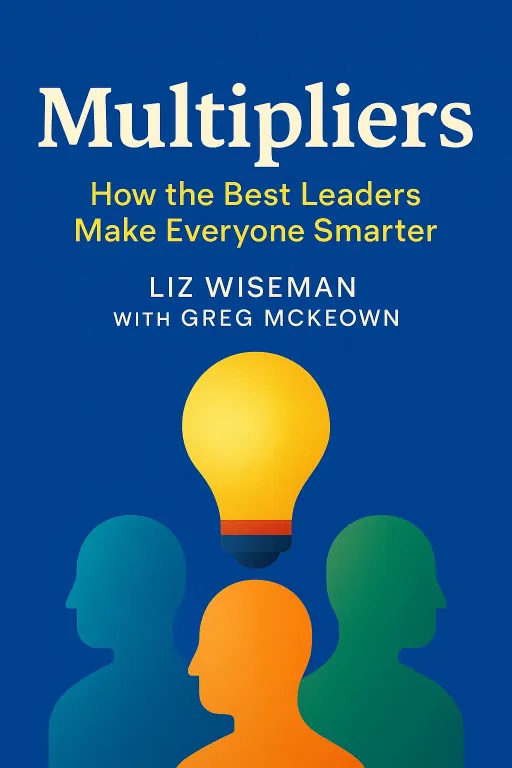
Nova: Perfect! Because those five-word reality checks perfectly set the stage for today's topic, which is all about the transformative power of delegation, not as a shortcut, but as a strategic art form. We’re diving into "The Art of Letting Go: Radical Delegation for Growth," pulling insights from two incredibly impactful books: Liz Wiseman's "Multipliers" and Timothy Ferriss's "The 4-Hour Workweek."
Atlas: Yes! And what I find so fascinating about Liz Wiseman's work in "Multipliers" is how she didn't just theorize about leadership; she spent years studying actual leaders across hundreds of companies, meticulously categorizing behaviors that either amplified or diminished intelligence. It wasn't just a hunch; it was data-driven insight into how some leaders inadvertently suck the life out of their teams while others, well, multiply it.
Nova: Exactly. It's not just about getting tasks done; it’s about an entire philosophy of leadership. And for our listeners, the visionaries and architects building sustainable ecosystems, this isn't just theory. This is the blueprint for unlocking your team's collective genius.
Empowering Genius: The Multiplier Mindset
SECTION
Atlas: Okay, so let's jump straight into this 'Multiplier' concept. I imagine a lot of our listeners, especially those driven by impact and seeking mastery, might be thinking: "I already empower my team. I delegate stuff all the time. What's so radical about this?"
Nova: That’s a great question, because true radical delegation, as Wiseman describes, goes far beyond just assigning tasks. She brilliantly outlines the difference between 'Multipliers' and 'Diminishers.' A Diminisher is that leader who, often unintentionally, drains intelligence and capability from their team. They might be the 'idea guy' who always has to have the best idea, or the 'savior' who jumps in to fix everything, or even the 'micromanager' who controls every detail.
Atlas: Oh man, I know that feeling. It’s like, you come to the table with a brilliant idea, and they just… take it, tweak it, and suddenly it’s brilliant idea. Or you're knee-deep in a project, and they swoop in, "just to help," but really they're just doing it for you. It’s soul-crushing.
Nova: Exactly! And the intention might be good, but the impact is devastating. Multipliers, on the other hand, are the genius makers. They're not necessarily the smartest people in the room, but they're the ones who make everyone else smarter. They create an environment where the best ideas can emerge from anywhere, where people feel safe to take risks, and where ownership is truly distributed.
Atlas: So you’re saying it's less about their individual brilliance and more about their ability to cultivate brilliance in others? Like a gardener cultivating a thriving ecosystem, rather than just being the biggest, most impressive plant in the garden?
Nova: That’s a perfect analogy! Wiseman found that Multipliers don't just delegate tasks; they delegate and. They pose challenging questions instead of giving answers. They create space for debate and divergent thinking. They treat mistakes as learning opportunities, not failures to be punished. They essentially ask, "How can I get 100% of the team's brainpower working on this problem, not just 10%?"
Atlas: Wow, that’s actually really inspiring. Because as a visionary, you want to build a sustainable ecosystem, and you can't do that if you're the single point of failure or the only source of innovation. But what's the core difference in their approach to delegation then? Is it just about letting go, or is there a specific technique?
Nova: It’s definitely not just 'letting go.' It's a deliberate, strategic act. A Diminisher might delegate by saying, "Here, do this task exactly how I showed you." A Multiplier delegates by saying, "Here's the problem we need to solve, here are the resources, and I trust you to figure out the best way to get there. I'm here to support, not to direct." It's about giving away the and focusing on the and.
Atlas: So, it's about amplifying the intelligence that's already there, and even fostering new intelligence. I can see how that would not only boost results but also create a much more engaged and innovative culture. It aligns perfectly with building a high-performance culture, which many of our listeners are striving for. But how does this connect with the idea of leveraging time and automation? Because that sounds like a different beast entirely.
The New Rich: Leveraging Time for Radical Freedom
SECTION
Nova: That's a brilliant segue, Atlas, because while Wiseman focuses on empowering people, Timothy Ferriss, in "The 4-Hour Workweek," brings in the element of radical efficiency and leveraging systems, which is another form of radical delegation. He challenges the entire premise of the traditional 9-to-5, or even 9-to-9 grind, by asking: "What if you could achieve disproportionate results with minimal time input?"
Atlas: I mean, that sounds almost too good to be true. For someone who's constantly pushing for growth and trying to build something lasting, the idea of a '4-hour workweek' could sound like… well, a fantasy. Like it's for people who want to escape work, not master it.
Nova: That’s a common misconception about the book, actually. Ferriss isn't advocating for laziness; he's advocating for – or, more accurately,. He argues that most of what we do in a typical workday is busywork, not impactful work. His core idea is to identify the 20% of activities that generate 80% of the results, and then ruthlessly eliminate, automate, or outsource the rest.
Atlas: So, it's about optimizing for output and impact, rather than just clocking hours. That resonates with the visionary who wants to create lasting value. But how does this apply to delegation? Is it just about handing off low-value tasks?
Nova: It's more profound than that. Ferriss introduces the concept of the "New Rich," who aren't necessarily billionaires, but individuals who have maximized their "time income." They achieve this by strategically delegating and automating everything that doesn't require their unique genius. This often means outsourcing not just mundane tasks, but entire processes, to virtual assistants or specialized services, freeing up their own time for high-leverage activities, creative pursuits, or simply enjoying life.
Atlas: That makes me wonder, though. For a leader who's trying to foster a high-performance culture, how do you balance Ferriss's approach of outsourcing and automating with Wiseman's idea of empowering your internal team? Isn't there a tension there between leveraging external resources and developing internal talent?
Nova: Absolutely, and that's where the art comes in. It's not an either-or. A Multiplier knows when to empower their team to take ownership and innovate, and they know when a task is simply a commodity that can be efficiently handled by an external resource, freeing up their internal team to focus on higher-value, more creative problems. Imagine a leader who delegates a complex strategic project to a rising star on their team, while simultaneously outsourcing all their email management and scheduling to a virtual assistant. Both are forms of radical delegation, serving different but complementary goals.
Atlas: So, the goal isn't just to offload; it's to strategically position your own genius, and your team's genius, on the problems that truly matter. It’s about creating maximum leverage, both human and systemic. That’s a powerful insight for anyone looking to scale their impact without scaling their personal workload. It’s not about working less for the sake of it, but working smarter to achieve more profound results and personal freedom.
Synthesis & Takeaways
SECTION
Nova: Precisely, Atlas. The "Art of Letting Go" isn't about laziness or escaping responsibility. It's about a radical commitment to growth – your own, and your team's. It's about understanding that your desire for control, while well-intentioned, can often be the single biggest limiter to innovation, ownership, and ultimately, your impact.
Atlas: That's a powerful challenge, because it forces us to confront that deep question: What area are we holding onto simply out of a desire for control, and how might that be inadvertently limiting our team's potential? It's not just about productivity; it’s about unlocking human potential.
Nova: And that's the profound insight here. When you embrace radical delegation – whether it’s empowering a team member to own a process or leveraging automation to free up your own high-value time – you're not just reorganizing tasks. You're fundamentally reshaping your leadership, your culture, and your life. You're moving from being an individual contributor, no matter how brilliant, to a true multiplier of genius.
Atlas: It's transformative. So, for our listeners, that tiny step we talked about earlier: identify one recurring task you currently do that could be delegated. Document the process, empower a team member to own it. Or, if it's a more mundane task, explore how you might automate or outsource it. The goal is to free up your own genius, and the genius of those around you, to focus on the things that truly move the needle.
Nova: Exactly. It's about letting go to grow. It’s about trusting your evolving vision and practicing the radical delegation necessary to build the sustainable ecosystems you envision. This is Aibrary. Congratulations on your growth!









