Rebuilding Trust in Accelerated Growth
Golden Hook & Introduction
SECTION
Nova: Silicon Valley famously told us to move fast and break things. But they forgot to mention that the thing we end up breaking most often is trust, and once trust is broken, everything slows to an absolute crawl.
Atlas: That is a massive shift from the usual move fast and break things narrative we have been fed for the last two decades. I mean, we have practically worshipped the ground of leaders who just run through brick walls, regardless of the collateral damage.
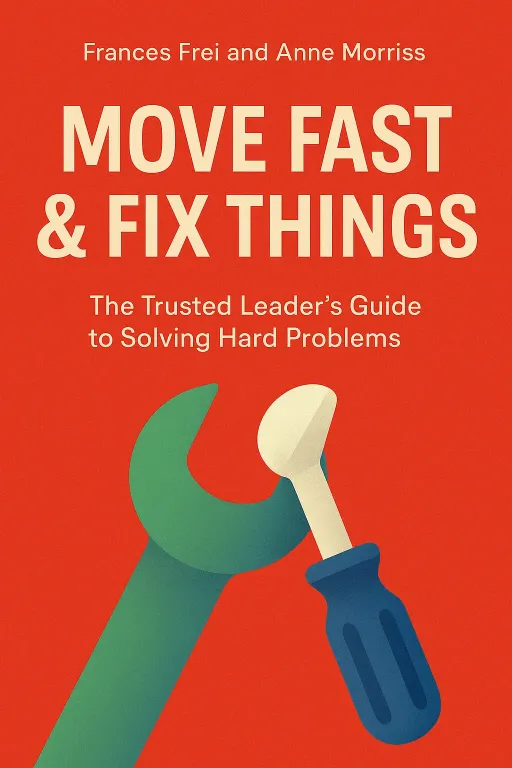
Nova: We absolutely have. But today we are looking at a brilliant counter-strategy. We are diving into the book Move Fast and Fix Things, written by Frances Frei and Anne Morriss. What makes this book so incredible is the background of the authors. Frances Frei is a Harvard Business School professor who was actually brought into Uber as their Senior Vice President of Leadership during their massive cultural crisis. She was literally tasked with rebuilding trust in one of the most toxic, high-speed corporate environments in recent history.
Atlas: Oh, I remember that period. It was a complete public relations nightmare for them. It seemed like every week there was a new headline about culture problems. So she was actually in the trenches, applying these theories in real time while the world was watching.
Nova: Exactly. She and Anne Morriss created a practical, five-day framework to show leaders how to solve complex problems and accelerate change, by integrating speed with trust rather than sacrificing one for the other.
Atlas: That sounds like exactly what our listeners need. Let us face it, when you are trying to scale a business or lead a team, you feel this constant pressure to choose between moving quickly and keeping everyone happy. How do they suggest we bridge that gap?
The Speed-Trust Paradox
SECTION
Nova: The core of their argument is that speed and trust are not opposing forces. We often treat them like a trade-off, thinking we have to slow down to build trust, or run fast and accept that trust will be damaged. The authors argue that trust is actually the ultimate accelerator. When trust is high, organizations move at lightspeed because there is no friction.
Atlas: I can see that. When you do not trust someone, you double-check their work, you BCC five people on every email, and you schedule three meetings to discuss a single decision. That is where all the speed goes to die.
Nova: You have nailed it. That is the trust tax. To help us understand how to build this trust, Frei and Morriss introduce what they call the Trust Triangle. It has three distinct drivers, authenticity, empathy, and logic. If all three are strong, you have maximum trust. But if even one of these legs is wobbly, the whole structure collapses.
Atlas: Let us break those down because they sound simple, but I bet the execution is where people trip up. Authenticity is the first one. Why is that a speed factor?
Nova: Authenticity means people believe they are experiencing the real you. If they feel you are wearing a mask, or holding back information, they start playing detective. They spend half their cognitive energy trying to figure out your hidden agenda instead of doing the work. That translation process slows down every single interaction.
Atlas: That makes complete sense. It is like trying to read a coded message instead of just reading the text. What about empathy? In a high-stakes business environment, empathy is often dismissed as a soft, secondary concern.
Nova: That is a common mistake. Empathy in this framework is the belief that you are in it for the other person, that you care about their success as much as your own. If your team thinks you only care about yourself or the quarterly metrics, they immediately go into self-protection mode. They stop taking risks, they hide mistakes, and they build bureaucratic walls to protect their territory. Empathy is what allows people to feel safe enough to move fast and take creative leaps.
Atlas: Right, because if I know you have my back, I am willing to run faster. If I think you will throw me under the bus the moment I slip, I am going to walk very carefully.
Nova: Precisely. And the third leg is logic, which is the quality of your judgment and your ability to communicate it. People need to believe that your plans make sense and that you actually know how to get to the destination. If your logic is shaky, or if you cannot explain it clearly, people hesitate. And hesitation is the absolute enemy of speed.
Atlas: I can see how those three interact. But how do we know which one is holding us back? I imagine most leaders think they are doing great on all three.
Nova: We almost always have a favorite leg, and we almost always have a trust wobble, which is the one leg that tends to fail us under pressure. The first step to fixing things fast is diagnosing your specific wobble.
The Five-Day Diagnostic
SECTION
Atlas: Okay, so if we are looking at this five-day framework, how do we actually start diagnosing and fixing these wobbles when everything is moving at a million miles an hour?
Nova: It starts on Day 1, which is all about identifying your real problem. The authors point out that most organizations spend massive amounts of time solving the wrong problems because they rely on surface-level symptoms.
Atlas: That sounds like a classic diagnostic error. Like treating a fever when the patient actually has an infection.
Nova: That is the perfect analogy. When Frances Frei arrived at Uber, the popular narrative was that they had a technology problem or a branding problem. But she realized the core issue was an empathy wobble. The leadership had designed a system that rewarded individual performance at the expense of collective well-being. They had created a culture where people were encouraged to compete with their own teammates.
Atlas: That sounds incredibly exhausting. If your teammate is your competitor, you are definitely not going to share information or help them succeed.
Nova: Exactly. So Day 2 of the framework is about fixing that specific trust wobble. If your wobble is empathy, you have to change how you show up. The authors offer a very practical, almost deceptively simple piece of advice for empathy wobbles, put away your phone in meetings.
Atlas: Oh, that is a big one. We are all guilty of the half-multitasking thing, looking at our screens while someone is talking, thinking we are being efficient.
Nova: We think we are being productive, but what we are actually communicating is that the person in front of us is not important. That kills empathy instantly. If your wobble is logic, the fix is different. You need to change how you communicate. Many smart leaders use what the authors call the mystery novel approach to communication. They start with the background, build up the suspense, and only reveal the conclusion at the very end.
Atlas: I know exactly what you mean. You are sitting there for fifteen minutes wondering, what is the point of all this?
Nova: It drives people crazy and makes them question your logic. The authors suggest flipping it. Start with the headline. State your conclusion in the first sentence, and then use the rest of the time to explain your supporting evidence. It gives people an immediate framework to understand your logic.
Atlas: That is incredibly practical. It saves time and builds immediate confidence. What about the authenticity wobble? That feels harder to fix because you cannot just write a checklist for being real.
Nova: The key to fixing an authenticity wobble is to stop trying to fit into a pre-packaged mold of what a leader is supposed to look like. When we try to play a role, people sense the gap between the character and the actual person. The authors suggest paying attention to the moments where you feel you have to hide your true thoughts or modify your behavior to fit in. Those are the moments where your authenticity is wobbling.
Empowering the Team through Sacred Delegation
SECTION
Atlas: This brings us to a major challenge for a lot of visionaries and builders. Once you start fixing these trust wobbles, you have to scale the organization, which means you have to delegate. But delegating critical tasks is incredibly terrifying for people who like to maintain control.
Nova: It is the ultimate test of leadership. The authors make a crucial distinction here. They talk about the difference between presence and absence. True leadership is not about how well your team performs when you are in the room. It is about how they perform when you are not there.
Atlas: That is a beautiful way to frame it. But how do you actually transition from being the heroic problem solver who does everything, to being the builder of a system that runs itself?
Nova: It requires moving from Day 3, which is making space for others, to Day 4, which is building a compelling narrative, and finally Day 5, which is empowering your team. The transition begins with what they call sacred delegation. You have to give away meaningful authority, not just tasks.
Atlas: Hold on, what is the difference between delegating a task and delegating authority? Because to me, they sound pretty similar.
Nova: When you delegate a task, you are asking someone to execute your instructions. You are still the brain, and they are just the hands. If something unexpected happens, they have to come back to you for a decision. That creates a massive bottleneck. When you delegate authority, you are giving them the ownership of the outcome. They are the brain and the hands.
Atlas: That sounds great, but what if they make a mistake? If I give away authority and they mess up, it is still my head on the block.
Nova: That is where the Trust Triangle comes back into play. You cannot delegate authority safely if you have not built logic and empathy first. If you have spent time ensuring your team understands your strategic logic, and if you have built a culture of empathy where they feel safe to ask for help, then delegation is not a reckless gamble. It is a calculated release of capability.
Atlas: I see. So delegation is not the starting point, it is the reward for building a high-trust system.
Nova: You have it. And to make that delegation work, you have to master Day 4, which is crafting a compelling narrative. You have to give people a clear, inspiring picture of where the organization is going and why it matters. If they do not understand the destination, they cannot make good decisions in your absence.
Atlas: That makes perfect sense. If the map is clear, they can find their own way around the obstacles. If the map is blank, they will just stand there waiting for you to tell them where to step next.
Nova: Exactly. A great narrative aligns everyone’s logic so they can act autonomously. It is how you scale speed without losing control.
Synthesis & Takeaways
SECTION
Atlas: This has been an incredibly rich discussion. We started with the idea that the old mantra of moving fast and breaking things is fundamentally flawed, and we have explored this practical, five-day framework for building speed through trust.
Nova: It is a complete reframing of how we think about high performance. The core insight of Move Fast and Fix Things is that trust is not a soft, emotional luxury. It is a hard, operational necessity. If you want to accelerate your growth, you cannot ignore the trust triangle. You have to actively diagnose and fix your wobbles.
Atlas: And for everyone listening who is managing a team or building a culture, the immediate action step is to look in the mirror and ask, which leg of my triangle is the wobbly one? Is it authenticity, empathy, or logic?
Nova: Once you identify that wobble, you can start applying these simple, daily fixes. Put the phone away to build empathy, start with the headline to clarify your logic, or drop the mask to show your authenticity.
Atlas: That is a powerful and actionable roadmap for sustainable growth.
Nova: This is Aibrary. Congratulations on your growth!