

Leading with Speed and Human Synergy
Golden Hook & Introduction
SECTION
Nova: Silicon Valley once told us to move fast and break things. Today, we know the highest-performing leaders move fast while building unbreakable trust.
Atlas: Oh, I love that shift. The old playbook of leaving a trail of destruction behind you in the name of progress is officially obsolete.
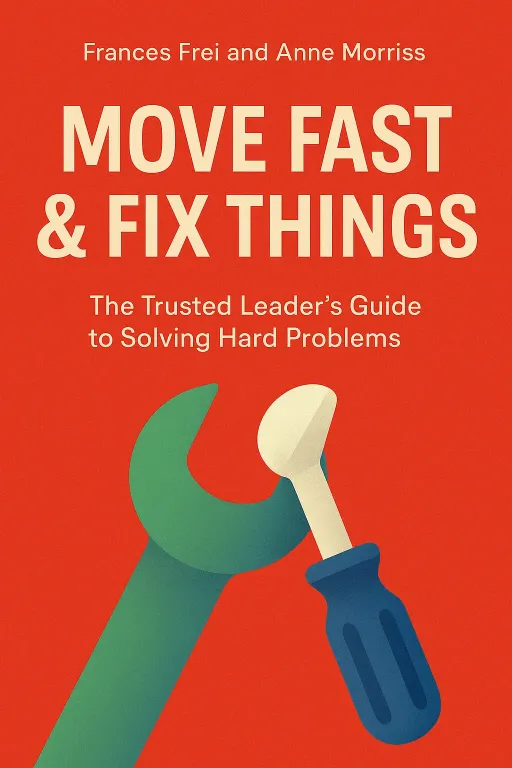
Nova: It really is. Today we are diving into two incredible books that map out this new landscape. First, we have Move Fast and Fix Things, written by Harvard Business School professor Frances Frei and leadership coach Anne Morriss. Their work is highly acclaimed, especially because Frances famously went inside Uber during its most turbulent period to help them rebuild their fractured culture.
Atlas: That is an intense trial by fire. If you can fix trust there, you can fix it anywhere.
Nova: Exactly. And to complement that, we are looking at The Human Edge by Greg Orme, a brilliant thinker from London Business School whose research focuses on how humans can thrive in the age of artificial intelligence.
Atlas: I am curious about how these two ideas connect. On one hand, we have organizational speed and trust, and on the other, we have individual survival in the AI era.
Nova: They connect beautifully. To build a truly future-proof career, we must combine operational speed with deep human connection. We will explore this through two distinct lenses. First, we will look at how to build immediate credibility using the Trust Triangle. Then, we will focus on cultivating curiosity as our ultimate shield against technological obsolescence.
The Trust Triangle and the Speed Paradox
SECTION
Atlas: Let us start with this idea of speed. There is a common assumption that if you run fast, you are going to drop things, and usually, those things are relationships. How do Frances Frei and Anne Morriss challenge that?
Nova: They argue that speed and trust are actually partners, not enemies. When organizations slow down excessively to avoid mistakes, they often breed anxiety and bureaucracy, which actually erodes trust. The key is to build what they call the Trust Triangle. Trust has three core drivers: empathy, logic, and authenticity. When all three are strong, you can make hard decisions and implement changes overnight.
Atlas: That makes sense, but what happens when one of those drivers breaks down?
Nova: That is what they call a trust wobble. Most of us have a signature wobble. For some, it is empathy. People believe we are smart and authentic, but they doubt we are truly committed to their success. For others, it is logic. People believe we care and that we are being real, but they doubt our plan or our data. And for some, it is authenticity. They feel we are hiding our true selves or holding back.
Atlas: Oh, I know that feeling. You are in a meeting, and someone is giving a perfectly polished presentation, but you feel this invisible wall. You just do not buy what they are saying because you cannot feel the human behind the slides.
Nova: That is a classic authenticity wobble. And in high-stakes environments, that wobble acts like sand in the gears. It slows everything down because people spend energy trying to decode your real motives instead of executing the strategy.
Atlas: So how do we diagnose our own wobble? If I am a leader trying to move a project forward, how do I know which leg of my triangle is shaky?
Nova: You look at the feedback patterns in your professional life. If people often ask you to repeat your data or question your methodology, you might have a logic wobble. If people feel blindsided by your decisions, or if they hold back their true opinions around you, that point to an empathy wobble. And if people describe you as hard to read or overly professional, authenticity is likely your challenge.
Atlas: That is a very helpful diagnostic. Let us make this concrete. Can you share a story of how this actually plays out in a real organization?
Nova: Let us look at the work Frances Frei did during a major corporate turnaround. The company was growing exponentially, but internally, the culture was toxic. Employees felt used, and drivers felt completely disconnected from the leadership. The logic of their business model was brilliant, but they had massive empathy and authenticity wobbles.
Atlas: So the foundation was completely unstable. How did they begin to fix it?
Nova: They started with very simple, highly structured interventions. For example, they noticed that in executive meetings, leaders were constantly on their phones, answering emails and ignoring the person speaking. This created a massive empathy wobble. It sent a clear signal that the people in the room did not matter. Frei instituted a strict no-technology rule during these sessions. Leaders had to look at each other, listen, and engage.
Atlas: That sounds almost too simple to work, but I imagine the ripple effect was huge.
Nova: It was profound. By forcing people to be fully present, they rebuilt the empathy leg of the triangle. People felt heard. Once that trust was restored, the leadership could make strategic pivots in days rather than months because the internal friction was gone. They could move fast because they fixed the trust dynamics first.
Atlas: It is like tuning an engine. If the pistons are not aligned, pressing harder on the gas pedal just destroys the machine faster. You have to align the parts to get the speed.
Nova: That is a perfect analogy. The Trust Triangle is the alignment tool. When you solve the trust problem, speed becomes a natural byproduct.
The Human Edge and the Four Cs
SECTION
Atlas: This leads us directly to Greg Orme and The Human Edge. If we are talking about speed and trust in the workplace, we have to talk about the massive wave of technology washing over us. AI is moving faster than any human organization can adapt. How do we keep our footing?
Nova: Orme argues that our competitive advantage in this new era does not lie in our ability to process information or perform repetitive tasks. AI will always win that race. Instead, our edge lies in what he calls the 4Cs: Consciousness, Curiosity, Creativity, and Collaboration. These are the deeply human capabilities that machines cannot replicate.
Atlas: I am especially interested in curiosity. We often treat curiosity as a nice-to-have trait, like a hobby, rather than a core professional skill. Why does Orme elevate it to such a critical level?
Nova: He views curiosity as the ultimate antidote to technological obsolescence. The half-life of professional skills is shrinking rapidly. What you learned in college, or even three years ago, may no longer be relevant. If you are not constantly asking questions, exploring new domains, and updating your mental models, you become obsolete. Curiosity is the engine of continuous adaptation.
Atlas: That makes sense, but in a high-pressure job, finding time to be curious feels like a luxury. We are constantly put under pressure to deliver, to execute, to clear our inboxes. How do we actually make space for this?
Nova: This is where we need to be highly intentional. Orme suggests that we must treat curiosity not as a random spark, but as a daily discipline. We need to schedule it.
Atlas: Wait, scheduling curiosity sounds like a contradiction. How do you schedule wonder?
Nova: You do it by creating a non-negotiable appointment with your future self. Dedicate just twenty minutes a day to active exploration. This is not about mindless scrolling. It is about deep, focused learning. You might spend those twenty minutes reading a research paper outside your field, studying a new system, or mapping out a complex problem from a completely different angle.
Atlas: It is like a daily workout for your brain. If you do not schedule your workouts, they do not happen. The same goes for intellectual exploration.
Nova: Exactly. And the magic happens when you combine this structured curiosity with the collaboration aspect of the 4Cs. You use your curiosity to understand other people's perspectives, which feeds directly back into the empathy leg of the Trust Triangle.
Atlas: I see the connection now. Curiosity is not just about learning facts. It is about understanding systems and people. If I am curious about why a colleague is struggling with a project, I am building empathy, which strengthens my Trust Triangle, which allows us to collaborate faster.
Nova: You have mapped it out perfectly. It is a virtuous cycle. Your curiosity drives deep collaboration, which builds logic and empathy, which ultimately allows you to move with incredible speed.
Synthesis and Actionable Blueprints
SECTION
Atlas: Let us bring this down to a practical blueprint for our listeners. Many of them are analytical, strategic thinkers who want to make a meaningful impact but feel overwhelmed by the sheer volume of information out there. How do they start applying this today?
Nova: First, we need to release the pressure to read and consume everything. That is a losing battle. Instead, we must focus on the few high-impact ideas that actually move the needle.
Atlas: So, focus on depth over coverage.
Nova: Yes. Commit to that single twenty-minute session daily. Treat it as a sacred time for your professional development. Use that time to either diagnose your trust wobbles or explore a complex system that challenges your current thinking.
Atlas: If I am looking at my own Trust Triangle today, what is the first step I should take to fix a wobble?
Nova: Start with a simple audit. Ask a trusted colleague for honest feedback. You might say, when we are working under pressure, do you feel I wobble more on empathy, logic, or authenticity? Their answer will give you your growth blueprint. If it is empathy, practice active listening in your next meeting. If it is logic, spend more time structuring your arguments. If it is authenticity, share a genuine challenge you are facing instead of presenting a perfect facade.
Atlas: That is a very actionable way to build immediate credibility. It takes the abstract concept of trust and turns it into a daily practice.
Nova: It really does. And as we look to the future, this combination of operational speed and deep human synergy is what will define successful leadership. We are moving into a world where systems thinking and future ethics are paramount. We cannot build a better society if we are constantly breaking trust in the pursuit of speed.
Atlas: That is a profound point. True progress is not just about how fast we can run. It is about who we are bringing along with us and what we are building together.
Nova: That is the ultimate takeaway. Use the Trust Triangle to anchor your relationships, and use your curiosity to navigate the changing landscape. That is how you build a future-proof career with true purpose.
Atlas: This is Aibrary. Congratulations on your growth!









