Navigating Change & Leading without Formal Authority
Golden Hook & Introduction
SECTION
Nova: What if the biggest innovation in your company isn’t a new product, but a new way of learning? And what if your true influence at work has absolutely nothing to do with your job title?
Atlas: Whoa, those are some bold claims, Nova! Especially the second one. I think a lot of our listeners, myself included, have been conditioned to believe titles are everything.
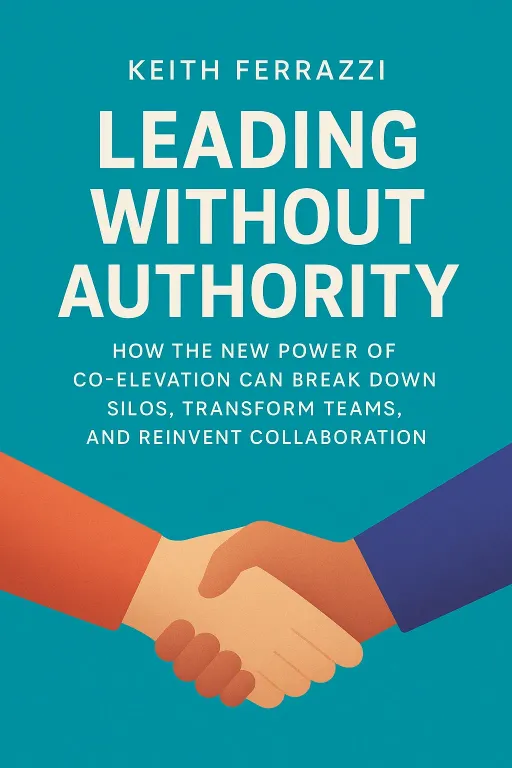
Nova: Exactly, Atlas! And that's precisely what we're challenging today. We're diving into two incredibly insightful books that, when put together, offer a powerful roadmap for navigating change and leading effectively in any modern organization. First up, we have "The Loop Approach" by Sebastian Klein and Ben Hughes, and then we’ll explore the groundbreaking ideas in "Leading Without Authority" by the masterful relationship-builder himself, Keith Ferrazzi, who you might know from his earlier work on professional networking.
Atlas: Ferrazzi’s insights on building connections are legendary, so I’m really curious to see how he takes that into the realm of leadership without formal power. And "The Loop Approach" sounds like it’s tackling that perennial challenge of making big companies move like startups. How do these two concepts intertwine?
Nova: They are two sides of the same coin, Atlas. One gives you the agility to adapt, the other gives you the power to drive that adaptation from anywhere. It’s about creating an environment where change isn't just possible, but inevitable, and then empowering everyone to be a catalyst for it.
The Power of Loops for Rapid Adaptation
SECTION
Nova: Let's start with "The Loop Approach." Klein and Hughes argue that for established companies to truly innovate and adapt rapidly, they need to build "loops" of continuous learning, experimentation, and feedback. Think of it like a living organism, constantly sensing, reacting, and evolving, rather than a rigid machine.
Atlas: Okay, so "loops." That sounds a bit abstract. Are we talking about a specific process, or more of a mindset? Because I can imagine a lot of our listeners, especially those who enjoy deep thinking, are probably picturing endless meetings and process diagrams right now.
Nova: That’s a fair point! It’s both, actually. It’s a systematic way of working, but it absolutely requires a mindset shift. Imagine a large, traditional financial institution, let's call it "Global Bank." For years, their customer service process for loan applications was clunky, taking weeks, involving multiple departments and mountains of paperwork. Feedback was slow, changes even slower.
Atlas: Sounds like a nightmare for both customers and employees. I’ve been there.
Nova: Precisely. Now, "Global Bank" decides to implement a "loop approach" for a new, small-business loan product. Instead of a year-long development cycle, they assemble a small, cross-functional team – let's say, two people from product development, one from marketing, one from IT, and crucially, one customer service rep who deals directly with small businesses.
Atlas: So, a mini-startup within the big bank. That makes sense.
Nova: Exactly! Their first "loop" isn't to build the perfect product, but to define the simplest viable version of a digital application process. They launch it with a handful of pilot customers, specifically chosen for their willingness to provide direct, unfiltered feedback. Within a week, they gather data: where do customers get stuck? What questions do they have? What's confusing?
Atlas: And that feedback goes straight back to the team, I assume? No waiting for quarterly reports?
Nova: Absolutely. The team reviews the feedback daily. They don't just collect it; they on it. They identify one or two key pain points, rapidly prototype a solution – maybe a clearer explanation, a new form field, or even just a pop-up FAQ – and then push that updated version to a new batch of pilot customers the very next week. This is their second loop.
Atlas: So, it's not just "getting feedback," it's about "rapidly iterating based on feedback." That's the key difference. It’s like a scientist in a lab, constantly adjusting the experiment.
Nova: You've got it. They're not afraid to fail, they're afraid to. Each loop is a mini-experiment. They might discover that an initial feature they thought was crucial is actually unnecessary, or that a simple change in wording dramatically improves completion rates. This rapid cycle of "build, measure, learn" allows "Global Bank" to adapt their new loan product in weeks, not months or years, fostering an agile, entrepreneurial culture that embraces change.
Atlas: That’s fascinating. It’s like they're building a muscle for change, one repetition at a time. But how does that connect to leadership? Because you can have the most agile team in the world, but if the broader organization isn't receptive, or if you don't have the "authority" to make these loops happen, it feels like it could stall.
Influence Beyond Hierarchy
SECTION
Nova: And that, Atlas, is where Keith Ferrazzi's "Leading Without Authority" comes in. He argues that true influence and impact in modern organizations come from building strong relationships, fostering mutual accountability, and driving change through collaboration, irrespective of your formal title. You don't need a corner office to be an impactful leader.
Atlas: That resonates with me. For anyone who enjoys deep thinking, the idea that power isn't just top-down hierarchy is really compelling. But how do you actually that? How do you lead without the explicit authority to tell people what to do?
Nova: It's about shifting from a command-and-control mindset to one of co-creation. Think of a mid-level manager, let’s call her Maya, working at a large tech company. She sees a critical gap in how different product teams share customer data, leading to duplicated efforts and missed opportunities. She has no direct authority over these other product teams, yet she knows this problem needs solving for the company to truly function like an agile "loop" organization.
Atlas: So, if she can't just mandate a new data-sharing protocol, what's her move?
Nova: Her move is to lead without authority. She doesn't go to her boss asking for permission to other teams around. Instead, she starts by identifying key stakeholders across those product teams – the engineers, the product managers, the data scientists – who are also experiencing this pain point, even if they haven't articulated it yet. She schedules informal coffee chats, not formal meetings.
Atlas: Ah, building relationships, understanding their perspectives.
Nova: Exactly. She listens more than she talks, understanding their individual challenges and goals. She frames the problem not as "you're doing it wrong," but as "how can all work better together to achieve our shared goals?" She then organizes a small, voluntary working group, framing it as a "problem-solving session," not a "new initiative."
Atlas: And she's not the boss of this group, so she has to inspire them to participate and contribute. That takes a different kind of leadership.
Nova: It absolutely does. She fosters mutual accountability by getting everyone to commit to small, achievable steps. She facilitates the discussion, ensures everyone's voice is heard, and helps them collectively design a solution – perhaps a shared data dashboard or a new integration. Her influence comes from her ability to connect people, articulate a shared vision, and empower the group to own the solution. She's not dictating; she's orchestrating. The success isn't hers alone; it's theirs.
Atlas: That's powerful. It's about seeing leadership as an act of service, of enabling others, rather than just giving orders. And it sounds like this kind of leadership is essential for making those "loops" from "The Loop Approach" actually work, because you need people to voluntarily engage in experimentation and feedback.
Nova: You've hit the nail on the head. These two ideas are profoundly interconnected. You can't have truly agile, adaptive loops if your organizational culture is rigidly hierarchical and people feel they lack the authority to initiate change or collaborate across boundaries. And conversely, leading without authority means you're constantly seeking better ways to operate, which naturally leads to implementing iterative, learning-focused approaches.
Synthesis & Takeaways
SECTION
Nova: So, what we're really talking about today is a fundamental shift in how we approach work and leadership. It’s about recognizing that the future belongs to organizations and individuals who can learn and adapt fastest, and who can drive impact through connection and collaboration, not just command.
Atlas: That’s a really insightful way to put it. For our listeners who enjoy deep thinking and want to explore new knowledge areas, this isn’t just about making your company better; it’s about making a more effective and influential professional, regardless of your current role. So, Nova, what’s one tiny step someone can take today to embody these principles?
Nova: Here’s your tiny step, Atlas, and for all our listeners: Identify one area within your team or a project where you can initiate a "learning loop." It doesn't have to be massive. Maybe it's how you gather feedback on a weekly report, or how you test a new internal tool. Focus on rapid feedback and iterative improvement.
Atlas: So, a small experiment, learn from it, then adjust. Got it. And for the "leading without authority" part?
Nova: For that, practice influencing without direct command. The next time you encounter a challenge that requires cross-functional input, instead of waiting for a manager to assign it, proactively seek collaborative solutions. Identify key people, reach out for their input, and build those stronger relationships. Frame it as a shared problem, not just yours.
Atlas: That’s incredibly actionable. It’s about taking agency, being proactive, and understanding that your title doesn’t define your capacity for impact. It's truly about building a more adaptive, collaborative future, one loop and one relationship at a time.
Nova: Absolutely. It’s empowering, isn’t it? To realize that the power to create meaningful change is already within you, waiting to be unleashed through these thoughtful, strategic approaches.
Atlas: It really is. Thank you, Nova, this was a fantastic dive into some truly transformative ideas.
Nova: My pleasure, Atlas. Always a joy to explore these profound concepts with you.
Nova: This is Aibrary. Congratulations on your growth!