Battle-Tested Principles for Modern Managers
Golden Hook & Introduction
SECTION
Nova: Most leadership advice is like a luxury sedan: comfortable, but it won't survive a war zone. What if the best management lessons come from places where failure isn't an option?
Atlas: Whoa. That’s a pretty intense opening, Nova. Are we talking about corporate battlefields here, or actual ones? Because some of my Monday morning meetings like combat.
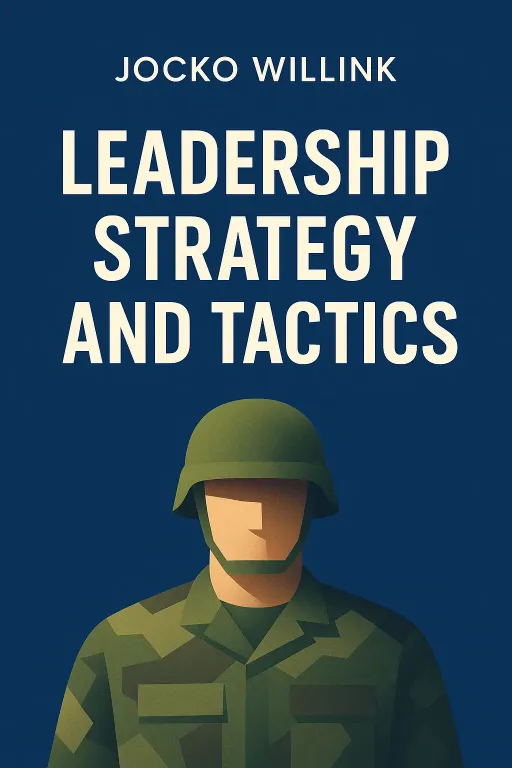
Nova: Exactly! Today, we're diving into how the crucible of high-stakes environments can forge unparalleled leadership principles, and then, how we can actually those principles in our everyday roles. We’re drawing insights from two incredibly powerful books. First up, the no-nonsense wisdom of Jocko Willink's "Leadership Strategy and Tactics." Willink, a decorated Navy SEAL commander, brings a perspective forged in the most extreme conditions imaginable, where the stakes are life and death.
Atlas: Oh, I know Jocko. His "Extreme Ownership" concept has become almost legendary. But I have to ask, how do we translate that kind of intense, combat-derived discipline into, say, managing a marketing team or leading a software development project? It sounds a bit… heavy-handed for a quarterly review meeting.
Battle-Tested Principles: The Willink Way
SECTION
Nova: That’s the beauty of it, Atlas. Willink argues these aren't just military tactics; they're universal truths about human behavior and effective organization. The core idea is "Extreme Ownership": a leader owns in their world. No excuses, no blaming others. If your team fails, you failed. If a decision goes south, it’s on you.
Atlas: I can definitely relate to that feeling of wanting to own the outcome, especially for our listeners who are visionary leaders. But isn't there a fine line between extreme ownership and, well, just burning yourself out by shouldering every single burden? How do you empower a team when the leader is supposed to take the blame?
Nova: That’s where his second critical principle comes in: "Decentralized Command." It sounds contradictory, right? But it's actually about empowering junior leaders to make decisions. The senior leader provides the overall strategic intent – the and the – but the is left to the teams on the ground. Think of a SEAL squad: the commander can’t be everywhere. Each team leader needs to understand the mission, the commander’s intent, and then be empowered to adapt and execute based on real-time conditions.
Atlas: So you're saying it’s about crystal clear communication of the, but then trusting your people implicitly with the? Like, "Here's the mountain we need to climb, and here's why, now you figure out the best route."
Nova: Exactly! And the leader’s job then shifts from micromanaging to supporting, removing obstacles, and ensuring everyone understands the overall goal. It fosters initiative and problem-solving at every level. Imagine a project where a key deadline is missed. Instead of the project manager blaming the engineering team for delays, the Willink principle would have them ask: "What did fail to do to provide resources, clarify communication, or anticipate roadblocks?"
Atlas: Wow, that’s actually really inspiring. It reframes failure not as a personal shortcoming of a team member, but as a leadership opportunity. For anyone focused on developing future leaders, that’s a powerful mindset shift. It’s about building capability, not just delivering tasks. But how do we actually ourselves to think this way? It’s one thing to understand it, another to live it.
The Leader Lab: Practicing for Mastery
SECTION
Nova: And that naturally leads us to the second key idea we need to talk about, which often acts as the perfect tactical counterpart to Willink's strategic imperatives. This is where "The Leader Lab" by Tania Luna and LeeAnn Renninger comes in. Luna, a behavioral scientist, and Renninger, a cognitive psychologist, approach leadership not as an innate talent, but as a set of measurable behaviors that can be deliberately practiced and improved.
Atlas: Okay, so we’ve got the grand, battle-tested strategy from Jocko. Now, how do these "experiments" from The Leader Lab actually help a manager who's trying to improve something as nuanced as, say, giving constructive feedback or running more productive meetings? Isn't that just "common sense" repackaged? What's the "lab" part?
Nova: The 'lab' part is the scientific, iterative approach. They argue that leadership skills are often treated like abstract concepts. We know we be good at giving feedback, but how do we get better, specifically? Their method breaks down these complex skills into tiny, actionable experiments. Instead of saying, "I need to give better feedback," you set up an experiment like: "This week, during my next one-on-one, I will practice active listening by repeating back the last three words my team member said before offering my perspective."
Atlas: Oh, I see! So it's not about a grand overhaul, but about micro-interventions. Like, you don't just to be a better listener; you define a specific behavior, apply it, and then reflect on the outcome. That makes it feel much less daunting, especially for leaders who are already juggling a million things.
Nova: Exactly. And the beauty is, these experiments are designed to be low-risk, high-feedback. You try it, you see what happens, you learn, and you adjust. It’s like a scientist refining an experiment. It could be practicing asking open-ended questions in meetings, or dedicating the last five minutes of every meeting to gather feedback on the meeting itself. It’s about building a habit of continuous, deliberate practice, not just hoping to get better.
Atlas: That’s a great way to put it. It shifts the focus from an overwhelming goal to a series of manageable, iterative steps. For our listeners who are focused on self-growth and want to cultivate their team's potential, this 'deliberate practice' framework offers a tangible path forward, rather than just abstract inspiration. It’s about making improvement a daily, measurable process.
Synthesis & Takeaways
SECTION
Nova: So, when we combine these two approaches, we get something incredibly powerful. Willink gives us the unwavering strategic compass, the absolute necessity of extreme ownership, and the power of decentralized command. Luna and Renninger then provide the tactical, iterative steps to actually navigate that path, breaking down those grand strategies into measurable, actionable experiments.
Atlas: So it's not either/or, but a powerful 'and.' It's about having that unshakeable foundation of responsibility and clear intent, coupled with the scientific rigor of improving your actual leadership behaviors. For a leader looking to develop others, this means not just setting a high bar, but also providing the concrete tools and the mindset for continuous improvement.
Nova: Absolutely. The core of our podcast today is really an exploration of how to bridge the gap between high-level leadership philosophy and the daily, practical actions that build truly effective, empowering teams.
Atlas: So, for our listeners, who are often visionary, strategic, and empathetic, what’s one tangible step they can take this week to apply this powerful combination?
Nova: Here’s your tiny step, straight from our content: Pick one leadership challenge you're currently facing. Maybe it's communication, or team empowerment. Then, identify one principle from Willink – say, 'decentralized command' – and one practical experiment from Luna & Renninger – like 'practice active listening during your next 1-on-1' – to apply this week. It’s about bringing that battle-tested clarity to your immediate actions.
Atlas: That makes perfect sense. It’s about making every interaction a potential growth opportunity, both for yourself and for your team. What one principle, what one experiment, are you going to try this week to elevate your leadership?
Nova: This is Aibrary. Congratulations on your growth!