The Practice of Leadership: How to Navigate Complexity and Inspire Trust.
Golden Hook & Introduction
SECTION
Nova: What if the biggest barrier to your leadership isn't your team, or your data, or even your competitors, but something far closer: your own mind?
Atlas: Oh, I like that. That's a bold claim, Nova. I mean, we're constantly battling external factors, market shifts, tech limitations. How can something so internal be the biggest hurdle to leading effectively, especially when you're trying to make data-driven decisions?
Nova: It feels counterintuitive, doesn't it? But that's precisely the profound insight at the heart of our discussion today, inspired by a powerful concept we explore in "The Practice of Leadership." This framework draws heavily from two transformative works: "Leadership and Self-Deception" by The Arbinger Institute and "Dare to Lead" by Brené Brown. Arbinger, you know, they're not just about behavioral change; their unique approach as an organization focuses on transforming the itself, empowering countless leaders to resolve deep-seated conflicts by getting to the root of internal blind spots. And then you have Brené Brown, a research professor whose groundbreaking work on vulnerability and empathy has completely reshaped how we think about brave leadership globally. Together, these ideas expose a critical blind spot many of us carry, often unknowingly, and offer a path to true impact.
Atlas: Okay, so we're talking about more than just managing people or processes. We're diving into the psychology of leadership itself, and how it impacts everything, even the integrity of our data systems. That makes me wonder, what exactly is this "blind spot" and how does it manifest in the day-to-day?
The Blind Spot of Self-Deception
SECTION
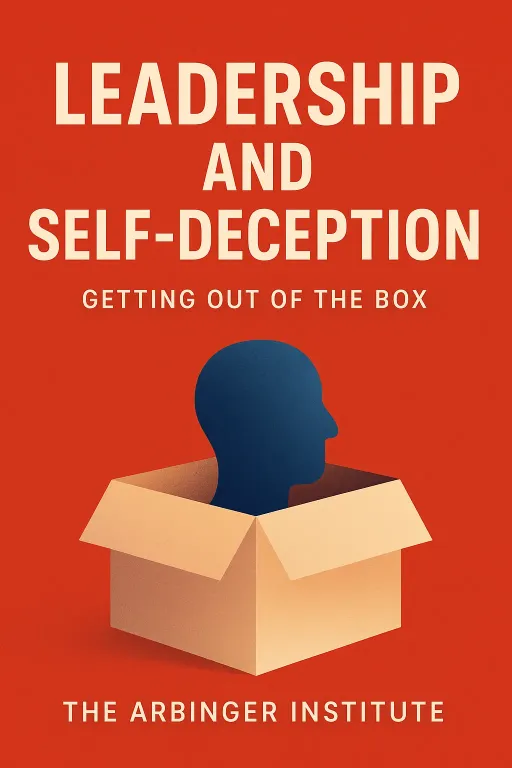
Nova: Well, the Arbinger Institute calls it "being in the box." Imagine you have a problem, say, a data project that's consistently behind schedule. When you're "in the box," you start to see your team members not as complex individuals with their own challenges, but as objects—obstacles, lazy, incompetent, or simply not as smart as you—who are the problem. You blame them, you justify your own behavior, and you secretly believe you're the only one truly trying to make things work.
Atlas: Oh man, I know that feeling. For our listeners who are managing high-pressure data teams, it's easy to point fingers at the "messy data" or "poor communication" from other departments when a dashboard is inaccurate. But you're saying the real problem might be our own internal narrative about those things are happening?
Nova: Exactly. Let's take a hypothetical, but all too common, example. Meet Sarah. She's a brilliant data analytics manager, prides herself on her objective analysis and rigorous methodology. When a critical project to build a new customer segmentation model starts lagging, Sarah immediately concludes her team isn't up to par. She sees them as disorganized, lacking attention to detail. She's convinced the one holding everything together, often working late to "fix" their perceived mistakes. She'll say things like, "If only they could follow the data governance rules, we wouldn't have this issue."
Atlas: So, she thinks she's being a rigorous leader, holding people accountable to the data. But what's really happening?
Nova: What's really happening is that Sarah is deeply "in the box." She's not seeing her team members—David, who's struggling with a sick parent, or Maria, who's been overloaded with three projects due to recent layoffs—as people. She sees them as impediments to her success. She's consistently blaming them, and her internal narrative justifies her own frustration and overwork. This leads her to micromanage, to criticize rather than coach, and to withhold information she believes they "won't understand" or "can't handle."
Atlas: Wow, that's kind of heartbreaking. Because from her perspective, she's trying to maintain standards. But the on her team, I imagine, is devastating. It's like building a data pipeline where the initial assumptions are flawed, but because we’re ‘in the box,’ we keep pushing bad data downstream, then blame the next team when the insights are garbage. How does this self-deception erode trust?
Nova: It erodes trust systematically. Her team feels constantly devalued, unheard, and distrusted. They stop bringing problems to her, fearing blame. They start doing the bare minimum because they feel their best efforts are never good enough. The data quality actually because they're not collaborating, not sharing critical context, and certainly not raising ethical concerns about data usage, because why would they expose themselves to more criticism? Sarah's internal blind spot has created a culture of fear and underperformance, directly impacting the integrity and ethical application of their data insights.
Atlas: That sounds incredibly hard to spot in yourself. Especially if you're a data professional who's trained to be objective and relies on numbers. You're thinking, "I'm just looking at the facts." How do you even begin to see that you're 'in the box,' that your own mind is sabotaging your leadership?
Shifting Perspective: Cultivating Self-Awareness, Empathy, and Trust
SECTION
Nova: That's exactly where the "shift" comes in, and it's where Brené Brown's work on vulnerability and courage becomes absolutely critical, even for data teams. It's about moving from seeing others as objects to seeing them as full, complex human beings, with their own challenges, hopes, and fears.
Atlas: For someone who builds systems and relies on "hard data," vulnerability can feel like a direct threat to credibility. It's like, if I admit I don't have all the answers, especially in a data ethics discussion, won't I be seen as less competent or less confident in my analysis?
Nova: That's a very common fear, Atlas, and it's a powerful one. But Brown argues that true courage in leadership isn't about being stoic or having all the answers; it's about showing up fully, imperfections and all, even when it's uncomfortable. It's the strength to be real. Let's look at Mark, another data analytics manager, who inherited a struggling team, much like Sarah's. His team was disillusioned, and data quality was a mess. Instead of blaming, Mark started by admitting his own past mistakes.
Atlas: Okay, so what did that look like? Admitting mistakes in a data-driven environment?
Nova: He gathered his team and openly discussed a time early in his career when he missed a critical data anomaly due to rushing a report, and how it led to a flawed business decision and significant rework. He talked about the shame he felt, but also how it taught him the absolute importance of thoroughness, asking for help, and creating a culture where it's safe to flag potential issues. This act of vulnerability, inspired by Brown's principles, was surprisingly transformative.
Atlas: I can see that. That’s actually really inspiring. It’s like he gave them permission to be human, to not be perfect.
Nova: Exactly! It opened up the team. They started sharing their own struggles with data quality issues, process bottlenecks, and even personal challenges impacting their work. Mark, instead of judging, listened with genuine empathy. He worked them to redesign workflows, implement better data validation checks, and establish a weekly "data dilemma" session where they could openly discuss ethical concerns or tricky interpretations without fear of blame.
Atlas: So, in a practical sense, for a data leader, this means actively seeking out diverse perspectives, maybe even from outside your immediate team, when you're designing a new data product or making a critical decision about data usage? And being open to hearing things you might not want to hear?
Nova: Absolutely. It means having the courage to ask "why" we're collecting certain data, even if it challenges a business objective. It means having empathy for the real-world impact our algorithms and data products have on human lives, not just seeing them as numbers on a spreadsheet. It’s about building a system where ethical considerations are baked in from the start, not an afterthought. You can’t do that if you’re "in the box" and can't see the human behind the data point.
Atlas: I guess that makes sense. It's about leading with an awareness that every data point, every algorithm, has a human story behind it, and our own internal state profoundly affects how we interpret and act on that. It's about building trust, not just models.
Synthesis & Takeaways
SECTION
Nova: Precisely. The blind spot of self-deception keeps us from seeing others as full human beings, leading to fractured teams and compromised outcomes. But the shift, fueled by vulnerability, courage, and empathy, allows us to build data systems and lead teams that are not just smart, but truly human-centered. It’s moving from "what's the data telling me about them" to "what's the data telling me about and our collective impact on the world?" It's a fundamental reorientation.
Atlas: That gives me chills. It’s a powerful call to self-reflection for anyone in a leadership role, especially in fields like data where objectivity is so prized. It’s not a one-time fix, but an ongoing practice of self-awareness. A muscle we need to continually flex, especially when the stakes are high.
Nova: It truly is. So, we challenge our listeners today to reflect: where in your current projects or team dynamics might you be inadvertently 'in the box'? How could a small shift in perspective, a moment of vulnerability, unlock greater collaboration and more ethical, human-centered outcomes for your team and your data?
Atlas: That’s a deep question, and one worth sitting with. It's about transforming ourselves to transform our impact.
Nova: This is Aibrary. Congratulations on your growth!