Stop Managing, Start Leading: The Guide to Empowering Your Team
Golden Hook & Introduction
SECTION
Nova: Atlas, what's the first thing that comes to mind when I say 'managing teams'? Be honest.
Atlas: Oh man, it's usually a frantic mental image of me juggling flaming chainsaws while simultaneously trying to herd cats through a spreadsheet. You know, just a typical Tuesday. And then somehow, the spreadsheet still ends up on fire.
Nova: Exactly! That's the universal leader's lament, isn't it? That feeling of constant, frantic, hands-on intervention. Today, we're going to dive into how to put down those chainsaws and let the cats, perhaps, herd themselves, drawing from a powerful guide called "Stop Managing, Start Leading: The Guide to Empowering Your Team."
Atlas: That title alone feels like a deep breath for anyone in a leadership role.
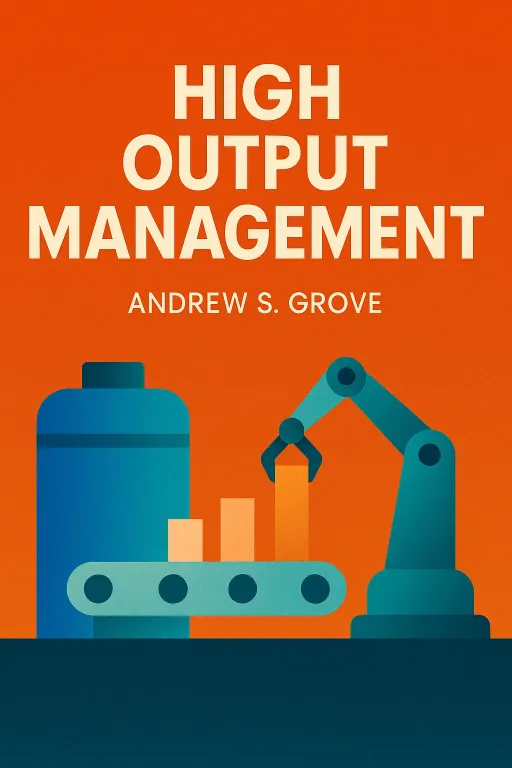
Nova: It absolutely is. This guide distills the wisdom of giants who truly redefined what leadership means. We're talking about figures like Andrew S. Grove, the legendary former CEO of Intel, who quite literally wrote the book on "High Output Management." And also, the incredible NFL coaching titan, Bill Walsh, whose "Standard of Performance" philosophy didn't just transform the 49ers into a dynasty, but fundamentally shifted modern leadership thinking across all industries.
Atlas: So, we're talking about insights from people who operated at the absolute pinnacle of their respective fields, not just theory. That’s a serious pedigree.
Nova: Precisely. And their combined wisdom points to a profound truth: many leaders mistakenly believe their core role is to simply manage tasks and enforce rules. But true leadership, the kind that creates lasting impact and robust systems, is about something far more potent.
The Paradigm Shift & High Output Management
SECTION
Nova: Atlas, have you ever found yourself in a situation where you're just... doing everything? Picking up every slack, making every decision, feeling like if you don't personally touch it, it won't get done right?
Atlas: Oh, Nova, I totally know that feeling. It's that insidious belief that my personal output is the only output that truly counts, and the more I do, the more successful we'll be. It's exhausting.
Nova: And it's a trap. Because that's the cold fact: true leadership isn't about individual output. It's about cultivating an environment where individuals and teams can thrive, making decisions and taking ownership. This shift from managing to leading unlocks greater, almost exponential, potential.
Atlas: Wait, so are you saying doing might actually make me a leader? That sounds incredibly counter-intuitive when I feel like I constantly need to be hands-on, especially when building something new.
Nova: It’s not about doing less in terms of effort, Atlas, but about doing things. Andrew S. Grove, with his concept of "High Output Management," fundamentally rewired how we think about a manager's impact. He argued that a manager's output isn't just what achieve. It's the sum of the output of their entire organization, plus the output of any neighboring organizations under their influence.
Atlas: Okay, so it’s like a force multiplier, not just an individual contribution. Give me an example of what that kind of "leverage" actually looks like in practice.
Nova: Imagine a leader who spends an hour personally correcting a report. That's one report fixed. Now, imagine that same leader spends an hour training five team members on how to identify and correct those errors independently, providing them with the tools and the confidence to do so. Suddenly, you're not just fixing one report; you're preventing dozens of future errors across five people, who then go on to train others. That one hour of strategic investment now has a ripple effect, multiplying your impact far beyond what you could achieve alone.
Atlas: That makes me wonder, for our listeners who are trying to architect growth in their organizations, what's a concrete way to start thinking about this "leverage" without just feeling like they're dumping tasks on their team? It can feel like a fine line.
Nova: It absolutely can. The key is to shift from "how can I solve this problem?" to "how can I enable my team to solve this problem, and similar problems, in the future?" It's about designing systems and processes, and providing clear parameters, rather than constantly providing individual solutions. Think of it like a gardener who nurtures the soil and plants the right seeds, rather than spending all day pulling individual weeds. The gardener's leverage comes from creating a thriving ecosystem. It's a fundamental investment in capabilities.
Atlas: That’s a great analogy. So it's not about abandoning the work, but about elevating your role to a systemic level.
Building Inevitable Success & The Standard of Performance
SECTION
Nova: And that naturally leads us to the second key idea, which often acts as the bedrock for effective empowerment. Because you can empower people all you want, but how do you ensure that when you empower them, they're not just flailing, but consistently hitting home runs and building something truly robust?
Atlas: That's the million-dollar question, isn't it? Because empowerment without direction can quickly devolve into chaos. We’ve all seen that.
Nova: Indeed. This is where Bill Walsh, the legendary NFL coach, comes in with his philosophy of "The Score Takes Care of Itself." Walsh was obsessive, not about the scoreboard, but about establishing an incredibly detailed "Standard of Performance." He believed that by focusing on fundamental excellence and process, success became an inevitable outcome. He removed the element of chance.
Atlas: Okay, so he's saying if you perfect the little things, the big things will follow? That sounds almost too simple for the high-stakes world of professional sports.
Nova: It sounds simple, but it's profoundly difficult to implement with the rigor Walsh demanded. He micro-managed the, not the people. He had a specific way for everything: how players entered a huddle, the exact language they used in plays, how they tied their shoelaces, how they ate their dinner. He even had a standard for how they spoke to the media.
Atlas: Wow. That's granular. I mean, tying shoelaces? That’s dedication to detail.
Nova: It was. And the point was to eliminate variables. If every single fundamental action was performed with absolute excellence, consistently, then the outcome—winning—became a predictable byproduct. It empowered every team member to contribute not just with their talent, but with unwavering consistency within a defined framework. The team knew exactly what excellence looked like for every single action, reducing ambiguity and fostering a sense of shared mastery.
Atlas: But Nova, in today's fast-paced, agile world, doesn't such rigid 'standardization' stifle innovation and creativity? It sounds a bit like micromanagement in disguise, especially for our listeners building innovative products or services where flexibility is key.
Nova: That’s a really important distinction, Atlas. It's crucial to understand Walsh wasn't stifling creativity; he was providing an incredibly strong foundation it. Think of a jazz musician. They spend years mastering scales, chords, and music theory – a "standard of performance" for their instrument. That deep, almost unconscious mastery then frees them to improvise, to create, to innovate on stage. Without that fundamental excellence, their improvisation would just be noise.
Atlas: So it's about building a robust, predictable system that allows for creative freedom within its boundaries, rather than dictating every single creative output. It’s like an architect defining the structural integrity of a building so the designers can then innovate within those safe parameters.
Nova: Exactly! It's about empowering within clear parameters. For our listeners who are trying to cultivate robust systems and lasting value, how can they start defining their own "Standard of Performance" within their teams, beyond just a generic mission statement?
Atlas: Because a mission statement is great, but it doesn't tell you how to tie your shoelaces, so to speak.
Nova: Precisely. It starts by identifying those recurring decisions or tasks that consistently come back to you. What are the key actions that, if done consistently and excellently, would elevate your team's overall output? And then, instead of just people what to do, you define the of excellence for those actions. You provide the "how" and the "what good looks like," so they can own the "doing."
Synthesis & Takeaways
SECTION
Nova: So, what we're really talking about here is a profound transformation in leadership. It’s moving beyond the frantic firefighting of a task-master, as you described earlier, to becoming a growth-enabler. It's about leveraging your influence through strategic empowerment, as Grove taught us, and then building the fundamental processes and clarity, the "Standard of Performance" from Walsh, that makes success inevitable for your empowered team.
Atlas: It sounds like this isn't just about getting more done, but about building something truly sustainable and self-perpetuating, something that can grow and thrive even when you're not personally juggling every single chainsaw. It’s about building a legacy of capability.
Nova: That’s Nova’s take right there. It’s transforming your role from a task-master to a growth-enabler, driving exponential impact through your team, not just your team. And to get started, we have a tiny step for everyone listening.
Atlas: I love a tiny step, especially when the big picture feels so transformative.
Nova: Here it is: Identify one recurring decision your team brings to you. Just one. Then, empower them by defining clear parameters for them to make that decision independently next time.
Atlas: That's brilliant. So it's not about throwing them into the deep end, but giving them a clear, shallow end to practice in, building that muscle of ownership one decision at a time. It’s a very pragmatic, architect-like approach to empowerment.
Nova: Absolutely. It's about building that trust and capability brick by brick. And before you know it, you’ll have a team that doesn't need you to herd the cats, because they've built their own incredibly effective, self-managing system.
Nova: This is Aibrary.
Atlas: Congratulations on your growth!