

Leading Your Team, Not Just Managing Tasks: The Core of Sustainable Growth
Golden Hook & Introduction
SECTION
Nova: Founders are often celebrated for their vision and their hustle. They're the ones burning the midnight oil, coding, designing, selling, making magic happen. But what if the very thing holding back your brilliant product isn't the market, or the tech, or even your funding? What if it's something far closer to home? Something you might be actively avoiding?
Atlas: Hmm, that's a bold claim, Nova. I imagine a lot of our listeners, especially early-stage founders, are thinking, "What could I possibly be avoiding that's more critical than my product or my users?" Is this about that elusive work-life balance everyone talks about but no one achieves?
Nova: Not exactly, Atlas. While balance is important, what we're talking about today is even more foundational: it's your team. Specifically, your ability to that team, not just manage a list of tasks. Many founders, especially in the early chaos, see 'management' as a distraction, a necessary evil that pulls them away from the 'real' work. But what if management, done right, is actually the ultimate growth hack?
Atlas: That's a fascinating reframe. I've definitely felt that tension—the pull between getting my hands dirty with product development and dedicating time to team dynamics. It often feels like a zero-sum game. So, where do we even begin to unpack this idea?
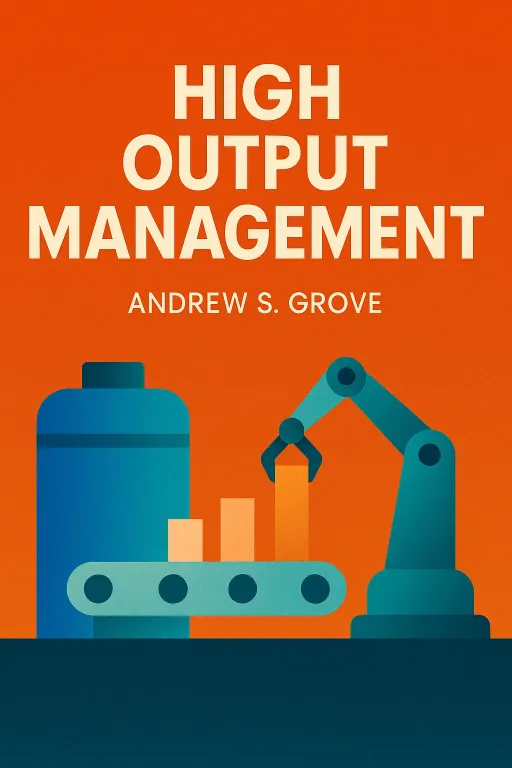
Nova: Well, we begin with a legend. Today, we're diving into insights heavily influenced by Andrew S. Grove's seminal work,. Grove wasn't just a theorist; he was the former CEO of Intel, an engineer who brought a rigorous, almost scientific approach to the art of managing people. He showed how you could quantify and optimize human output, making management less about 'soft skills' and more about strategic leverage.
Atlas: Right, like an engineer optimizing a circuit, but with humans. I can see how that might appeal to a founder who's building a technical product. But how does that engineering mindset translate to the messy, unpredictable reality of early-stage teams, where everyone's wearing ten different hats and things change daily?
Management as a High-Leverage Activity: The Grove Approach
SECTION
Nova: That's exactly the brilliance of Grove's thinking, Atlas. He reframed management itself as the a leader can undertake. Think of it like this: your time as a founder is your most precious, non-renewable resource. Every hour you spend has an 'output multiplier.' If you spend an hour coding, you get an hour's worth of code. But if you spend an hour training a team member, or structuring a meeting effectively, that single hour can multiply the output of your entire team for days, weeks, even months.
Atlas: So you're saying it's not about doing more tasks, but about doing the tasks that make more productive? That's actually a pretty compelling argument for a time-strapped founder. It's like finding a force multiplier.
Nova: Precisely. Let me give you a classic Grove-esque scenario. Imagine a founder, let's call her Sarah, who's brilliant at sales. She's just hired two new junior sales reps. Sarah could spend her entire week making calls herself, closing deals, and hitting her quota. Or, she could dedicate a focused half-day to designing and delivering a killer sales training program for her new hires. The cause: Sarah's intentional investment in training. The process: a structured workshop covering product knowledge, objection handling, and closing techniques. The outcome: those two junior reps, now properly equipped, start closing deals consistently, collectively generating more revenue than Sarah could have alone. Her initial half-day investment yielded a return of hundreds of additional sales hours, effectively multiplying her own output by coaching others.
Atlas: Wow. That's a powerful example. It shifts the entire perspective from "I have to do everything" to "I have to empower everyone to do their best." But wait, for many founders, especially when things are chaotic, that dedicated half-day feels like an impossible luxury. They're probably thinking, "I just need those new reps selling, not next week after I've trained them." How do you justify that upfront 'cost' when you're burning cash and racing against the clock?
Nova: That's where Grove's concept of 'leverage' becomes critical. He argues that the highest leverage activities are often preventative or capacity-building. Yes, the immediate gratification of closing a deal yourself is tempting. But if those new reps fumble because they're untrained, you're not just losing potential sales; you're creating headaches, damaging customer relationships, and possibly even losing valuable team members due to frustration. So, that 'cost' of training isn't a luxury; it's an investment that prevents far greater future costs and unlocks exponential growth.
Atlas: Okay, I get the long-term vision. But what's the tiniest, most actionable step a founder can take to start applying this without feeling like they need to suddenly become a full-time HR manager? Something that feels like a 'micro-leverage' point?
Nova: A fantastic question, Atlas. Grove would say: schedule a highly structured 1:1 meeting with a key team member. Not a casual chat, but a planned discussion where you're actively listening, understanding their challenges, and identifying blockers. That single hour, focused on their output and growth, can be incredibly high-leverage. It helps you understand where to invest your next managerial minute for maximum impact.
Deconstructing Team Dysfunctions: Lencioni's Blueprint for Cohesion
SECTION
Nova: Speaking of those 'small investments' that pay off, sometimes the biggest returns come from fixing what's in the team's foundation. Because even the most brilliant individuals, expertly managed, will falter if the team itself is dysfunctional. And that naturally leads us to our second profound insight today, from Patrick Lencioni's.
Atlas: Ah, Lencioni! I've heard that book mentioned in so many leadership circles. He's a consultant, right? So he's seen the messy reality of teams up close and personal.
Nova: Exactly. Lencioni isn't just theorizing; he's distilled observations from countless organizations into a remarkably clear and actionable model. He argues that five common dysfunctions, like a pyramid, build upon each other to sabotage team effectiveness. And at the very bottom, the foundational dysfunction, is the.
Atlas: The absence of trust. That sounds pretty dire. I imagine a lot of early-stage founders might feel like they have trust – they hired these people, after all! But what does 'absence of trust' really look like in a startup environment, beyond just obvious backstabbing?
Nova: It's far more insidious than that, Atlas. It's not about malice; it's about vulnerability. An absence of trust means team members are unwilling to be vulnerable with each other. They hide mistakes, they don't ask for help, they don't admit weaknesses. Imagine a small product team, racing to hit a deadline. One developer, let's call her Maya, realizes she's made a critical error in a code module. She knows it will set the project back, but she's terrified of looking incompetent, especially to the founder. So, she tries to fix it silently, burning out, and ultimately delaying the project even more. The cause: Maya's fear of vulnerability. The process: she conceals the error, isolates herself. The outcome: a delayed launch, increased stress, and a team that doesn't learn from its mistakes because they're never brought into the light.
Atlas: Wow, that's kind of heartbreaking. It's like a silent killer of productivity and morale. I can totally see that happening in a high-pressure startup where everyone feels like they have to be perfect. But how do you build trust when everyone's under pressure and wearing multiple hats? It feels like a 'soft skill' that's hard to measure, especially for a founder who needs concrete results.
Nova: That's the beauty of Lencioni's model – he makes it concrete. He argues that trust isn't built through team-building exercises alone, but through. It's about leaders going first, admitting their own mistakes or uncertainties. It's about creating a safe space where team members can say, "I messed up," or "I need help," without fear of reprisal. A simple exercise he suggests is personal histories – having team members share a few key life experiences. It sounds trivial, but it opens the door to understanding each other as humans, not just roles.
Atlas: So, it's about seeing each other's humanity, not just their job titles. That makes a lot of sense. And if you fix that foundational layer of trust, what happens to the rest of the pyramid? Do the other dysfunctions just magically disappear?
Nova: Not magically, but they become addressable. Once you have trust, Lencioni says, you can then engage in. Because if you trust each other, you know that a disagreement isn't personal; it's about finding the best solution. Without trust, conflict becomes masked, political, and ultimately destructive. And this cascades up: healthy conflict leads to, commitment leads to, and accountability leads to. It's a virtuous cycle.
Synthesis & Takeaways
SECTION
Nova: So, think about it: Grove gives us the framework for maximizing individual and team output through smart, leveraged management. Lencioni gives us the blueprint for building the kind of cohesive, trusting team that can actually on those high-leverage activities without imploding. They're two sides of the same coin: how to build an engine that runs efficiently, and how to ensure that engine doesn't have fundamental flaws that will cause it to break down.
Atlas: That's a brilliant synthesis, Nova. It paints a much clearer picture of what 'team building' actually entails beyond just hiring good people. It's about intentional systems for both productivity and psychological safety. So, if I'm an early-stage founder listening right now, overwhelmed but genuinely wanting to build a great team, what's my very first, tiny step, combining these insights? What's the highest leverage, lowest effort action I can take?
Nova: The tiny step we highlighted from our input material is perfect here: It's a Grove-esque high-leverage activity because it's focused on output and capacity. And it's a Lencioni-esque trust-builder because it's an act of vulnerability from you, the founder, saying "I want to understand and support you."
Atlas: That's so practical. It's not about a huge overhaul, but about consistently showing up for your team in a structured, intentional way. It's a reminder that leadership isn't just about the product, it's about the people who the product. You're building a team, not just managing tasks.
Nova: Exactly. And the profound insight here is that your ability to build and lead a cohesive, high-performing team is not just a 'nice-to-have' for founders. It's the bedrock of sustainable growth. Without it, even the most innovative product can crumble under the weight of internal friction. Investing in your team’s well-being and effectiveness is the single greatest investment you can make in your product’s future.
Atlas: That gives me chills. It’s a powerful call to action for every founder who wants to move from just surviving to truly thriving.
Nova: Absolutely. This is Aibrary. Congratulations on your growth!









