The Architecture of High-Performing Teams
Golden Hook & Introduction
SECTION
Nova: Most teams they're aligned, but the reality is they're often just synchronized chaos. The secret to true high performance isn't just more meetings, it's a radical shift in how we visualize work and lead people.
Atlas: Ooh, that's a provocative opening, Nova. Synchronized chaos... I can definitely picture that. It sounds like the kind of situation where everyone's busy, maybe even shouting in the same general direction, but nobody's actually hitting the target.
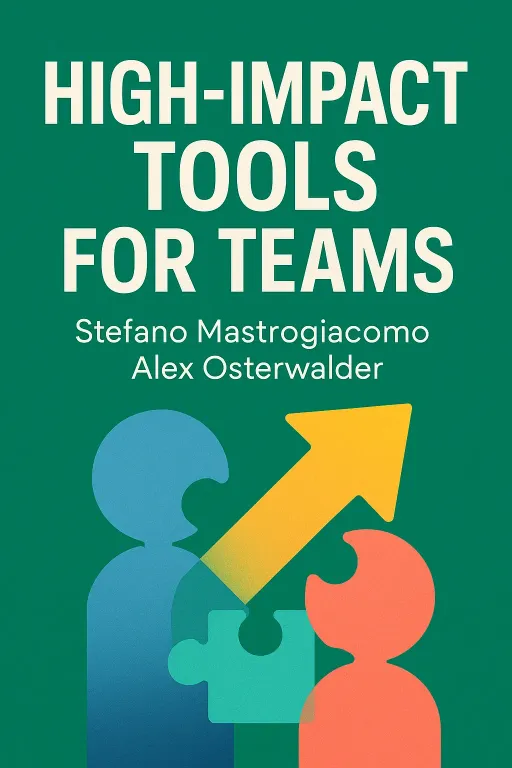
Nova: Exactly, Atlas. It’s that feeling of being on a treadmill – lots of motion, but no real progress. Today, we're diving into how to escape that and build truly high-performing teams, drawing insights from two powerful books: Stefano Mastrogiacomo's "High-Impact Tools for Teams" and Tania Luna's "The Leader Lab."
Atlas: Mastrogiacomo’s work, I recall, is all about bringing a surgeon's precision to the messy world of project execution, right? Focusing on those visual frameworks that cut through the fog.
Nova: Precisely. He’s all about creating clarity in complexity. And Tania Luna, with "The Leader Lab," dives deep into the human side – those crucial behavioral tipping points that separate a manager who just oversees from a leader who truly inspires and elevates.
Atlas: So, we're talking about building the engine the skilled driver, in a way. One provides the structure, the other the dynamic capability. This feels like it’s going to resonate with anyone who’s ever felt that frustration of a team not quite clicking.
Nova: Absolutely. And for our listeners who are driven by progress and seeking effective learning, this episode is designed to give you concrete strategies. We’ll explore how to architect clarity and cultivate the leadership behaviors that lead to tangible results.
Atlas: Let’s get into it.
The Architecture of Clarity: Visualizing Team Collaboration
SECTION
Nova: So, let’s start with Stefano Mastrogiacomo and the idea of clarity in complex projects. He’s essentially saying that ambiguity is the silent killer of team effectiveness. It’s the invisible force that leads to duplicated effort, missed deadlines, and that general sense of "are we even going the right way?"
Atlas: Ambiguity. That’s a great word for it. When you say ambiguity, what does that actually like on the ground for a team? Is it just people not knowing their tasks, or is it deeper than that? Because for someone who’s trying to master their professional path, understanding the root of that confusion is key.
Nova: It’s deeper, often. It’s not just about not knowing your specific task, though that’s part of it. It’s about not understanding the ‘why’ behind the task, how it connects to the larger objective, who else is relying on it, and what success actually looks like for your piece of the puzzle. Imagine a massive jigsaw puzzle, but half the pieces are missing, the box art is smudged, and everyone’s working on a different corner without talking. That’s ambiguity.
Atlas: Oh, I know that feeling. It’s like being in a dense fog, trying to navigate. You can hear other people, maybe even see vague shapes, but you can’t tell if you’re walking towards a destination or off a cliff. And in that scenario, how do these visual frameworks actually help? Are we talking about flowcharts? Gantt charts?
Nova: Mastrogiacomo offers more dynamic, specific tools, and one of his key recommendations, which is perfect for our takeaway today, is the Team Alignment Map. Think of it as a sophisticated blueprint for collaboration. It’s not just a static chart; it’s a living document that visualizes responsibilities, dependencies, and critical milestones. It’s designed to create a shared understanding so everyone sees the whole picture, not just their sliver.
Atlas: A Team Alignment Map. Okay, that sounds very pragmatic. So, what exactly does this map? How does it help someone who’s staring down a huge project sprint, maybe a critical quarter-end push, and they need everyone pulling in the same direction? Because that’s where tangible results are made.
Nova: Great question. The map acts as a powerful communication tool. Before a sprint even begins, the team can collaboratively build this map. It forces conversations about who owns what, what are the critical hand-offs, what are the potential roadblocks, and what does ‘done’ actually look like for each component. For instance, imagine a software development team gearing up for a major feature release. Without alignment, Developer A might build a feature assuming Backend Team B will provide data in a specific format. But if Backend Team B is working on a different assumption, or hasn't even started that part, you’ve got a massive misalignment brewing.
Atlas: Right, and that misalignment doesn't just cause delays; it breeds frustration. People feel like their work is being held up, or worse, that their contribution isn't valued because it doesn't fit. So, this map… does it just lay out tasks, or does it get into the dependencies and the 'why'?
Nova: It absolutely gets into the dependencies and the 'why.' It’s about mapping out the entire ecosystem of the project. You might have sections for key objectives, then break those down into major deliverables, and then assign owners and dependencies for each. It creates a visual chain reaction. When you see that your task, Task C, can't start until Task B is completed by Sarah’s team, and Task B relies on a deliverable from Mark’s team, suddenly the interconnectedness is crystal clear. It shifts the focus from individual tasks to collective outcomes. It’s like looking at the schematics of a complex machine – you see how every gear, every circuit, every connection is vital for the whole thing to function.
Atlas: That’s a powerful analogy. It takes it from a list of to-dos to a system. But what about the human element? People can be resistant to this level of upfront detail. Isn't there a risk of over-planning, of getting bogged down in the map and losing the agility needed to actually the work? Especially for those of us who are pragmatists and want to see momentum build quickly.
Nova: That's a very valid concern, and Mastrogiacomo addresses it by emphasizing that the map isn't meant to be rigid dogma. It’s a tool for, not for micromanagement. The goal is to reduce the that causes friction and wasted effort, not to stifle creativity or responsiveness. The map provides the agreed-upon framework, the shared understanding of the landscape. When unforeseen challenges arise – and they always do – the team can refer back to the map, see how the new development impacts other areas, and make informed decisions about adjustments. It actually agility by ensuring that any pivots are strategic, not chaotic. It’s about knowing where you’re going, so you can adjust your course intelligently when you hit unexpected terrain, rather than just wandering aimlessly.
Atlas: So, it’s less about dictating every single step and more about providing a clear, shared vision of the journey and the terrain. It sounds like a fantastic way to ensure everyone’s moving in the same direction before the sprint even kicks off. That’s the kind of actionable insight I think our listeners are hungry for, especially when they're focused on career acceleration and building momentum.
The Tipping Point of Leadership: Cultivating Behavioral Excellence
SECTION
Nova: And that focus on clarity, on shared direction, is absolutely essential. But what about the people these projects? What about the leaders who are meant to guide the team through that clarity? That’s where Tania Luna’s "The Leader Lab" comes into play, and it’s a crucial complement to Mastrogiacomo’s structural approach.
Atlas: Oh, this is where it gets really interesting for me. Because you can have the most perfect visual map, the clearest objectives, but if the leadership falters, if the human element isn't managed well, everything else can just… crumble. This hits home for anyone focused on career acceleration. We need leaders who can not only direct but also inspire. What are these "tipping point" skills Luna talks about? They sound intriguing.
Nova: They are indeed. Luna's core idea is that leadership isn't about a title or a personality; it's about a set of behaviors that create a positive cascade effect – a tipping point. These aren't necessarily grand gestures; they're often subtle shifts in how a manager interacts. Think about feedback and coaching. Most managers know they give feedback, but the and of that feedback can be the difference between a team member feeling criticized and a team member feeling empowered to grow.
Atlas: I can definitely relate to that. We’ve all had that manager who gives feedback that’s either vague, overly critical, or just plain unhelpful. It leaves you feeling worse, not better. So, what’s the difference between a manager giving feedback and a leader using these 'tipping point' skills? What does that look like in practice?
Nova: Excellent question. A manager might say, "This report isn't good enough. Fix it." That’s directive, and it leaves the recipient guessing. A leader, using a tipping point skill, might say, "I see you've put a lot of work into this report. Let's walk through it together. I’m noticing a few areas where we could strengthen the analysis, particularly in section three. What are your thoughts on how we could add more data points there to really drive home the conclusion?"
Atlas: Wow, okay. I can see the difference immediately. The first one is a command; the second is an invitation to collaborate and problem-solve. It’s not just pointing out a flaw, but actively guiding the person to find the solution themselves. It turns a critique into a development opportunity.
Nova: Exactly. It’s about shifting from a posture of judgment to one of partnership. Coaching, for example, isn't about telling someone what to do. It’s about asking powerful questions that help them uncover their own solutions, build their own confidence, and develop their own problem-solving muscles. It’s the difference between giving someone a fish and teaching them how to fish, but with a nuanced, insightful approach that respects their existing knowledge and potential.
Atlas: That makes so much sense for effective learning. Instead of just absorbing information, you're actively participating in your own development. But it sounds powerful, Nova, and also like a significant personal shift. For someone who might have been in a more command-and-control environment for years, how does one start developing these 'tipping point' skills? How do you build that momentum for personal leadership growth?
Nova: It starts with self-awareness and a commitment to practice. Luna suggests identifying one or two specific behaviors to focus on. Perhaps it's practicing active listening in your next team meeting, or consciously asking more open-ended questions during one-on-ones. It’s about small, consistent efforts. You might record your own interactions mentally, or even jot down notes afterwards: "In that conversation, I noticed I interrupted three times. Next time, I’ll focus on letting the other person finish their thought." It’s about deliberate practice, much like learning a musical instrument or a new sport.
Atlas: So, it’s not about a sudden transformation, but a series of intentional micro-steps. That’s reassuring. It means that even with a busy schedule, we can integrate this into our professional journey. It’s about building that habit, that muscle memory for effective leadership. It’s the pragmatist’s approach to developing softer, yet arguably more critical, skills.
Nova: Absolutely. And when you start seeing the results – team members who are more engaged, more innovative, more accountable – that positive feedback loop fuels your own motivation and builds unstoppable momentum. It’s the synergy: the clarity provided by structures like the Team Alignment Map, combined with the elevated human performance driven by skilled leadership, that creates truly high-impact teams.
Synthesis & Takeaways
SECTION
Nova: So, as we bring these two powerful ideas together, it’s clear that high-performing teams aren't built on chance. They are architected with intention. Stefano Mastrogiacomo gives us the blueprint for clarity, showing us how to visualize responsibilities and dependencies to cut through complexity, especially before a big project sprint.
Atlas: And Tania Luna provides the master craftspeople – the leaders – equipping them with the behavioral skills, like nuanced feedback and genuine coaching, to inspire that clarity into action. It’s about moving beyond just managing tasks to truly cultivating potential.
Nova: The synergy is profound. When you combine a clear, visual understanding of how the work fits together with leaders who can empower and guide their teams through that structure, you unlock an entirely new level of performance. It’s not just about getting more done; it’s about getting the things done, effectively, and with a team that feels genuinely connected and capable.
Atlas: And the immediate, tangible takeaway for our listeners, as Mastrogiacomo suggests, is to try using that Team Alignment Map before your next big project sprint. It’s a practical step that can dramatically improve direction and reduce that dreaded ambiguity. It’s about taking control of your team’s trajectory.
Nova: That’s right. The deep insight here is that true high performance isn't a singular achievement; it’s a dynamic, ongoing process. It’s the fusion of robust, logical structures and empathetic, skilled human interaction. It’s about building systems that empower people, and people who empower systems.
Atlas: It’s fascinating to think about how much potential is unlocked when we get these two elements right. For listeners who are strategizing their career acceleration or just looking to build better momentum in their work, implementing even one of these ideas could make a significant difference. What’s one aspect of your team’s alignment or your leadership approach that you’ll focus on this week?
Nova: That’s a great question to ponder. It’s about continuous growth, about embracing that journey of discovery.
Atlas: Well said, Nova. This has been incredibly insightful.
Nova: Thank you, Atlas.
Atlas: This is Aibrary. Congratulations on your growth!