Cultivating Effective Teamwork
Golden Hook & Introduction
SECTION
Nova: You know, Atlas, I’ve often wondered if the biggest obstacle to a team's success isn't external competition or market shifts, but something far more insidious: a lack of internal clarity, almost like everyone's speaking a different language in the same meeting.
Atlas: Oh, I know that feeling! It’s like being in a beautifully designed car, but everyone has their own idea of the destination and which pedal does what. You end up going nowhere fast, or worse, crashing.
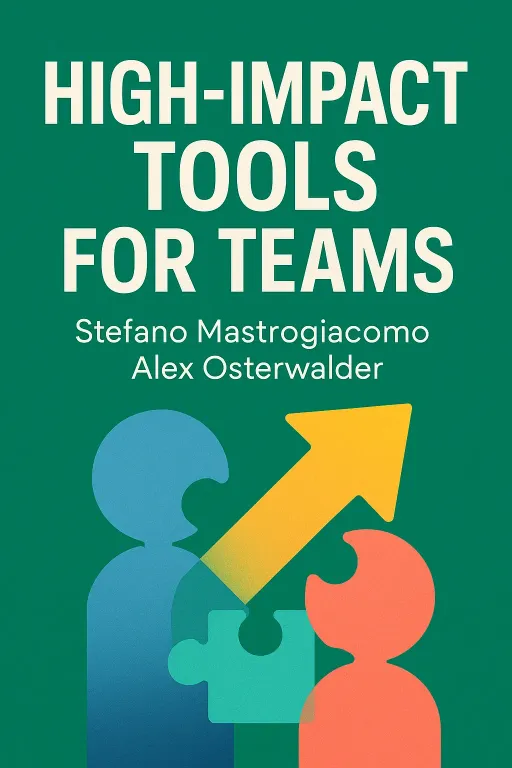
Nova: Exactly! And that’s precisely what we’re dissecting today, through the lens of two incredibly insightful books. We're talking about Stefano Mastrogiacomo and Alexander Osterwalder’s, and Dermot Crowley’s.
Atlas: Two powerhouses, both tackling the perennial challenge of getting groups of smart people to actually work together. What strikes me immediately about Mastrogiacomo and Osterwalder is their focus on visual frameworks. Osterwalder, for instance, is already renowned for the Business Model Canvas, which transformed how startups and established companies strategize. It's no surprise he'd bring that same visual, collaborative genius to team dynamics. He’s all about making the abstract tangible, which is a godsend for complex team environments.
Nova: Absolutely. And Crowley, with, comes from a background rooted in productivity and efficiency, applying those principles directly to collective work. He's building on the "why" and "what" of smart work, then showing us how that translates to a group. It’s like one gives you the blueprint and the other gives you the foundational engineering principles.
Atlas: So, basically, one is giving us the specific tools, the templates, the "how-to," and the other is laying down the broader philosophy and principles—the "why" we even need those tools in the first place?
Nova: Precisely. And for anyone out there leading a team, or even just being part of one, these insights are gold. We’re going to explore how bringing structure and clarity, not just to tasks, but to the very within teams, can unlock incredible potential.
The Power of Visual Tools for Clarity
SECTION
Nova: Let's dive into first. What Mastrogiacomo and Osterwalder really champion is this idea that complexity isn't the enemy; ambiguity is. They argue that many team failures stem from unshared understanding, even when everyone thinks they're on the same page.
Atlas: Wait, so you’re saying that the problem isn't that projects are inherently complex, but that we often approach them with fuzzy, undefined expectations? That’s going to resonate with anyone who’s sat in a meeting where everyone nodded along, only to deliver wildly different interpretations of the same assignment a week later.
Nova: Exactly! And their solution is elegantly simple: visual and collaborative tools. Think of it like this: if you're building a house, you don't just tell the carpenter to "build a nice house." You give them blueprints, right? You show them the layout, the dimensions, the materials. These tools are the blueprints for team objectives, decisions, and progress.
Atlas: Can you give an example? Like how does a visual tool clarify something that a written memo can't?
Nova: Take their "Team Alignment Map," for instance. It's a single canvas where a team collectively maps out their shared purpose, their individual contributions, key stakeholders, and potential risks. It forces everyone to externalize their internal models, literally putting them on the table. When you see your colleague's understanding next to yours, discrepancies become glaringly obvious, not hidden in assumptions. It’s like a shared mental model made visible.
Atlas: That’s a great way to put it. I can see how that would expose those hidden assumptions. Because if I just write "build a strong marketing campaign," what I mean by "strong" might be completely different from what you mean. But if we're visually mapping out target demographics, key messages, distribution channels, and success metrics, suddenly, the word "strong" takes on a collectively understood meaning.
Nova: Absolutely. And it's not just about initial alignment. They also offer tools for decision-making, like "Decision Boards," which help teams systematically weigh options against criteria and record the rationale, making future accountability transparent. Or "Progress Trackers" that aren't just Gantt charts, but visual representations of dependencies and potential roadblocks, encouraging proactive problem-solving.
Atlas: So, it’s not just about starting right, but staying right throughout the process. I’m curious, though, don’t these tools add more overhead? Sometimes, introducing new processes can feel like adding more work, not less.
Nova: That's a common concern, and a valid one. But the argument is that the upfront investment in clarity saves exponential time and resources down the line. Think of the cost of rework, missed deadlines, or outright project failure due to miscommunication. These tools are designed to prevent those costly errors by building a shared reality from the start. They argue that the time spent clarifying is an investment in efficiency, not a drain on it. It’s about being effective being efficient.
Principles of Smart Work in Team Settings
SECTION
Nova: Shifting gears a bit, Dermot Crowley’s really unpacks the broader principles underpinning these kinds of tools. While gives us the "what to use," Crowley delves into the "why it works" and "what mindset shifts are needed."
Atlas: So, if Mastrogiacomo and Osterwalder are the architects of the blueprints, Crowley is the structural engineer explaining the physics of why those blueprints hold up?
Nova: Exactly! Crowley emphasizes three core tenets: efficient communication, clear roles, and shared accountability. He argues that "smart work" isn't just about individual productivity hacks, but about how those apply to a collective. He’s essentially saying that a team of individually smart people doesn’t automatically make a smart team.
Atlas: That’s a crucial distinction. I’ve seen plenty of brilliant individuals flounder in a team setting because the collective intelligence wasn't properly harnessed. How does he define "efficient communication" in a team context? Because that term can mean a lot of things to different people.
Nova: For Crowley, efficient communication isn't just about sending fewer emails or having shorter meetings. It's about ensuring every communication has a clear purpose, a defined audience, and elicits a specific action or understanding. He champions structured conversations, whether written or verbal, that cut through noise and ambiguity. He’s big on the idea of "deliberate communication"—being intentional about what you say, how you say it, and why.
Atlas: That makes perfect sense. It’s about quality over quantity, right? And the "clear roles" part – that sounds almost self-evident, but I bet it's something teams struggle with constantly.
Nova: Oh, absolutely. It's not just about job titles. Crowley pushes for clarity on who is responsible for what. Not just "marketing department," but "Sarah is responsible for the social media campaign strategy, Mark for content creation, and Emily for analytics reporting." This granular clarity prevents duplication of effort, identifies gaps, and empowers individuals to own their contribution. It builds on the idea that when everyone knows their piece of the puzzle, the whole picture comes together faster and more smoothly.
Atlas: And shared accountability, then, must be the glue that holds it all together. Because if roles are clear and communication is efficient, but nobody feels truly on the hook, it can still fall apart.
Nova: Precisely. Crowley highlights that shared accountability isn't about everyone being responsible for, but about everyone being accountable for their in achieving the collective goal. It fosters a sense of collective ownership and mutual reliance. It's about creating a culture where team members feel empowered to call out issues, offer help, and celebrate wins together, because they all have skin in the game. It’s a powerful motivator.
Synthesis & Takeaways
SECTION
Nova: So, bringing these two perspectives together, we see a powerful synergy. Mastrogiacomo and Osterwalder give us the tangible tools to build clarity and structure. Crowley gives us the underlying principles—the bedrock of efficient communication, clear roles, and shared accountability—that make those tools truly effective.
Atlas: It’s like one says, "Here's the hammer and the nails," and the other says, "Here's why you need to hit the nail squarely and how a strong joint works." You need both for a sturdy structure. For our listeners, especially those driven by impact and seeking to elevate their professional influence, understanding this combination is vital. It’s not just about managing tasks; it's about connecting people through shared understanding and purpose.
Nova: Exactly. The core of effective teamwork, whether you're a strategist or a leader, isn't about finding a magic bullet. It's about intentionally designing interactions and processes that foster transparency, align individual efforts, and cultivate a collective sense of ownership. It’s about moving beyond just a team to a smart, high-impact team.
Atlas: And it’s a journey, right? It's not a one-time fix. It requires continuous cultivation, using these tools and principles as a living guide. What truly resonates is this idea that clarity is kindness, and structured collaboration is the ultimate accelerant for any team's goals.
Nova: It truly is. This is Aibrary. Congratulations on your growth!