The Infinite Game: Why Long-Term Vision Outperforms Short-Term Wins
Golden Hook & Introduction
SECTION
Nova: What if everything you thought you knew about "winning" was actually setting you up to lose in the long run? We're talking about a fundamental shift in how we approach success, one that redefines what it means to truly thrive.
Atlas: Whoa, that's a bold claim, Nova. My entire life has been about winning, about achieving the next goal, hitting the next target. Are you telling me that's been a mistake?
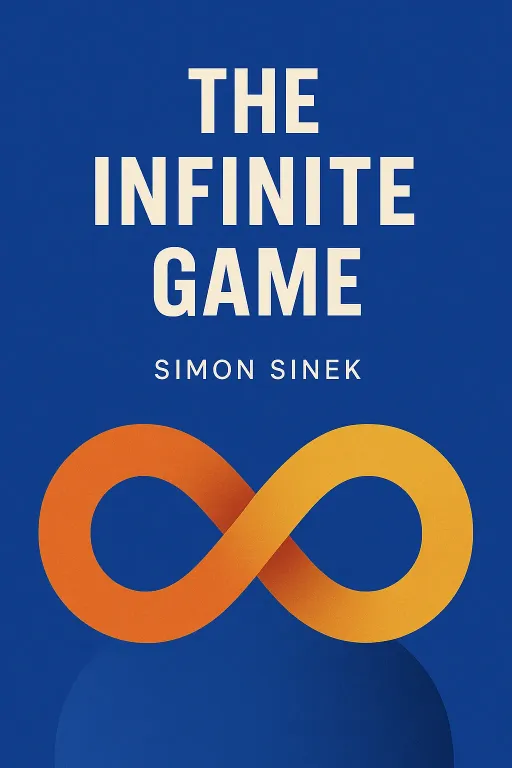
Nova: Not a mistake, Atlas, but perhaps an incomplete picture. Today, we're diving into a concept that turns that finite view of success on its head. We're exploring "The Infinite Game" by the incredible Simon Sinek. Sinek, who many know from his influential work on 'Start With Why,' has this remarkable ability to illuminate complex leadership and strategic ideas with such clarity. This book, widely acclaimed for its fresh perspective, really challenges us to rethink the very nature of competition and long-term viability.
Atlas: I’ve heard whispers about this idea, but it feels almost counter-intuitive in our competitive world. Everywhere you look, there are winners and losers, quarterly reports, market share battles. How can you play to win?
Nova: Exactly! And that's where the blind spot lies. We often approach both business and life as if they are these finite games with clear winners and losers, but in doing so, we often undermine our own long-term resilience and sustained growth.
The Fundamental Distinction: Finite vs. Infinite Games
SECTION
Nova: So, let's break it down. Sinek masterfully distinguishes between two types of games: finite and infinite. Think of a finite game like a football match. It has known players, fixed rules, a clear objective – to win – and defined boundaries of time and space. When the whistle blows, the game is over, and there's a clear victor.
Atlas: Yeah, I get that. Super Bowl, chess, a sales quarter. Clear objectives, clear outcomes. Makes perfect sense. But that’s how most of us operate, isn’t it? We set goals, we compete, we try to win.
Nova: Absolutely. And that's perfectly fine for actual finite games. The problem arises when we apply a finite mindset to an game. An infinite game, on the other hand, has known and unknown players, the rules are often mutable, and there's no defined endpoint. The objective isn't to win, because there no winning. The objective is to keep playing, to perpetuate the game.
Atlas: Hold on. You're saying life itself is an infinite game? My career? My marriage? That’s a fundamentally different way of looking at things. So, in business, what does "keeping playing" even mean when investors are demanding returns and competitors are breathing down your neck?
Nova: It means shifting your focus from "beating" the competition to "outlasting" them. From maximizing short-term gains to building an organization so robust and adaptable that it can navigate continuous change and uncertainty. When you play with an infinite mindset, your worthy rivals aren't enemies to be defeated, but partners in pushing the game forward, making everyone better.
Atlas: That sounds a bit out there for someone in a high-stakes environment. I imagine a lot of our listeners, especially those integrating roles like macro trading with leadership, are thinking: "How do I explain 'I'm just trying to keep playing' to a board expecting exponential growth?" It feels like a luxury, not a strategy. What happens when a company, or even an individual, tries to play an infinite game with a finite mindset?
Nova: That's where the danger lies, Atlas. It leads to ethical fading, a decline in trust, innovation stagnation, and ultimately, burnout. Companies focused solely on winning the next quarter might cut corners, exploit employees, or stifle creativity, all to hit a short-term target. They might win a few battles, but they lose the war for long-term relevance and employee loyalty.
Cultivating an Infinite Mindset for Enduring Success
SECTION
Nova: And understanding that danger, Atlas, actually leads us to the crucial part: how do we actually an infinite game when all our instincts scream 'finite'? Sinek outlines five essential practices for leading with an infinite mindset. We can't cover all five today, but two that really resonate are having a Just Cause and embracing Existential Flexibility.
Atlas: "Just Cause"... so it's about purpose? I can see how that fits with leadership, inspiring teams, but how does that translate into, say, a trading floor, where it feels like the 'purpose' is purely profit? How do you infuse purpose into something that seems so transactional?
Nova: That's a brilliant question, and it's where the mastery comes in. A Just Cause isn't just about making money; it's a vision for a future state so appealing, so profound, that people are willing to make sacrifices to advance it. It's a positive, future-oriented, inclusive, and service-oriented vision. Think of companies, like those Jim Collins highlighted in "Good to Great," that endured and thrived not just because they were profitable, but because they had an unwavering purpose that transcended market fluctuations. Their deep, almost obsessive, focus on their mission allowed them to make disciplined, long-term decisions that outperformed their rivals.
Atlas: So, it’s not about the daily grind of trading, but the larger impact those trades enable? Or the ethical framework they operate within? That's a powerful reframing. It shifts the focus from simply winning a trade to contributing to a larger, more meaningful economic ecosystem.
Nova: Exactly. And that leads us to Existential Flexibility. This isn't just about being adaptable; it's the capacity to make radical strategic shifts to advance your Just Cause, even if it means disrupting your current business models or giving up short-term gains. It's about being willing to blow up your own successful product line if it means better serving your ultimate purpose.
Atlas: And that sounds terrifying for any established organization. "Blow up your own successful product?" That's a bit like a seasoned trader saying, "I'm going to completely abandon my proven strategy because the market change significantly in five years." It’s a massive leap of faith, isn't it?
Nova: It is. But companies that lack this flexibility, that cling to what brought them success yesterday, are often the ones that become obsolete. Think of Kodak, once a titan in photography, that failed to embrace digital photography despite inventing some of the core technology. They were playing a finite game, trying to protect their current revenue streams, while the world had moved on to an infinite one. Existential flexibility requires courage to lead, to make those tough calls that prioritize the long-term vitality of the organization over a comfortable status quo.
Atlas: That's a stark reminder. It’s not just about being smart; it’s about being brave enough to evolve, even when it’s uncomfortable.
Synthesis & Takeaways
SECTION
Nova: Precisely. The infinite game isn't just about changing you do, but you see the world and your role in it. It's about building something that lasts, that adapts, that continually serves a greater purpose, rather than just chasing the next fleeting victory. It's a profound shift in perspective that allows for continuous growth.
Atlas: So for someone striving for mastery, integrating complex fields like macro trading with impactful leadership, this isn't just a business strategy. It's a personal philosophy, a way to build a resilient career and life where the goal isn't 'winning' the next deal, but ensuring you're still playing, and thriving, decades from now. It’s about building a legacy, not just hitting targets.
Nova: That's the deep insight, Atlas. The true power lies in realizing that every 'finite' challenge – whether it's a tough market, a difficult negotiation, or a leadership dilemma – can be reframed as an opportunity for continuous growth and adaptation within your infinite game. It’s about asking: how does this challenge allow me to strengthen my Just Cause, build a more trusting team, or demonstrate existential flexibility?
Atlas: That’s actually really inspiring. It shifts the entire dynamic. So, we leave you with this: What 'finite' challenge in your work right now can you reframe as an 'infinite' opportunity for continuous growth? How does shifting your mindset change your next move?
Nova: This is Aibrary. Congratulations on your growth!