The Infinite Game: Why a Long-Term Mindset Wins in the Short Run
Golden Hook & Introduction
SECTION
Nova: Alright Atlas, quick game. You're a CEO, I'm a philosopher. How do we argue about next quarter's revenue targets?
Atlas: Oh, I love this! Easy, I'd say, "Show me the money, Nova, the numbers speak for themselves!" And you, you'd probably say, "But what money, truly? A construct? A fleeting illusion?"
Nova: Exactly! And that, my friend, is precisely the blind spot we're dissecting today. That immediate, tangible "win" versus the broader, often unquantifiable, long game. It's a trap many of us fall into, in business and in life.
Atlas: That makes me wonder, how many times have I been so focused on winning a single battle, I missed the whole war?
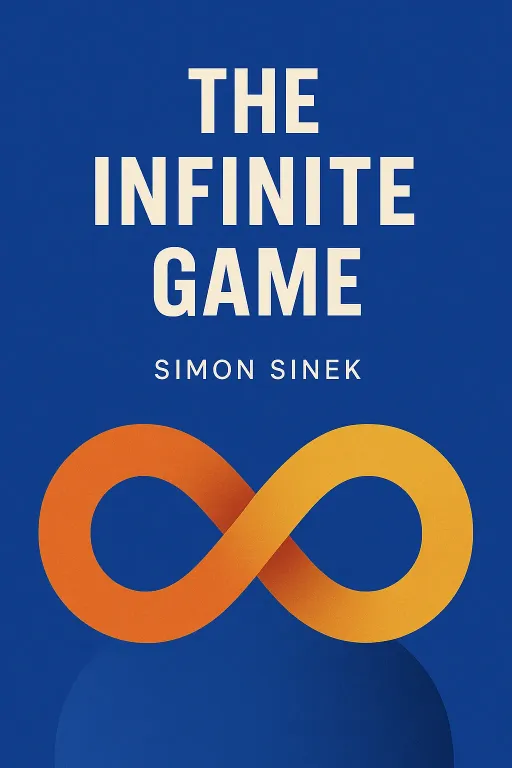
Nova: A lot, probably! And that's why today, we're diving into by Simon Sinek. Sinek, who actually started his career in advertising before pivoting to become a renowned leadership expert and ethnographer, spent years observing what truly makes organizations not just succeed, but long-term, beyond just quarterly reports or market share.
Atlas: Oh, I see. So this isn't just another leadership book telling us to "think big." It's about fundamentally changing how we define success, right? For anyone trying to build something foundational, that's huge.
Nova: Absolutely. Today we'll explore the 'blind spot' of finite thinking that too many of us fall into, then we'll discuss how embracing an infinite mindset can unlock true, lasting success and resilience.
The Blind Spot: Why We Play Finite Games in an Infinite World
SECTION
Nova: So, let's start with the central premise: Sinek argues there are two kinds of games. Finite games, like a football match, have known players, fixed rules, and a clear end point with a winner and a loser. Then there are infinite games, like life itself, or business, or even politics. Unknown players, changeable rules, and no true end. Nobody "wins" life.
Atlas: Okay, but isn't competition good? Doesn't it drive innovation? What's wrong with wanting to 'win' in business? I mean, for architects and cultivators, there's a drive for tangible impact, a desire to create something that clearly works better than what came before.
Nova: And that's precisely where the blind spot lies. When you apply a finite mindset to an infinite game, you create a host of problems. Imagine a company whose sole focus is to "beat" its competitors each quarter, or to hit a specific stock price target. They might cut corners on R&D, underpay employees, or even compromise on product quality just to make those numbers look good.
Atlas: That sounds rough, but isn’t that just, like, capitalism? Every entrepreneur I know is driven to outperform the competition.
Nova: Exactly, but the outcome is often devastating in the long run. Take the example of Blockbuster versus Netflix. Blockbuster was playing a finite game, focused on maximizing late fees and maintaining physical store dominance. Netflix, on the other hand, understood the infinite game of entertainment delivery. They were willing to pivot, experiment, and even initially money on streaming, because they saw the horizon.
Atlas: Wow, that’s a perfect example. Blockbuster "won" so many battles, but completely lost the war. So, it's not just about losing, it's about fundamentally misunderstanding the game you're in? What does that look like day-to-day for someone trying to build something lasting, something robust?
Nova: It means you're constantly reactive. You're not building resilient systems; you're just patching holes. You're not fostering lasting innovation; you're just copying what your "rivals" are doing. It limits your vision, prevents true, lasting success, and can even lead to burnout because the "finish line" keeps moving, but you're still running like it's a sprint. You end up chasing metrics instead of purpose.
The Shift: Cultivating an Infinite Mindset for Enduring Value
SECTION
Nova: So, if we're all caught in this 'finite trap,' how do we break free and start cultivating an infinite mindset? Sinek outlines five essential practices, but two really stand out for anyone looking to build enduring value: having a Just Cause and building Trusting Teams.
Atlas: A 'Just Cause' sounds great on paper, like a mission statement. But how does a leader actually that in a team, especially when they're focused on quarterly deliverables, or trying to scale a new system? For someone building robust systems, this feels like an abstract leap.
Nova: It's more than a mission statement. A Just Cause is a specific, positive, and inclusive vision of the future that is bigger than any single product or profit margin. It's something you're willing to sacrifice for. Think about Patagonia. Their Just Cause isn't just selling outdoor gear; it's about saving the planet.
Atlas: Right, like they'll literally tell you to buy their products if you don't need them, which seems counter-intuitive for a finite game.
Nova: Exactly! That commitment to their Just Cause, to environmentalism, isn't a marketing gimmick. It attracts customers who share that belief, and crucially, it attracts employees who are deeply committed to that vision. And that leads directly to the second practice: building Trusting Teams. When people believe in a shared vision, and feel psychologically safe, they innovate, they support each other, and they adapt gracefully to change.
Atlas: I can see how that would be powerful. It reminds me of Jim Collins' work in, where he talks about building disciplined cultures and fostering leadership that thinks beyond immediate pressures. So, Collins' 'disciplined cultures' and 'leadership that thinks beyond immediate pressures' is essentially another way of describing this infinite game, just from a different angle?
Nova: Precisely! Collins' research revealed that truly great companies prioritize sustained performance over quick wins. They build these disciplined cultures and foster leadership that thinks beyond immediate pressures, echoing the infinite game's principles. It's about building an organization that can outlast its founders, its products, even its current market. It's about adaptability and resilience, not just winning today's sales pitch.
Atlas: That makes perfect sense. For anyone cultivating resilient systems or communities, that shift from "beating the competition" to "advancing a cause" is profound. It's about creating something that truly lasts and evolves.
Synthesis & Takeaways
SECTION
Nova: So, what we're really talking about here is a fundamental reframing. It's not about ignoring short-term realities or quarterly reports entirely, but about understanding them within the context of a larger, ongoing purpose. It's about realizing that the true measure of success isn't a single victory, but the ability to keep playing, to keep improving, and to leave something better behind.
Atlas: That gives me chills. It’s such a hopeful way to look at it. But let's get concrete. Where in our current projects are we playing a finite game? How might an infinite mindset change that approach? For our listeners, especially those building robust systems and communities, what’s one tangible thing they can do to start making this shift?
Nova: A fantastic question. One simple yet powerful step: dedicate 15 minutes daily to reflective journaling. Don't just list tasks or achievements. Process the wins, yes, but also the lessons. Ask yourself: "Did this move my Just Cause forward, or was it just a distraction?" "Did this decision build trust, or erode it?" This isn't about blaming yourself, it's about cultivating that long-term vision, trusting your intuition as much as your data, and aligning your daily actions with that enduring value you're striving to create.
Atlas: I totally know that feeling. It's about connecting the small, daily actions to the bigger, infinite purpose. That's how you build lasting value and human connection, not just products.
Nova: Exactly. Embracing an infinite mindset liberates you from the pressure of constant 'winning,' allowing you to cultivate enduring value and adapt gracefully to change.
Atlas: What a powerful idea to leave us with.
Nova: This is Aibrary. Congratulations on your growth!