The Mechanics of Flow and Efficiency
Opening
SECTION
Nova: Content` lines, section headers, no stage directions.
Golden Hook & Introduction
SECTION
Nova: You know, Atlas, I was thinking about how often we try to solve big problems with even bigger, more expensive solutions. We're talking about massive tech overhauls, entire department restructures, huge capital investments.
Atlas: Oh, I know that feeling. It's the "boil the ocean" approach, right? When everything feels broken, the instinct is to try and fix everything at once, usually with a budget that matches the ambition.
Nova: Exactly! But what if I told you the most profound breakthroughs in efficiency and flow don't always come from those grand, sweeping gestures? Sometimes, the most transformative insights arrive not from a boardroom strategy session, but from simply watching someone do their job for an hour.
Atlas: Whoa. You’re saying the answers are hiding in plain sight? That sounds almost too simple for the complex systems many of our listeners are trying to build and scale. I mean, we're strategists, we're builders, we're looking for the next big innovation.
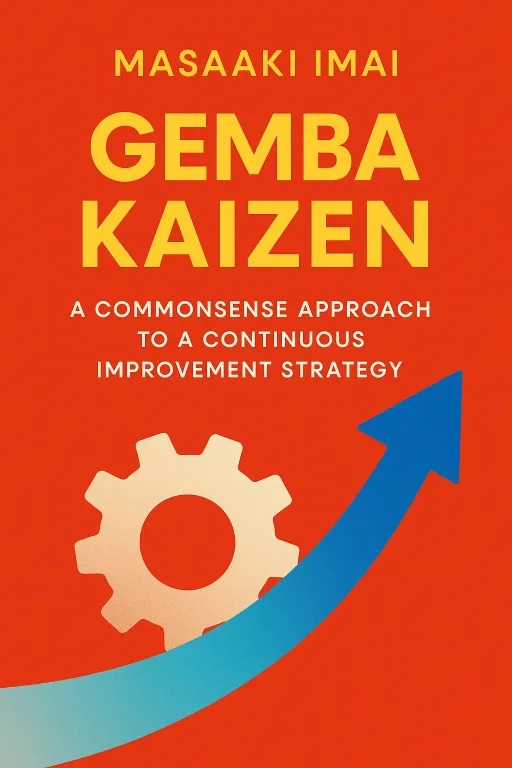
Nova: Well, prepare to have your mind subtly shifted, because today we're diving into two landmark works that champion this very idea. We're talking about Masaaki Imai's foundational work, "Gemba Kaizen," and Eliyahu M. Goldratt's revolutionary business novel, "The Goal."
Atlas: A business novel? That's definitely an unusual approach for what sounds like heavy operational theory.
Nova: It absolutely is! Goldratt, a physicist turned management guru, chose that narrative format precisely to make his complex Theory of Constraints accessible. "The Goal" became a global phenomenon, making dry operational concepts relatable through a compelling story, which was groundbreaking for its time. And Imai, often called the father of Kaizen, really distilled a human-centric philosophy of continuous improvement that resonated globally, challenging the Western focus on purely technological fixes.
Atlas: That makes sense. It’s about making high-value insights accessible, not just for the experts, but for anyone looking to drive growth. So, where do we start with these seemingly simple, yet profound ideas?
Deep Dive into Core Topic 1: Gemba Kaizen
SECTION
Nova: We start at the Gemba. In Japanese, 'Gemba' literally means "the actual place." In the context of business, it’s the place where value is created, where the real work happens – be it a factory floor, a customer service desk, a software development team's workspace, or even your own desk.
Atlas: So it's about getting out of the office, away from the spreadsheets, and seeing the action firsthand. I can see how that's important, but why is it so revolutionary? Aren't managers already aware of what's happening in their operations?
Nova: That’s the critical point. Imai’s "Gemba Kaizen" isn't just about there; it's about with a specific mindset. It’s about respect for the process and for the people doing the work. You're not there to criticize or impose a top-down solution. You're there to learn, to ask "why" five times, and to find small, iterative improvements.
Atlas: "Why" five times. That's a classic. But give me an example. For a strategist building a new business model, "the Gemba" isn't always a physical place. How does this translate?
Nova: Think of it this way: a software development team is consistently missing deadlines. The immediate thought might be "we need more developers" or "our project management software isn't good enough." But a Gemba walk for that team might involve literally sitting with a developer, watching them code, seeing how they interact with their tools, how they get requirements, what interrupts them.
Atlas: Like being a fly on the wall.
Nova: Exactly. And what you might observe is not a lack of skill or software, but something incredibly subtle. Perhaps the build process takes 15 minutes, but it frequently fails, forcing the developer to restart, losing focus each time. Or maybe they spend 30% of their day searching for documentation that’s scattered across different platforms.
Atlas: Oh, I’ve been there. The death by a thousand paper cuts.
Nova: Precisely! A manager in an office might never see these small, accumulating frustrations. But on the Gemba, you might see an operator in a manufacturing plant struggling with a poorly designed tool, or constantly reaching for a component just out of easy reach. The solution isn't a million-dollar automation; it's often a simple, low-cost jig, a better-placed shelf, or a slight tweak to a process that the person doing the work immediately identifies.
Atlas: So it's about empowering the people closest to the work to be the source of improvement, rather than waiting for a top-down directive. That resonates with the idea of iterative learning – every small step forward counts. It makes the "builder" in me think about how much faster we could build efficient systems if we just paid more attention to the people actually them.
Deep Dive into Core Topic 2: Theory of Constraints (TOC)
SECTION
Nova: And that naturally leads us to Goldratt's "The Goal," which provides a brilliant framework for to improve first, once you're on the Gemba. Goldratt introduces the Theory of Constraints, or TOC, and its core idea is incredibly powerful: any system, whether it's a factory, a project, or even a personal workflow, is only as strong as its weakest link. That weakest link is what he calls the "bottleneck."
Atlas: The weakest link. That makes perfect sense for anyone trying to scale or achieve sustainable growth. But how do you that single biggest bottleneck when everything feels urgent and interconnected? It often feels like there are a dozen "weakest links."
Nova: That's where Goldratt's genius comes in. He outlines five focusing steps. First, you the constraint. This is where your Gemba walk comes in handy. It’s the resource or process step that limits the system's output. For example, if you have a production line, it’s the machine or workstation with a backlog building up in front of it.
Atlas: Okay, so you find the choke point. Then what?
Nova: Second, you the constraint. This means getting the absolute most out of it with existing resources, without major investment. Make sure it's never idle. Give it the best operators, ensure it has high-quality inputs, reduce its setup times.
Atlas: So, don't let your most critical, slowest component ever sit around waiting.
Nova: Exactly. Third, you everything else to the constraint. This is the counter-intuitive part. All non-bottleneck resources should operate at a pace dictated by the bottleneck. If other machines are faster, let them wait. If they produce more than the bottleneck can handle, that's just building up wasteful inventory.
Atlas: Wait, so you're saying if I have a super-efficient team, but they're waiting on inputs from a slower, bottlenecked team, I should make the efficient team slow down? That sounds... inefficient.
Nova: It feels that way, doesn't it? But if you let the faster team run ahead, they'll just create more work-in-progress, more inventory, more complexity, which ultimately costs more and doesn't increase the system's output. The goal isn't to optimize individual parts; it's to optimize the entire system's flow.
Atlas: That’s a powerful reframing. It challenges the conventional wisdom that everyone should always be working at 100% capacity. It’s about strategic idleness.
Nova: Precisely. Fourth, you the constraint. If exploiting and subordinating aren't enough, then you invest to increase the bottleneck's capacity – buy a new machine, add more staff, improve its technology. This is where those bigger investments come in, but only you've confirmed it's truly the limiting factor.
Atlas: And the fifth step? I imagine it's not a one-and-done deal.
Nova: You're right. Fifth,. Once you've elevated one constraint, it will likely cease to be the bottleneck, and a new one will appear elsewhere in the system. So, you go back to step one and start the cycle again. It's continuous improvement, but with a laser focus.
Atlas: That makes me wonder, for our listeners who are constantly iterating on business models or trying to innovate, this isn't just about manufacturing. This applies to any process, right? Like identifying the single biggest blocker in a user acquisition funnel, or the one team that's always holding up product launches.
Synthesis & Takeaways
SECTION
Nova: Absolutely. Goldratt’s insights, delivered through a compelling narrative, show that this isn't just for factory floors. It’s about strategic clarity, about knowing exactly where to apply your finite resources for maximum impact. And when you combine that with Imai’s Gemba Kaizen, you get an incredibly powerful duo.
Atlas: I see it now. Gemba provides the eyes and the human-centered understanding of the problems and potential solutions truly lie, by observing the actual work. And TOC gives you the brain, the analytical framework to identify of those problems, or which point in the process, is the most critical to address for overall system improvement.
Nova: That’s a perfect synthesis. These aren't just academic theories; they are calls to action for anyone driven by growth and efficiency. So, for our listeners, the takeaway this week is incredibly practical.
Atlas: I think I know where you’re going with this. Walk your 'Gemba.' Whether that’s literally your workspace, your team's daily stand-up, or even your own personal project workflow.
Nova: Yes! And then, with Goldratt’s lens, identify the single biggest bottleneck. What is the one thing that, if it went away, would dramatically improve your flow or output? And then, before you think about complex solutions, apply a small, iterative improvement to that bottleneck.
Atlas: It almost sounds like a mindset shift – from trying to fix everything, to precisely fixing the thing, and trusting that the people doing the work often hold the keys to those right fixes. That's a profound insight for anyone building resilient organizations.
Nova: It truly is. Sometimes the most powerful answers are the ones we can see, if we just know where to look and what questions to ask.
Atlas: What's the biggest constraint in your own work right now, Nova?
Nova: Oh, that's a whole other podcast episode, Atlas! But let's just say, my Gemba walk often involves a lot of coffee and very focused observation of my inbox.
Nova: This is Aibrary. Congratulations on your growth!