Engineering Breakthroughs: High-Performance Team Dynamics
Golden Hook & Introduction
SECTION
Nova: What if the secret to your team's next breakthrough isn't more effort, but a radical shift in how you talk and what you measure? Forget incremental, we're talking genuine leaps.
Atlas: Whoa, genuine leaps? That's a bold claim, Nova. I imagine a lot of our listeners, especially those driven by progress and seeking impactful knowledge, are leaning in right now. What kind of magic are we talking about here?
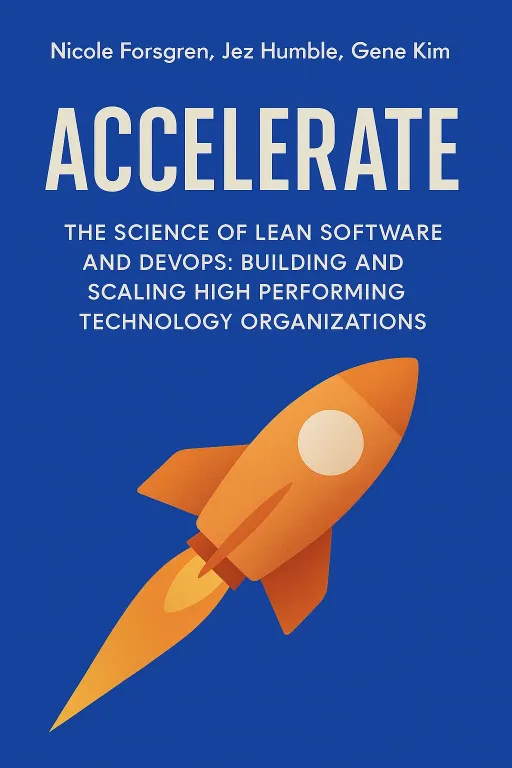
Nova: No magic, Atlas, just brilliant engineering – both technical and human. Today, we're dissecting two powerhouse books that, when combined, offer a roadmap to truly high-performance teams. First up, we have "Accelerate" by Nicole Forsgren, Jez Humble, and Gene Kim.
Atlas: Ah, "Accelerate." That one made serious waves in the tech world.
Nova: Absolutely. It's a pioneering work because it brought rigorous, empirical data to what was often just anecdotal wisdom about software delivery and organizational performance. Forsgren, Humble, and Kim didn't just certain practices were better; they it with science. It became a foundational text for anyone serious about DevOps and modern engineering practices.
Atlas: That makes sense. For a long time, it felt like everyone was just guessing. So, "Accelerate" gives us the hard data, the scientific blueprint, if you will.
Nova: Precisely. And then, we pivot to a completely different, yet utterly complementary, approach with Adam Kahane's "Facilitating Breakthrough." Kahane is a master of guiding diverse, often adversarial groups through seemingly intractable problems. His work is less about metrics and more about the messy, human art of deep collaboration and difficult conversations.
Atlas: That’s fascinating. It sounds like one book gives us the "what" and the other gives us the "how" for handling the human element. For a strategic communicator, that blend feels essential.
The Data-Driven Engine of High Performance
SECTION
Nova: Exactly. Let's dive into "Accelerate" first, because it lays a crucial foundation. The authors identified four key metrics that consistently predict high performance in technology organizations. These aren't just vanity metrics; they're indicators of health and capability.
Atlas: Okay, I’m ready. For someone trying to architect growth, knowing what to measure is everything. What are these four golden metrics?
Nova: They are: Lead Time for Changes, Deployment Frequency, Mean Time to Restore, and Change Failure Rate. Think of it this way: Lead Time measures how quickly code goes from commit to production. Deployment Frequency is how often you release. MTTR is how fast you recover when things go wrong. And Change Failure Rate is how often those changes cause problems.
Atlas: So, if I'm hearing this right, high-performing teams aren't just deploying more often, but they're also recovering faster and failing less? That sounds like a dream. But how does that translate into real-world impact beyond just tech?
Nova: It’s not just about speed, it's about and. Imagine a Formula 1 pit crew. Their "lead time" is how fast they change tires; their "deployment frequency" is how many pit stops they can do efficiently. Their "MTTR" is how quickly they can fix a minor issue on the track, and their "change failure rate" is whether a tire comes loose.
Atlas: That’s a perfect analogy! You want the pit stop to be fast, frequent, reliable, and if something goes wrong, you fix it instantly.
Nova: Exactly! "Accelerate" shows that organizations excelling in these four metrics don't just ship faster; they have higher profitability, market share, and even better employee satisfaction. It's about building a culture of continuous delivery, lean management, and constant learning. It’s about small, frequent, high-quality changes rather than big, risky, infrequent ones.
Atlas: So, for a focused achiever, it’s not just about the output, but the of output, optimized for continuous improvement and resilience. But isn't there a risk of becoming focused on metrics and losing sight of the bigger picture, or even burning out the team?
Nova: That’s a critical question, and it's where the "strong culture" piece comes in. The book emphasizes that these metrics aren't achieved by cracking the whip. They're a of a healthy, blame-free culture that supports experimentation, learning from failure, and psychological safety. It's about creating an environment where people deliver quickly and reliably, not forcing them to. It’s about removing friction, not adding pressure.
Atlas: I can see how that would empower a team. It’s not just about they achieve, but they're supported to achieve it. So, data gives us the objective truth about performance. But what happens when the problem isn’t just about optimizing a pipeline, but about people not agreeing on pipeline to build in the first place?
Navigating the Human Labyrinth for Breakthroughs
SECTION
Nova: That's a perfect pivot, Atlas, because that's precisely where Adam Kahane's "Facilitating Breakthrough" steps in. While "Accelerate" gives us the objective measures of performance, Kahane tackles the subjective, often messy, reality of human collaboration, especially when problems seem intractable.
Atlas: Oh, the messy human element! I imagine a lot of our listeners, especially those in leadership roles, encounter this daily. It's one thing to have the data, another to get brilliant minds, often with conflicting agendas, to genuinely innovate together. What's Kahane's "unconventional" approach?
Nova: Kahane, with his extensive background in conflict resolution and working with diverse, often opposing groups, realized that traditional facilitation often falls short. It aims for consensus, which can sometimes just be superficial agreement that avoids the real, difficult issues. His approach is about "stretch collaboration" – pushing people beyond their comfort zones to confront underlying problems directly.
Atlas: So, it's not about smoothing things over? That sounds almost counter-intuitive for someone who wants to maintain team harmony.
Nova: Exactly! It's less about finding the "right" answer immediately and more about creating the for a answer to emerge. He argues that true breakthroughs often require what he calls "difficult conversations," where people can speak their truth, acknowledge power dynamics, and truly listen to perspectives that challenge their own, without necessarily agreeing.
Atlas: Can you give us a vivid picture of what a "difficult conversation" facilitated by Kahane might look like, compared to a typical corporate meeting? Because a lot of corporate meetings are just people talking past each other.
Nova: Imagine a scenario where a city council, local businesses, and community activists are all trying to solve a complex urban development problem. A traditional meeting might have everyone present their pre-baked solutions, leading to gridlock. Kahane's approach would involve creating a space where each group is invited to articulate not just their solutions, but their for the city, and to hear others do the same.
Atlas: So, instead of debating solutions, they're exploring the problem space, and each other's perspectives, at a much deeper level?
Nova: Precisely. It’s about understanding the complex system of relationships and interests at play. He encourages participants to "act their way into new thinking" rather than "think their way into new acting." This means trying small, experimental actions together, even if they don't fully agree, to build trust and uncover new possibilities. It's a radical act of humility and shared vulnerability that often unlocks solutions no one saw coming.
Atlas: That sounds incredibly powerful for a growth architect looking to map business growth, especially when dealing with complex market shifts or internal organizational changes. It’s about letting go of the illusion of control to gain genuine insight and momentum. So, it's not about making everyone friends, but about making them effective collaborators even when there's tension.
Nova: Exactly. It's about recognizing that intractable problems often that tension to be surfaced and processed, not suppressed. Suppressing it just leads to incremental, unsatisfying solutions, or worse, organizational paralysis.
Synthesis & Takeaways
SECTION
Nova: So, bringing it all together, Atlas, we see that high-performance teams aren't just built on technical prowess or brilliant minds. They thrive when they seamlessly integrate the data-driven clarity of "Accelerate" with the human-centric, breakthrough facilitation of "Facilitating Breakthrough."
Atlas: That's a powerful combination. You need the objective truth about your operations from "Accelerate" – knowing your lead times, your deployment frequency, your recovery speed, and your failure rates. But you also need the profound human skill from Kahane to navigate the inevitable conflicts, diverse opinions, and complex emotional landscapes that come with any ambitious team.
Nova: One without the other leaves you incomplete. You can have the most optimized pipeline, but if your team can't have those difficult conversations, you'll hit a ceiling on innovation. Conversely, you can have amazing facilitators, but if you're not measuring what truly matters, you might be having great conversations about the wrong things.
Atlas: It makes me think of our "Tiny Step" recommendation for our listeners: implementing a weekly "learning hour" with your team. That's a perfect micro-implementation of this blend, isn't it?
Nova: It absolutely is. That learning hour isn't just about sharing technical knowledge; it's a dedicated space to discuss process improvements, using data from "Accelerate," and to practice collaborative problem-solving techniques, drawing inspiration from Kahane's facilitated dialogue. It creates a safe container for both technical excellence and those tough, breakthrough conversations.
Atlas: So, for our listeners, the real question is: how are fostering an environment where both technical excellence those challenging, breakthrough conversations aren't just tolerated, but actively celebrated? How are you letting them lead to genuine leaps forward, not just incremental improvements, within your team?
Nova: Because that, truly, is the engineering breakthrough we're all seeking.
Atlas: This is Aibrary. Congratulations on your growth!