The Art of the Pivot: How Leaders Adapt and Thrive in Dynamic Threat Landscapes.
Golden Hook & Introduction
SECTION
Nova: What if I told you that the very act of 'empowering your team' could, in some situations, be the riskiest move you make in cybersecurity? Not because your team isn't capable, but because of a fundamental misunderstanding of true leadership.
Atlas: Whoa, Nova, that sounds almost… heretical. We hear so much about delegation and empowering our people, especially in high-stakes environments like cybersecurity. Are you saying we should be micromanaging? Because I imagine a lot of our listeners, who are building robust defenses and guiding next-gen security, might find that idea pretty jarring.
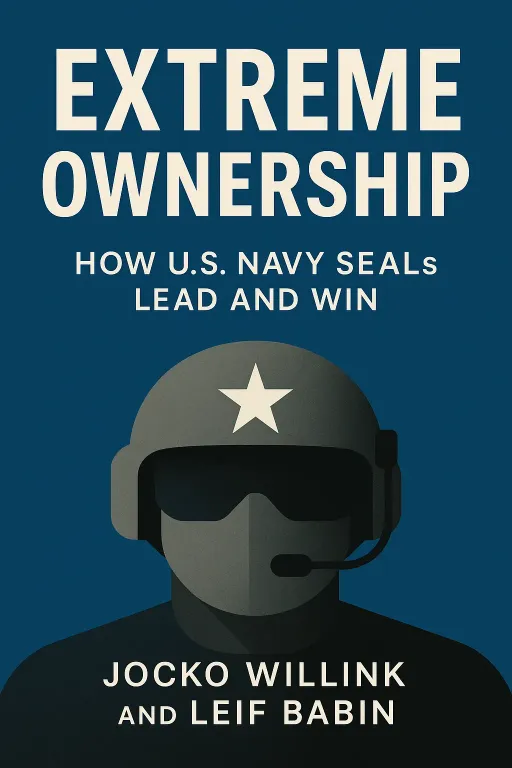
Nova: Absolutely not micromanaging, Atlas. It's actually about a much deeper, more profound form of leadership. Today, we're diving into two incredibly insightful books that, when combined, offer a powerful framework for leaders navigating the treacherous waters of dynamic threat landscapes. First up, we have "Extreme Ownership" by Jocko Willink and Leif Babin. Now, these aren't your typical business gurus; they’re former U. S. Navy SEALs, and their combat experience has forged an uncompromising view of what it means to lead when lives are on the line.
Atlas: That's a serious pedigree. So, what can SEALs teach us about firewalls and threat intelligence?
Nova: More than you’d think! And then, we'll pull in "Adapt" by Tim Harford, which shifts our perspective from military precision to the organic, iterative processes that allow successful systems—from biology to economics—to thrive through constant evolution. Together, these books lay the groundwork for a leadership approach that is both fiercely responsible and incredibly agile. They're essential for anyone who's driven by a desire to protect and build enduring solutions.
Atlas: That makes me wonder, how do these two seemingly different philosophies—unyielding responsibility from SEALs and a more fluid adaptation—actually work together in the unpredictable world of cybersecurity? Because a single misstep there can have massive real-world impact.
Nova: That’s the magic, Atlas. Let’s start with that unyielding standard.
The Unyielding Standard: Extreme Ownership in Cybersecurity
SECTION
Nova: "Extreme Ownership" posits that a leader is entirely responsible for everything in their world. Not just their own actions, but the actions of their team, the effectiveness of their strategy, and even the outcomes of their failures. Willink and Babin don't just talk about it; they lived it in the brutal realities of combat in Iraq. They recount an incident where two SEAL teams, operating under the same command, mistakenly engaged friendly forces in a chaotic urban environment.
Atlas: That’s a nightmare scenario. I can only imagine the immediate internal response there—who made the mistake? Who pulled the trigger?
Nova: Exactly. And the natural instinct is to dissect the chain of command, point to the junior officer who misidentified targets, or the intelligence team that provided incomplete data. But Jocko Willink, as the overall task unit commander, didn’t do that. He stepped up and took full, unequivocal responsibility for the entire incident. He stated that was ultimately responsible for the planning, the training, the communication, and the understanding of the mission among his men.
Atlas: So, he took the fall. That’s admirable, but how does that actually? Doesn’t it just mean the leader gets blamed for everything, even when others mess up? For our listeners building robust defenses, does that mean if ransomware bypasses their systems, the CISO should just say, "My bad," and that's it?
Nova: That’s a common misconception, Atlas, and it’s a crucial distinction. It’s not about taking the fall in a performative way or simply accepting blame. It's about owning. When Willink took extreme ownership, it wasn't to absolve his team. It was to clarify that the buck stops with him, which then allows him to systematically identify systemic failures, adjust training, improve communication protocols, and ensure such a mistake never happens again. It eliminates excuses. It shifts the focus from 'who messed up' to 'how do fix this, and how do ensure my team is equipped to prevent it?'
Atlas: I see. So, instead of saying, "The analyst clicked a phishing link," it's about the security leader saying, "My team wasn't adequately trained, or our email filters weren't strong enough, or our incident response plan didn't account for this specific type of social engineering." That’s a powerful reframing. It means the leader is responsible for.
Nova: Precisely. In a cybersecurity context, this means that when a breach occurs, the leader doesn't just look for a scapegoat. They ask: "Did I provide the best tools? Was our threat intelligence current? Did we run enough drills? Was our team empowered with clear objectives and the authority to act swiftly?" It transforms strategic planning from reactive problem-solving into proactive system design, fostering a culture of accountability and continuous improvement throughout the entire team. It empowers everyone because they know their leader is ultimately behind them, owning the big picture.
Atlas: That’s actually really inspiring. It means the leader isn't just a manager; they're the ultimate architect of the team's environment and capabilities. It aligns perfectly with the idea of building robust defenses by taking full responsibility for every layer.
The Agile Imperative: Adapting to Evolving Cyber Threats
SECTION
Nova: And that naturally leads us to the second key idea we need to talk about, which often acts as a critical counterpoint and complement to extreme ownership: the imperative for constant adaptation. Because once you own the problem and the solution, the cyber threat landscape is a moving target. This is where Tim Harford's "Adapt" comes in. Harford explores how successful systems, from biological evolution to economic markets, thrive not through perfect upfront planning, but through constant trial-and-error, iterative learning, and a willingness to embrace failure as a feedback mechanism.
Atlas: Okay, but wait. "Trial and error" and "embracing failure" sound a bit... risky, when we're talking about cybersecurity. We're trying to prevent catastrophic failures, not invite them! How do you reconcile the need for robust, unyielding defenses with the agile, sometimes messy, process of adaptation? I imagine many of our listeners, the guardians of digital assets, are thinking that sounds like an open invitation for an attacker.
Nova: That’s a brilliant question, Atlas, and it highlights the tension. Harford isn't advocating for reckless experimentation. What he's really talking about is the. Think about how nature operates: it doesn't design a perfect organism from scratch. It constantly iterates. Small changes, some fail, some succeed, and over time, incredibly resilient and effective systems emerge. In the economic world, companies don't launch a single, perfect product; they release MVPs, gather feedback, pivot, and refine.
Atlas: So, it’s not about making a mistake and just shrugging. It’s about making calculated, small-scale 'mistakes' or 'experiments' to learn and then rapidly incorporating those lessons. Like a security team deploying a new detection tool.
Nova: Exactly! Let’s say a cybersecurity team is implementing a new AI-driven threat detection system. Instead of a 'big bang' rollout across the entire enterprise, which could have massive, unforeseen consequences if flawed, an adaptive approach would be to deploy it in a smaller, controlled environment. They'd monitor its performance, analyze initial alerts—even false positives—and learn from every single interaction. They'd iteratively refine the system, tweak its algorithms, and adjust its parameters based on real-world feedback scaling it.
Atlas: I can see how that reduces the blast radius of any potential errors. It’s like owning the adaptive itself. You take extreme ownership of the framework for learning and iterating, rather than just the final, static defense. That’s a much more dynamic way to build enduring solutions. It’s not just about having a plan; it's about having a plan for the plan.
Nova: Precisely. This mindset allows cybersecurity leaders to design policies and systems that evolve with the adversary, rather than being perpetually a step behind. It acknowledges that the threat landscape is not static, and therefore, our defenses cannot be either. It’s about building in resilience, redundancy, and a feedback loop that constantly strengthens your position. It's how you move beyond just reacting to threats and actually start to outmaneuver them.
Atlas: That’s really profound. It means extreme ownership isn't about being rigid; it's about owning the fluidity required to adapt.
Synthesis & Takeaways
SECTION
Nova: Absolutely. When you fuse these two ideas—the absolute accountability of extreme ownership with the iterative learning of adaptation—you unlock a powerful leadership paradigm. Extreme ownership gives you the clarity, the conviction, and the mandate to act. Adaptation gives you the method to ensure those actions are effective, refined, and resilient in the face of constant change. Together, they create leaders who aren't just reacting to the dynamic threat landscape; they're actively shaping their response to it. It’s about leading with a mindset of complete control over your, even when you can't control the initial threat.
Atlas: That gives me chills. This isn’t just about better security; it's about a fundamental shift in how leaders approach their role, moving from managing problems to architecting secure futures. For our listeners who are aspiring to strategic influence and ethical leadership, what’s one concrete action they could take this week to embody these principles?
Nova: I'd say, identify a recent cybersecurity challenge your team faced—a false alarm, a near miss, or even a minor incident. Instead of just reviewing the technical aspects, take 'extreme ownership' of. Ask yourself: What could have done differently to better prepare my team? What systemic changes could implement to prevent or mitigate this more effectively next time? It’s a powerful shift from 'what went wrong?' to 'what will do to make it right?'
Atlas: That’s a fantastic call to action, Nova. It puts the power squarely in the leader’s hands, not just to fix the immediate problem, but to evolve the entire defense. It’s about becoming the guardian our digital world needs.
Nova: Exactly. It's about building a legacy of security through relentless responsibility and intelligent evolution.
Atlas: What a powerful way to look at leadership in cybersecurity.
Nova: This is Aibrary. Congratulations on your growth!