Beyond Blueprints: Cultivating Trust in Project Leadership.
Golden Hook & Introduction
SECTION
Nova: What if I told you that the reason your meticulously planned project tanked wasn't because of bad tech, or budget cuts, or even impossible deadlines? What if it was because your team just... didn't trust each other?
Atlas: Whoa, that's a bold claim, Nova. Most strategists I know would point to the Gantt chart first, or maybe the budget spreadsheet. Are we talking about 'Beyond Blueprints: Cultivating Trust in Project Leadership' today, and those books we discussed?
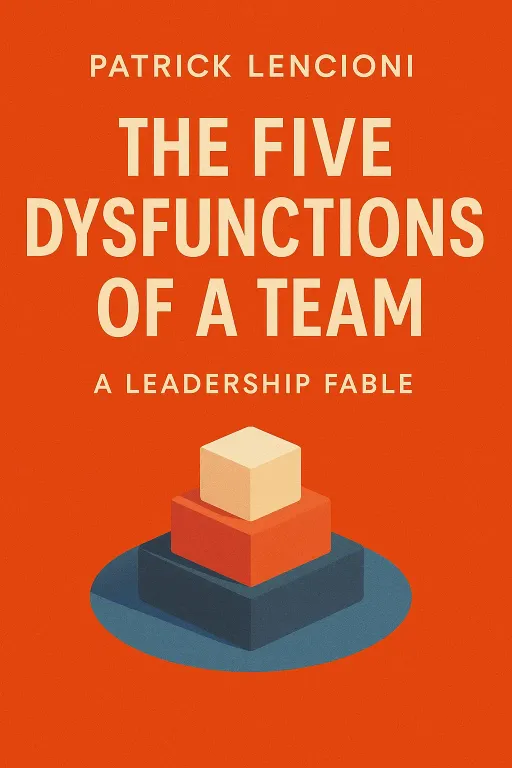
Nova: Exactly, Atlas! We're diving into that often-overlooked human element. Specifically, we'll be dissecting Patrick Lencioni's seminal work, "The Five Dysfunctions of a Team," a book that has profoundly reshaped how countless organizations view team health and performance. Lencioni's genius lies in presenting a clear, hierarchical model that makes the invisible dynamics of team trust visible and actionable.
Atlas: Oh, I like that. Making the invisible visible.
Nova: And then, we'll shift gears to the battlefield-tested principles of "Extreme Ownership" by former Navy SEALs Jocko Willink and Leif Babin. Their insights come from environments where trust and accountability literally mean life or death, offering a raw, unfiltered perspective on leadership. These aren't just management theories; they're the difference between project success and total collapse.
Atlas: So we're going from diagnosing the problem to getting a heavy dose of the solution, directly from the front lines of high-stakes environments. Let’s start with that initial diagnosis, then. The 'silent saboteur,' as you called it. What's at the root of project failure when the blueprints are flawless?
Nova: It’s the absence of trust, Atlas. Lencioni argues it’s the foundational dysfunction. Picture this: a highly skilled software development team, let's call them "The Quantum Coders." They have brilliant individual talent, a clear project roadmap, and state-of-the-art tools. But when a critical bug emerges, no one immediately raises their hand and says, "My code might be the culprit, let me get a second pair of eyes on this." Instead, there's a quiet scramble, a subtle deflection, a fear of appearing incompetent.
Atlas: Oh, I know that feeling. It's like everyone’s walking on eggshells, trying to protect their own turf. I imagine a lot of our listeners in competitive fields might think this is just how it is – a necessary evil in high-pressure environments.
Nova: That’s a great point, and it’s a common trap. But Lencioni says that kind of behavior isn't realism; it’s a symptom. Vulnerability-based trust, he explains, is about being able to admit mistakes, ask for help, or offer constructive criticism without fear of reprisal or judgment. Without that, you get a culture where everyone is protecting their own image, rather than the project's success. The unspoken resentments fester, conflicts go unresolved, and critical information gets withheld.
Atlas: So in that "Quantum Coders" example, it wasn't one big catastrophic technical failure, but a thousand tiny cuts from people not speaking up, not collaborating openly? Like death by a thousand paper cuts to the project timeline and budget?
Nova: Precisely. And it’s not just about efficiency; it’s about attracting and retaining skilled labor. Who wants to work in an environment where you can't be your authentic self, where every mistake is a potential career killer? Lencioni shows how this absence of trust ultimately leads to a fear of conflict, then a lack of commitment, avoidance of accountability, and finally, inattention to results. It's a domino effect, all starting with that lack of psychological safety.
Atlas: That’s actually really inspiring, because it means the problem isn't always some insurmountable technical hurdle. It's human. And if it's human, we can change it.
From Blame to Breakthrough: The Transformative Power of Extreme Ownership
SECTION
Nova: You've hit on the core insight, Atlas. If Lencioni gives us the diagnostic, then Willink and Babin offer the radical cure. Because once you understand teams falter, the next logical step is to ask: how do we it? How do we build that culture of trust and accountability? And their answer, forged in the crucible of combat, is "Extreme Ownership."
Atlas: Extreme ownership. Okay, as someone who values tangible results and efficiency, that sounds powerful. But it also sounds… exhausting. Like, if a project fails because a vendor didn't deliver, is the project lead supposed to say, "My fault!"? That seems a bit much, maybe even disingenuous.
Nova: That’s a brilliant question, Atlas, and it hits on a common misconception. It's not about taking for things you didn't do. It's about taking for the outcome. It’s about asking, "What could have done differently to prevent this vendor issue? Did I vet them properly? Did I communicate the expectations clearly enough? Did I have a backup plan?"
Atlas: So it’s not about being a martyr, it's about being an ultimate problem-solver. It’s about being proactive even when things are outside your direct control.
Nova: Exactly. Let me give you a simplified example from their world. Imagine a Navy SEAL mission where a support team fails to provide crucial intelligence, leading to a dangerous situation. The SEAL commander doesn't just blame the support team. Instead, he owns it. He asks, "Did I communicate my needs clearly enough? Did I establish the right protocols? Did I train my team to adapt when external support falters?" By owning the problem, he doesn't just fix that specific issue; he sets a standard for accountability that permeates his entire unit.
Atlas: That makes perfect sense. It’s about leading by example. When leaders own the problem, it creates psychological safety for their team members to also own their part, knowing they won't be scapegoated. It’s a direct antidote to Lencioni's 'absence of trust'. It's about managing team coordination by setting an example that says, 'We solve problems, we don't just point fingers.'
Nova: Precisely. Willink and Babin argue that true leaders take absolute responsibility for everything in their domain, from the grand strategy down to the smallest detail. This mindset eradicates the blame game, fosters initiative, and cultivates a high-performing culture where everyone is empowered to find solutions. It’s about transforming a culture of excuses into one of excellence.
Atlas: That’s a powerful shift. It moves from a reactive, defensive posture to a proactive, problem-solving one. It aligns with the idea of building better – not just fixing what’s broken, but creating a system that’s inherently more resilient.
Synthesis & Takeaways
SECTION
Nova: And that's the core takeaway here, isn't it? Whether it's Lencioni's diagnostic framework or Willink and Babin's radical solution, the message is clear: creating a culture of trust and clear accountability is as vital as any technical skill for project success and team longevity. You can have the most brilliant blueprints in the world, but if the human foundation is crumbling, the structure will inevitably falter.
Atlas: It's a tough pill to swallow, this idea of looking inward and taking responsibility for every outcome, but it's also incredibly empowering. It shifts the focus from external circumstances to internal agency. It's about building better, not just building.
Nova: Exactly. And for all our listeners who are innovators, strategists, and stewards striving for sustainable impact and advanced leadership, here's your 'tiny step' for this week: In your very next team meeting, consciously create a safe space. Specifically ask for honest feedback on a recent project, not to point fingers, but to genuinely understand diverse perspectives. You'll be amazed at what surfaces when trust starts to build. Embrace that human element.
Atlas: That’s a challenge I think many leaders should take on. It’s a practical step towards that future impact we all want to see.
Nova: Absolutely. This is Aibrary. Congratulations on your growth!