

The Strategic Bet Framework
Golden Hook & Introduction
SECTION
Nova: We all celebrate our wins and dissect our losses, right? It feels intuitive. But what if I told you most of us are fundamentally misinterpreting why things go well, or why they go sideways?
Atlas: Misinterpreting? Whoa, Nova, that's a bold claim. I thought 'success is the best teacher' was practically a mantra for anyone trying to build something new. Or 'failure is just feedback.' Are you saying those are... oversimplified?
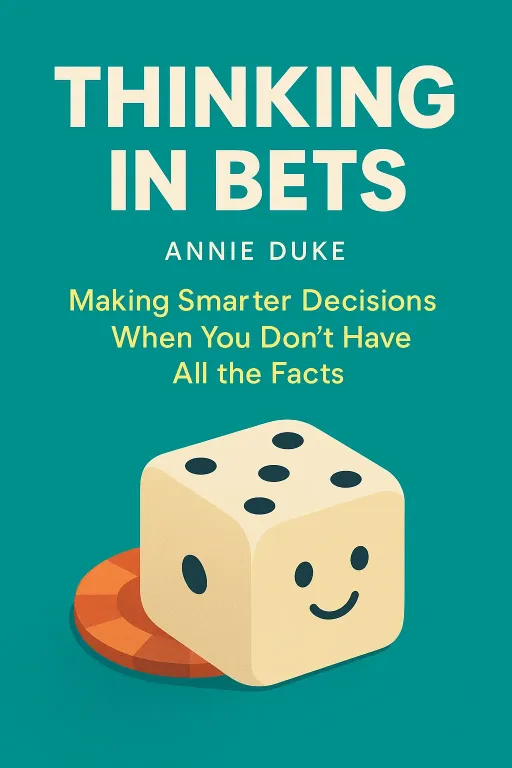
Nova: Not lies, Atlas, but often highly misleading. And it's a trap that can derail even the sharpest minds. Today, we're diving into how to truly understand your decisions, not just their outcomes, drawing on the brilliant insights of Annie Duke.
Atlas: Annie Duke. The former professional poker player, turned decision strategist? That's fascinating. Her background must give her a unique lens on high-stakes choices.
Nova: Absolutely. Her book, "Thinking in Bets," is a masterclass in separating the quality of your decision-making process from the quality of the actual result. She spent years in environments where the best decision often led to a terrible outcome, and vice-versa, all due to factors outside her control. It's a crucial distinction for anyone, especially for our listeners who are navigating complex, high-impact decisions daily.
Atlas: That resonates. For innovators and strategists, you're constantly making choices with imperfect information, and the market can be a fickle beast. I can see how getting tangled up in 'resulting' would be a huge problem.
The Trap of Resulting & Decision Quality
SECTION
Nova: Exactly. Duke calls this cognitive bias 'resulting.' It's our brain's tendency to judge the quality of a decision based solely on its outcome. If it worked out, it must have been a good decision. If it failed, it must have been a bad one.
Atlas: But wait, isn't a good outcome of a good decision? If I make a choice, and my venture scales, my strategy have been sound. Right?
Nova: Not necessarily. Imagine a startup founder who launches a product with minimal market research, a shaky business plan, and a huge dose of optimism. By all objective measures, the decision to launch was incredibly risky, perhaps even reckless, based on the information available at the time.
Atlas: Okay, I’m with you. A poor decision process.
Nova: But then, by some stroke of luck – maybe a competitor went bankrupt, or a new tech trend emerged that perfectly fit their underdeveloped product – they hit it big. Massive success. What's the natural human inclination?
Atlas: To say, "Wow, that founder is a genius! Their gut instinct was spot on!" And to try and replicate that "gut instinct" next time.
Nova: Precisely. We attribute the success to a brilliant decision, when in fact, the decision itself was flawed. The outcome was lucky. And the dangerous part is, that founder learns the wrong lesson. They might double down on reckless decisions, believing their intuition is infallible, leading to inevitable future crashes.
Atlas: Oh, I see. So the reverse is also true: a meticulously researched, well-thought-out decision, executed perfectly, could still fail due to unforeseen market shifts, a global pandemic, or a sudden change in regulations.
Nova: Exactly. A good decision can lead to a bad outcome, and a bad decision can lead to a good outcome. The poker table is full of examples: you can play a hand perfectly, with all the odds in your favor, and still lose to a lucky draw. Does that mean your play was bad? No, it means the cards fell poorly.
Atlas: That’s actually really inspiring, in a way. It means you can do everything right and still fail, but you shouldn't beat yourself up for the process. And it means you can succeed for all the wrong reasons. So how do you separate the two in real-time? For our listeners trying to master tech trends or scale ventures, the stakes are high. They can't afford to mislearn.
Nova: Duke emphasizes a few things. First,: before you even know the outcome, can you articulate you're making this decision? What information are you using? What are the probabilities? What are the potential pitfalls? Second,: imagine the decision failing, and then imagine it succeeding. What would be the reasons in each case? This helps you identify the 'luck' versus 'skill' factors.
Atlas: So it’s about documenting your rationale. Like, "Given X, Y, and Z information, I'm choosing option A because of these probabilities and potential upsides, acknowledging these risks."
Nova: Yes, and crucially, doing this the outcome reveals itself. It’s like a pre-mortem. This way, when the outcome arrives, whether good or bad, you have a baseline to evaluate your process against, rather than retroactively fitting the narrative to the result.
Atlas: That makes sense. So for someone trying to scale a venture, this means not blindly copying a competitor's success if their underlying process was flawed, even if it worked out for them. It’s about building a superior process for strategic bets.
The Bridge Model & Structured Problem Solving
SECTION
Nova: Precisely, Atlas. And once we understand the importance of having a superior process, the next logical question is: how do we build one? How do we move from identifying a challenge to executing a robust, logical solution? This is where John Adair's 'Bridge Model' for decision-making and problem-solving becomes incredibly powerful.
Atlas: John Adair. His work on leadership is foundational, isn't it? What does his 'Bridge Model' offer that’s unique for decision-making?
Nova: Adair, a pioneer in leadership development, created this model to provide a clear, systematic pathway. Think of it as literally building a bridge over a chasm. The chasm is your problem. You can't just jump across; you need a structured way to get to the other side, which is your solution.
Atlas: I like that analogy. So, what are the pillars of this bridge?
Nova: The model starts with. Sounds simple, but often people jump to solutions before truly understanding the problem. You need to define the 'gap' clearly. What exactly is the challenge? What are its symptoms versus its root causes?
Atlas: That sounds like a critical first step. I imagine a lot of time-strapped strategists just grab the nearest solution without fully diagnosing the issue.
Nova: Exactly. Next, Adair emphasizes. You need to collect all relevant data, facts, and perspectives. This is your raw material for building the bridge. Then,. Don't just settle for the first idea. Brainstorm widely, explore multiple paths, even seemingly unconventional ones.
Atlas: Okay, so define, gather, generate. What comes next? The actual decision?
Nova: Yes, then. This involves evaluating your options against criteria you've established, considering risks and benefits, and selecting the best path forward. It's where you commit to a specific design for your bridge. After that comes – putting your decision into action, building the bridge. And finally,. How well did the bridge hold up? Did it solve the problem? What did you learn? This feedback loop is crucial for continuous improvement, tying right back into Annie Duke's work.
Atlas: This sounds a lot like project management, or even just common sense. What makes Adair's 'Bridge' unique for specifically?
Nova: The 'Bridge Model' isn't just about managing tasks; it's about structuring your to ensure logical progression. It forces clarity at each stage, preventing impulsive leaps. For example, in the 'identify problem' phase, it pushes you to ask, "Is this the problem, or just a symptom?" In 'generating options,' it encourages divergent thinking before converging on a solution. It's a mental scaffold.
Atlas: I’m curious, though. For our listeners focused on productivity hacks and optimizing limited time, this structured approach might feel like it takes time. What if you're time-constrained? Can you 'bridge' quickly?
Nova: That's a great point. Adair's model isn't about being slow; it's about being. The speed comes with practice. For small, everyday decisions, you might run through these steps almost instantaneously. For high-stakes strategic bets, you allocate more time. The key is to internalize the so you're always thinking systematically, even under pressure. It's a mindset shift.
Atlas: So, it's about avoiding common pitfalls like jumping straight to a solution, or only considering one option, or not truly understanding the problem you're trying to solve. It's about building a robust mental framework.
Synthesis & Takeaways
SECTION
Nova: Absolutely, Atlas. When you combine Annie Duke's insight on 'resulting' with John Adair's 'Bridge Model,' you get a powerful one-two punch for strategic mastery. Duke teaches us our decision-making process correctly, ensuring we learn the right lessons from both success and failure. Adair, in turn, gives us a that robust, logical process in the first place, guiding us from problem identification to effective execution.
Atlas: It's about continuous improvement in strategic thinking. Not just getting lucky, but consistently making high-quality decisions, even when the future is uncertain. That's profound.
Nova: Indeed. True strategic mastery isn't about always being right; it's about consistently making high-quality decisions, understanding the role of luck, and continuously refining your process. This approach builds resilience, fosters genuine learning, and ultimately, drives long-term, sustainable growth. It's how you ensure your successes aren't just flukes and your failures become powerful teachers.
Atlas: That clarity is invaluable. It shifts the focus from simply chasing outcomes to mastering the craft of decision-making itself. For anyone striving for impact, that's the real game-changer.
Nova: So, here's a question for all our listeners: Reflect on your most successful project. Was that success due to a superior process, or was it simply a lucky break in the market? Think about it.
Atlas: And for those of you who just had an 'aha!' moment, Nova and I challenge you to take one small step this week. Schedule just 20 minutes to apply Adair's Bridge Model to a decision you're currently facing, even a small one. Or, simply observe your own tendency to 'result' when you evaluate a recent outcome. Start small.
Nova: Small steps build momentum, and your time is valuable, use it wisely.
Atlas: This is Aibrary. Congratulations on your growth!









